

View All VMA Actual Free Exam Questions Mar 26, 2026 Updated
Pass Authentic SAVE International VMA with Free Practice Tests and Exam Dumps
NEW QUESTION # 23
Which phase of the VM Job Plan is considered the heart of the Value Methodology?
- A. Function Analysis
- B. Creativity
- C. Implementation
- D. Presentation
Answer: A
Explanation:
The Value Methodology (VM) Job Plan consists of six phases, as taught in the VMF 1 course (Core Competency #3: Value Methodology Job Plan). According to SAVE International's Value Methodology Standard, "the Function Analysis Phase is considered the heart of the Value Methodology because it establishes the foundation for value improvement by identifying, classifying, and analyzing the functions of the system, which drives all subsequent phases." Function Analysis (the second phase) defines what the system does (e.g., using verb-noun combinations, FAST diagrams) and sets the stage for generating ideas (Creativity), evaluating them (Evaluation), and developing solutions (Development). Without understanding functions, the VM process cannot effectively improve value (function/cost), making this phase central to the methodology's success. This was alluded to in questions like 37 (FAST diagram logic) and 44 (defining functions).
* Option A (Implementation) is incorrect because Implementation is a post-study activity, not a formal phase of the VM Job Plan, and not the heart of VM.
* Option B (Function Analysis) is correct, as it is the foundational phase that drives the entire VM process, per SAVE International's standards.
* Option C (Creativity) is incorrect because, while important, Creativity relies on the functions identified in Function Analysis to generate ideas.
* Option D (Presentation) is incorrect because Presentation is the final phase, focused on communicating results, not the core of the methodology.
:
SAVE International, "Value Methodology Standard and Body of Knowledge," available athttps://www.value- eng.org, identifying Function Analysis as the heart of VM.
SAVE International, VMF 1 Core Competency #3 (Value Methodology Job Plan), emphasizing the centrality of Function Analysis in the VM process.
NEW QUESTION # 24
Which phase enables the VM team to select viable ideas?
- A. Function Analysis
- B. Development
- C. Evaluation
- D. Presentation
Answer: C
Explanation:
The Value Methodology (VM) Job Plan, as outlined in the VMF 1 course and SAVE International's Value Methodology Standard, consists of six phases, one of which is the Evaluation Phase, where the VM team selects viable ideas. In the Evaluation Phase, the team assesses ideas generated during the Creative Phase to determine their feasibility, cost impact, and alignment with project goals. According to the VMF 1 Core Competency #3 (Value Methodology Job Plan), the Evaluation Phase involves "evaluating the ideas for their potential to improve value, using criteria such as cost savings, performance, quality, and feasibility, to select the most viable alternatives for further development." Tools like weighted evaluation matrices may be used to rank ideas systematically.
* Option A (Function Analysis) is incorrect because this phase focuses on identifying and analyzing functions, not selecting ideas.
* Option B (Presentation) is incorrect because this phase involves communicating recommendations to stakeholders, after ideas have already been selected and developed.
* Option C (Evaluation) is correct, as it is the phase where the VM team filters and selects viable ideas based on defined criteria.
* Option D (Development) is incorrect because this phase involves refining selected ideas into actionable proposals, which happens after the Evaluation Phase.
:
SAVE International, "Value Methodology Standard and Body of Knowledge," available athttps://www.value- eng.org, detailing the Evaluation Phase in the VM Job Plan.
SAVE International, "Value Methodology Associate (VMA) Certification,"https://www.value-eng.org/page
/VMA, referencing VMF 1 Core Competency #3 (Value Methodology Job Plan).
NEW QUESTION # 25
All-the-time functions are:
- A. Undesirable
- B. Outside the study scope
- C. Continuous
- D. A drain on resources
Answer: C
Explanation:
In Value Methodology's Function Analysis, functions are classified based on their characteristics, as taught in the VMF 1 course (Core Competency #2: Function Analysis). According to SAVE International's Value Methodology Standard, "all-the-time functions are those that occur continuously or are always active during the operation of the system." In a FAST diagram, all-the-time functions are often shown vertically (e.g.,
"when" direction) alongside the critical path, indicating they are ongoing while the main functions are performed. For example, in a car, "provide safety" (e.g., through seatbelts) is an all-the-time function because it is always active when the car is in use. This aligns with the FAST diagramming convention of showing simultaneous functions.
* Option A (Outside the study scope) is incorrect because all-the-time functions are within the scope if they are part of the system's operation, though they may be supporting functions.
* Option B (A drain on resources) is incorrect because all-the-time functions are not necessarily resource- intensive; they are simply continuous.
* Option C (Continuous) is correct, as it matches the definition of all-the-time functions in VM.
* Option D (Undesirable) is incorrect because all-the-time functions are not inherently undesirable; they may be essential (e.g., "provide safety").
:
SAVE International, VMF 1 Core Competency #2 (Function Analysis), defining all-the-time functions as continuous in FAST diagramming.
SAVE International, "Value Methodology Standard," section on Function Analysis, describing all-the-time functions as those that occur continuously during system operation.
NEW QUESTION # 26
An effective Information Phase kickoff meeting:
- A. Indicates the VM solutions desired by decision makers.
- B. Outlines goals for the study subject and VM study objectives.
- C. Describes how functions have normally been accomplished.
- D. Discusses the challenges of the proposed VM study approach.
Answer: B
Explanation:
The Information Phase is the first phase of the Value Methodology (VM) Job Plan, where the team gathers and understands data about the study subject, as taught in the VMF 1 course (Core Competency #3: Value Methodology Job Plan). According to SAVE International's Value Methodology Standard, "an effective Information Phase kickoff meeting sets the stage for the VM study by outlining the goals for the study subject and the VM study objectives, ensuring alignment among team members and stakeholders." This involves clarifying the purpose of the study, the project's goals (e.g., reduce costs, improve performance), and the specific objectives of the VM study (e.g., achieve 20% cost savings while maintaining function). This aligns with the primary objective of the Information Phase-to understand the subject-and ensures the team starts with a clear direction.
* Option A (Discusses the challenges of the proposed VM study approach) is incorrect because, while challenges may be acknowledged, the primary focus of the kickoff is to set goals and objectives, not discuss challenges.
* Option B (Outlines goals for the study subject and VM study objectives) is correct, as it matches the purpose of an effective Information Phase kickoff meeting.
* Option C (Indicates the VM solutions desired by decision makers) is incorrect because solutions are developed later (e.g., in the Creativity and Development Phases), not during the Information Phase kickoff.
* Option D (Describes how functions have normally been accomplished) is incorrect because this level of functional detail is addressed in the Function Analysis Phase, not the Information Phase kickoff.
:
SAVE International, "Value Methodology Standard and Body of Knowledge," available athttps://www.value- eng.org, detailing the role of the Information Phase kickoff in setting goals and objectives.
SAVE International, VMF 1 Core Competency #3 (Value Methodology Job Plan), emphasizing the importance of outlining goals during the Information Phase (consistent with Question 39).
NEW QUESTION # 27
What is a function of a teacup?
- A. Allow drinking
- B. Contain tea
- C. Contain liquid
- D. Provide container
Answer: C
Explanation:
Function Analysis in Value Methodology involves identifying and classifying functions using verb-noun combinations, as taught in the VMF 1 course (Core Competency #2). The basic function of an item is its primary purpose-what it must do to fulfill its intended use, defined in broad, measurable terms. According to SAVE International's Value Methodology Standard, "functions should be expressed at a level that captures the core purpose of the item, avoiding overly specific or secondary actions." For a teacup, the basic function is the most fundamental action it performs. A teacup's primary purpose is tocontain liquid, as this captures the essential role of holding a liquid (e.g., tea, water, or any beverage), which applies to all teacups regardless of the specific liquid or use.
* Option A (Provide container) is incorrect because "provide container" is not a standard verb-noun function format and is too vague; the teacup itself is the container, and the function is what it does (contain liquid).
* Option B (Allow drinking) is incorrect because allowing drinking is a secondary function or outcome; the teacup must first contain liquid before drinking can occur, and not all uses involve drinking (e.g., holding liquid for soaking).
* Option C (Contain tea) is incorrect because, while a teacup often contains tea, this is too specific; a teacup can hold other liquids (e.g., coffee, water), so the basic function is broader.
* Option D (Contain liquid) is correct, as it defines the basic function of a teacup in the most fundamental terms, encompassing all potential uses, similar to how a pen's function was defined as "mark surface" in Question 38.
:
SAVE International, VMF 1 Core Competency #2 (Function Analysis), which includes defining basic functions using verb-noun combinations.
SAVE International, "Value Methodology Standard," section on Function Analysis, emphasizing the identification of basic functions as the core purpose of an item (consistent with Question 38).
NEW QUESTION # 28
In which costing technique is the time value of money essential?
- A. Break-even point
- B. Return on Investment
- C. Simple Payback
- D. Life Cycle Cost
Answer: D
Explanation:
Cost analysis in Value Methodology often involves financial techniques to evaluate the economic feasibility of alternatives, as taught in the VMF 1 course (Core Competency #4: Cost Analysis). According to SAVE International's Value Methodology Standard, "the time value of money is essential in costing techniques that account for costs and benefits over time, such as Life Cycle Cost (LCC)."Life Cycle Costis defined as "the total cost of a system or product over its entire life, including acquisition, operation, maintenance, and disposal, discounted to present value using the time value of money." The time value of money ensures that future costs and benefits are adjusted to their present value using a discount rate (as noted in Questions 6 and
7), making LCC a comprehensive method for comparing alternatives in VM studies.
* Option A (Return on Investment) is incorrect because, while ROI can consider the time value of money in some calculations, it is not essential; ROI is often calculated as a simple percentage (Profit ÷ Investment).
* Option B (Life Cycle Cost) is correct, as LCC inherently requires the time value of money to discount future costs to present value, ensuring a fair comparison over the project's life.
* Option C (Simple Payback) is incorrect because simple payback (as calculated in Question 26) does not account for the time value of money; it simply divides the initial investment by annual savings.
* Option D (Break-even point) is incorrect because the break-even point (similar to payback) typically does not incorporate the time value of money; it focuses on the point where costs equal revenues.
:
SAVE International, VMF 1 Core Competency #4 (Cost Analysis), which includes Life Cycle Cost as a technique requiring the time value of money.
SAVE International, "Value Methodology Standard," section on cost analysis, defining Life Cycle Cost and its reliance on discounting (consistent with Question 7 on Present Worth).
NEW QUESTION # 29
If an organization invests $160,000 in a new software system that improves analysis and reduces annual costs by $3,000 per year, the payback period would be approximately:
- A. 50 years
- B. 56 years
- C. 45 years
- D. 53 years
Answer: D
Explanation:
In Value Methodology, cost analysis often involves financial metrics like the payback period to evaluate the economic feasibility of alternatives, as taught in the VMF 1 course (Core Competency #4: Cost Analysis).
According to SAVE International's Value Methodology Standard, the payback period is "the time required for the cumulative savings or benefits from an investment to equal the initial cost, calculated as Initial Investment ÷ Annual Savings." Here, the organization invests $160,000 in a software system that saves
$3,000 per year.
* Payback Period = Initial Investment ÷ Annual Savings
* Payback Period = $160,000 ÷ $3,000 = 53.333 years
* Rounding to the nearest whole number, the payback period is approximately 53 years.
The question does not specify adjustments for the time value of money (e.g., discounting), which aligns with the simple payback method commonly used in VM for straightforward analysis.
* Option A (45 years) is incorrect because 160,000 ÷ 3,000 = 53.333, not 45.
* Option B (50 years) is incorrect because it underestimates the payback period (53.333 years).
* Option C (53 years) is correct, as it matches the calculated payback period when rounded.
* Option D (56 years) is incorrect because it overestimates the payback period.
:
SAVE International, VMF 1 Core Competency #4 (Cost Analysis), which includes calculating payback periods for economic evaluation in VM studies.
SAVE International, "Value Methodology Standard," section on cost analysis, referencing the simple payback method for assessing alternatives.
NEW QUESTION # 30
In which phase does one work to obtain a thorough understanding of the subject of the VM study?
- A. Creativity Phase
- B. Evaluation Phase
- C. Presentation Phase
- D. Information Phase
Answer: D
Explanation:
The Value Methodology (VM) Job Plan, as outlined in the VMF 1 course and SAVE International's Value Methodology Standard, consists of six phases, starting with the Information Phase. According to VMF 1 Core Competency #3 (Value Methodology Job Plan), the Information Phase is where the VM team works to
"obtain a thorough understanding of the subject of the study by gathering and analyzing data on project scope, costs, constraints, objectives, and stakeholder needs." This phase involves collecting all relevant information-such as drawings, specifications, cost data, and performance requirements-to establish a baseline for the study, ensuring the team fully understands the project before proceeding to function analysis.
* Option A (Information Phase) is correct, as it is explicitly defined as the phase for gaining a thorough understanding of the VM study's subject.
* Option B (Creativity Phase) is incorrect because this phase focuses on generating ideas, not gathering information.
* Option C (Evaluation Phase) is incorrect because this phase involves assessing ideas, which occurs after the subject is already understood.
* Option D (Presentation Phase) is incorrect because this phase involves communicating recommendations, not studying the subject.
:
SAVE International, "Value Methodology Standard and Body of Knowledge," available athttps://www.value- eng.org, detailing the Information Phase in the VM Job Plan.
SAVE International, VMF 1 Core Competency #3 (Value Methodology Job Plan), emphasizing the role of the Information Phase in understanding the study subject.
NEW QUESTION # 31
Which of the following letters represents the scope lines?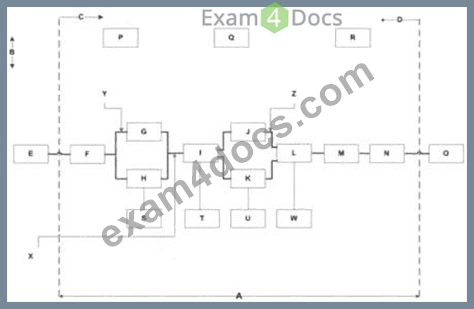
- A. A
- B. B
- C. D
- D. C
Answer: B
Explanation:
The diagram provided is a Function Analysis System Technique (FAST) diagram, a key tool in Value Methodology's Function Analysis phase, as taught in the VMF 1 course (Core Competency #2). FAST diagrams map the relationships between functions of a system, with the horizontal axis showing the "how- why" logic (critical path) and the vertical axis showing supporting functions. The vertical demarcations on the left and right of a FAST diagram are calledscope lines, which define the boundaries of the study. According to SAVE International's Value Methodology Standard, "scope lines indicate the limits of the system or project being analyzed, separating the functions within the study's scope from external functions or assumptions." This was previously established in Question 15, where scope lines were identified as the correct term for these vertical demarcations.
In the FAST diagram:
* The dashed vertical lines on the left and right are labeledB(left) andD(right). These lines define the scope of the study, with functions inside the lines (e.g., E, F, G, J, L, M, N, O) being within the study's focus, while functions outside (e.g., P, Q, R) are external assumptions or higher-level objectives.
* Ais a horizontal line at the bottom, representing the boundary of the diagram but not the scope lines.
* Cis an arrow indicating the direction of the "why" axis (left), not a scope line.
Since the question asks for the letter that "represents the scope lines," and both B and D are scope lines, the correct answer must be one of these. However, the options only allow for one letter to be selected, and in FAST diagramming convention, the left scope line (B) is often emphasized as the primary boundary for defining the study's starting point (e.g., the higher-order function E, as identified in Question 18). Thus,Bis the most appropriate choice among the options provided.
* Option A (A) is incorrect because A is a horizontal line, not a vertical scope line.
* Option B (B) is correct, as B is the left vertical scope line, marking the boundary of the study's scope.
* Option C (C) is incorrect because C is an arrow, not a scope line.
* Option D (D) is also a scope line (the right boundary), but since only one letter can be selected and B is the left scope line (often the primary focus in FAST diagramming), B is chosen. If the question intended to allow both B and D, the phrasing would need adjustment.
:
SAVE International, VMF 1 Core Competency #2 (Function Analysis), which includes the use of FAST diagrams and the definition of scope lines as vertical demarcations.
SAVE International, "Value Methodology Standard," section on Function Analysis, describing FAST diagramming conventions, including scope lines as the vertical boundaries of the study.
NEW QUESTION # 32
Which of the following best defines an activity?
- A. A task, action, or operation that describes why a function is performed
- B. A task, action, or operation that describes how a function is performed
- C. A specific task, action, or operation that is generic and changes viewpoints
- D. A specific task, action, or operation with a high level of abstraction
Answer: B
Explanation:
In Value Methodology's Function Analysis, the concepts of functions and activities are distinct but related, as taught in the VMF 1 course (Core Competency #2: Function Analysis). According to SAVE International's Value Methodology Standard, "a function is defined as what a product, process, or system does, expressed in a verb-noun format (e.g., 'contain liquid'), while an activity is a task, action, or operation that describes how a function is performed." For example, the function of a teacup might be "contain liquid," and the activity to achieve that function could be "holding the liquid in a ceramic structure." Activities are the actionable steps or processes that enable the function, often identified during the creation of a FAST diagram or Random Function Identification table (as noted in Question 19). The "how" aspect aligns with the How-Why logic of FAST diagrams, where activities detail the practical execution of a function.
* Option A (A task, action, or operation that describes why a function is performed) is incorrect because
"why" relates to the higher-order function or purpose (e.g., Question 20), not the activity, which focuses on "how."
* Option B (A specific task, action, or operation that is generic and changes viewpoints) is incorrect because activities are not about changing viewpoints; they are specific actions to perform a function.
* Option C (A task, action, or operation that describes how a function is performed) is correct, as it aligns with the definition of an activity in VM.
* Option D (A specific task, action, or operation with a high level of abstraction) is incorrect because activities are practical and specific, not abstract; functions are more abstract (e.g., verb-noun format).
:
SAVE International, VMF 1 Core Competency #2 (Function Analysis), distinguishing between functions (what) and activities (how).
SAVE International, "Value Methodology Standard," section on Function Analysis, defining activities as the tasks or operations that describe how functions are performed.
NEW QUESTION # 33
Which function is located to the left of the left vertical line in a FAST diagram?
- A. Basic Function
- B. Higher Order Function
- C. Secondary Function
- D. Lower Order Function
Answer: B
Explanation:
The Function Analysis System Technique (FAST) diagram is a key tool in Value Methodology's Function Analysis phase, as taught in the VMF 1 course (Core Competency #2). FAST diagrams map the relationships between functions, with the horizontal axis showing the "how-why" logic (critical path) and vertical lines called scope lines defining the study's boundaries. According to SAVE International's Value Methodology Standard, "the left vertical line in a FAST diagram is a scope line, and the function immediately to its right is typically the higher-order function, which represents the overarching goal or need for the system." The functionto the leftof the left scope line is outside the study's scope and often represents an even broader objective or external assumption that drives the higher-order function. However, in standard FAST diagramming, thehigher-order functionis the closest function to the left scope line within the scope, and functions to the left of the scope line (e.g., P in the diagram from Question 30) are external.
In the context of the VMA exam and VMF 1, the question likely tests the understanding of the higher-order function's position relative to the scope line. As established in Question 18, Function E (just inside the left scope line B) is the higher-order function. Functions to the left of the left scope line (e.g., P) are typically external assumptions or broader objectives, but the options provided (A, B, C, D) refer to standard function classifications within the FAST framework. Thehigher-order function(C) is the most relevant choice, as it is the function closest to the left scope line within the study's scope, and the question may be interpreted as asking for the function type associated with that position.
* Option A (Basic Function) is incorrect because the basic function is typically more central on the critical path, not at the far left.
* Option B (Secondary Function) is incorrect because secondary functions are vertical (supporting the critical path), not on the main path near the left scope line.
* Option C (Higher Order Function) is correct, as the higher-order function is located just to the right of the left scope line (e.g., Function E), and the question may be interpreted in this context based on standard FAST conventions.
* Option D (Lower Order Function) is incorrect because lower-order functions are to the right of the basic function, representing more specific outcomes, not near the left scope line.
:
SAVE International, VMF 1 Core Competency #2 (Function Analysis), defining the position of the higher- order function in FAST diagrams.
SAVE International, "Value Methodology Standard," section on Function Analysis, describing FAST diagramming conventions, including the role of scope lines and higher-order functions.
NEW QUESTION # 34
How many phases are in the VM Job Plan?
- A. 0
- B. 1
- C. 2
- D. 3
Answer: A
Explanation:
The Value Methodology (VM) Job Plan is a structured, systematic process central to Value Methodology, as defined in the Value Methodology Fundamentals 1 (VMF 1) course and SAVE International's Value Methodology Standard. According to these sources, the VM Job Plan consists ofsix phases: Information, Function Analysis, Creative, Evaluation, Development, and Presentation. These phases ensure a disciplined approach to analyzing functions, generating ideas, evaluating alternatives, and presenting value-enhancing recommendations.
* Information Phase: Collect and analyze data on project scope, costs, constraints, and objectives to establish a baseline for the study.
* Function Analysis Phase: Identify, classify, and analyze functions (e.g., basic, secondary) using tools like the Function Analysis System Technique (FAST) to understand their purpose and relationships.
* Creative Phase: Generate a broad range of ideas to improve value through brainstorming or other creative techniques, focusing on alternative ways to perform functions.
* Evaluation Phase: Assess the feasibility, cost impact, and benefits of ideas using criteria like performance, quality, and alignment with project goals.
* Development Phase: Refine the most promising ideas into detailed, actionable proposals, including implementation plans and cost estimates.
* Presentation Phase: Communicate recommendations to stakeholders through reports, presentations, or other deliverables to gain approval and facilitate implementation.
SAVE International's VMF 1 course, which is a prerequisite for the VMA exam, explicitly teaches these six phases as part of Core Competency #3 (Value Methodology Job Plan). The standard is consistent across SAVE International's documentation, including the Value Methodology Standard and certification guidelines.
Options A (3), C (7), and D (8) do not match the official six-phase structure of the VM Job Plan.
:
SAVE International, "Value Methodology Standard and Body of Knowledge," available athttps://www.value- eng.org, which outlines the six-phase VM Job Plan.
SAVE International, "Value Methodology Associate (VMA) Certification,"https://www.value-eng.org/page
/VMA, referencing the VMF 1 course content and Core Competency #3.
VMF 1 Course Objectives, as described in SAVE International's training materials, emphasizing the six- phase Job Plan structure.
NEW QUESTION # 35
The VM is defined by SAVE International as a:
- A. Structured process
- B. Specialized process
- C. Systematic process
- D. Sequential process
Answer: C
Explanation:
Value Methodology (VM) is defined by SAVE International in its Value Methodology Standard as "a systematic processthat uses a structured Job Plan to improve the value of projects, products, or processes by analyzing their functions and identifying opportunities to achieve required functions at the lowest total cost without compromising quality or performance." The term "systematic" emphasizes the methodical, disciplined approach of VM, which follows a defined sequence of phases (the VM Job Plan) and uses specific tools like Function Analysis and cost modeling to ensure consistency and effectiveness.
* Option A (Structured process) is partially correct, as VM is structured, but "systematic" is the precise term used by SAVE International to describe the methodology's comprehensive and methodical nature.
* Option B (Specialized process) is incorrect because VM is a general methodology applicable across industries, not limited to a specific domain.
* Option C (Systematic process) is correct, directly matching SAVE International's definition of VM.
* Option D (Sequential process) is incorrect because, while the VM Job Plan is sequential, the definition of VM focuses on its systematic nature, not just the sequence.
:
SAVE International, "Value Methodology Standard and Body of Knowledge," available athttps://www.value- eng.org, defining VM as a systematic process.
SAVE International, "Value Methodology Associate (VMA) Certification,"https://www.value-eng.org/page
/VMA, referencing VMF 1 Core Competency #1 (Value Methodology Overview).
NEW QUESTION # 36
Y is pointing to the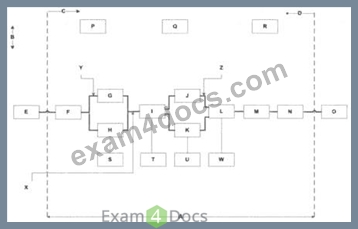
- A. "AND" Gate
- B. Minor Logic Path
- C. "OR" Gate
- D. Critical Logic Path
Answer: D
Explanation:
The diagram provided is a Function Analysis System Technique (FAST) diagram, a key tool in Value Methodology's Function Analysis phase, as taught in the VMF 1 course. FAST diagrams map the relationships between functions of a system, showing "how" and "why" relationships to identify the critical logic path (the primary sequence of functions that achieve the system's basic function) and minor logic paths (supporting functions). In FAST diagramming, functions are represented by boxes (e.g., G, H, J, K), and their relationships are shown with arrows.
* Yis a red arrow connecting function G to function J, running horizontally across the diagram. In FAST diagrams, the horizontal path from left to right represents thecritical logic path, which answers the question "how" each function is achieved to fulfill the system's primary purpose. Here, the path from E to F to G to J to L to M to N to O is the main sequence of functions, indicating the critical logic path.
* Z(another red arrow) points to a vertical connection between J and K, which represents a minor logic path-supporting functions that occur simultaneously or are secondary to the main path.
* Option A ("AND" Gate) and Option D ("OR" Gate) are incorrect because FAST diagrams use logic gates to show relationships between functions (e.g., AND for concurrent functions, OR for alternatives), but Y is an arrow on the main path, not a gate. Gates are typically symbols (e.g., triangles or diamonds) at junctions, not arrows.
* Option B (Minor Logic Path) is incorrect because minor logic paths are vertical connections in FAST diagrams (e.g., Z pointing to J-K), not the horizontal path that Y indicates.
* Option C (Critical Logic Path) is correct because Y lies on the main horizontal path, which represents the critical sequence of functions in a FAST diagram.
:
SAVE International, VMF 1 Core Competency #2 (Function Analysis), which includes the use of FAST diagrams to map critical and minor logic paths.
SAVE International, "Value Methodology Standard," section on Function Analysis, describing FAST diagramming conventions (horizontal for critical path, vertical for minor paths).
NEW QUESTION # 37
The VM Job Plan provides a structured sequence of phases designed to leverage which of the following types of thinking?
- A. Divergent and abstract
- B. Convergent and divergent
- C. Convergent and abstract
- D. Critical and divergent
Answer: B
Explanation:
The Value Methodology (VM) Job Plan, as outlined in the VMF 1 course (Core Competency #3: Value Methodology Job Plan), is a structured sequence of six phases designed to leverage bothdivergentand convergentthinking. According to SAVE International's Value Methodology Standard, "the VM Job Plan alternates between divergent thinking (to generate a wide range of ideas) and convergent thinking (to narrow down and refine those ideas)." Divergent thinking is used in the Creative Phase to brainstorm as many ideas as possible without judgment, while convergent thinking is applied in the Evaluation and Development Phases to analyze, select, and refine the best ideas into actionable proposals. This combination ensures a balance between creativity and practicality, maximizing value improvement.
* Option A (Divergent and abstract) is incorrect because, while divergent thinking is used, "abstract" is not a specific type of thinking emphasized in the VM Job Plan.
* Option B (Convergent and abstract) is incorrect because it omits divergent thinking, which is critical in the Creative Phase.
* Option C (Critical and divergent) is incorrect because, while critical thinking is involved in Evaluation, the VM Job Plan specifically emphasizes convergent thinking to narrow down ideas.
* Option D (Convergent and divergent) is correct, as it captures the dual thinking types leveraged across the VM Job Plan phases.
:
SAVE International, "Value Methodology Standard and Body of Knowledge," available athttps://www.value- eng.org, detailing the use of divergent and convergent thinking in the VM Job Plan.
SAVE International, VMF 1 Core Competency #3 (Value Methodology Job Plan), emphasizing the balance of divergent and convergent thinking.
NEW QUESTION # 38
What is the correct order for the three levels of filters used for evaluating ideas during the Evaluation Phase?
- A. Coarse, Fine, Medium
- B. Medium, Coarse, Fine
- C. Medium, Fine, Coarse
- D. Coarse, Medium, Fine
Answer: D
Explanation:
The Evaluation Phase of the Value Methodology (VM) Job Plan involves assessing ideas generated during the Creative Phase to select the most viable ones for further development, as taught in the VMF 1 course (Core Competency #7: Evaluation and Selection of Alternatives). According to SAVE International's Value Methodology Standard, the Evaluation Phase uses a three-level filtering process to systematically narrow down ideas: "Ideas are evaluated using a coarse, medium, and fine filter approach to progressively refine the list of alternatives."
* Coarse Filter: Initial screening to eliminate clearly unfeasible ideas (e.g., those that violate constraints or are impractical).
* Medium Filter: More detailed evaluation using criteria like cost, performance, and risk to shortlist ideas with potential.
* Fine Filter: In-depth analysis, often using tools like weighted evaluation matrices (as noted in Question
11), to select the best ideas for development.
This order-Coarse, Medium, Fine-ensures a logical progression from broad elimination to detailed selection, aligning with the VMF 1 curriculum's focus on systematic evaluation.
* Option A (Medium, Coarse, Fine) is incorrect because starting with a medium filter skips the initial broad screening.
* Option B (Coarse, Medium, Fine) is correct, as it matches the standard three-level filtering process in VM.
* Option C (Medium, Fine, Coarse) is incorrect because it reverses the logical progression of filtering.
* Option D (Coarse, Fine, Medium) is incorrect because the fine filter should be the last step, not followed by a medium filter.
:
SAVE International, "Value Methodology Standard and Body of Knowledge," available athttps://www.value- eng.org, detailing the coarse-medium-fine filtering process in the Evaluation Phase.
SAVE International, VMF 1 Core Competency #7 (Evaluation and Selection of Alternatives), emphasizing the three-level filtering approach for idea evaluation.
NEW QUESTION # 39
Which of the three levels of filters used for evaluating ideas during the Evaluation Phase applies an evaluation matrix technique?
- A. Fine
- B. Reasonable
- C. Medium
- D. Coarse
Answer: A
Explanation:
The Evaluation Phase of the Value Methodology (VM) Job Plan involves assessing ideas using a three-level filtering process, as taught in the VMF 1 course (Core Competency #7: Evaluation and Selection of Alternatives). According to SAVE International's Value Methodology Standard, the three levels of filters are Coarse, Medium, and Fine (as confirmed in Question 33). The standard further specifies that "the Fine filter applies detailed evaluation techniques, such as an evaluation matrix, to select the best ideas for development by scoring them against weighted criteria." An evaluation matrix (e.g., a weighted matrix, as noted in Question 11) is a tool where ideas are scored based on criteria like cost, performance, and risk, with weights reflecting their importance (as in Question 51). This detailed, quantitative approach is used in the Fine filter to make final selections after the Coarse (initial screening) and Medium (shortlisting) filters have narrowed down the ideas.
* Option A (Fine) is correct, as the Fine filter uses an evaluation matrix technique for detailed idea selection.
* Option B (Reasonable) is incorrect because "Reasonable" is not one of the three filter levels; the correct levels are Coarse, Medium, and Fine.
* Option C (Medium) is incorrect because the Medium filter involves a more general assessment (e.g., comparing ideas against criteria), not the detailed matrix technique.
* Option D (Coarse) is incorrect because the Coarse filter is for initial screening (eliminating unfeasible ideas), not detailed evaluation with a matrix.
:
SAVE International, "Value Methodology Standard and Body of Knowledge," available athttps://www.value- eng.org, detailing the Fine filter's use of an evaluation matrix in the Evaluation Phase.
SAVE International, VMF 1 Core Competency #7 (Evaluation and Selection of Alternatives), emphasizing the three-level filtering process and the Fine filter's techniques (consistent with Questions 11 and 33).
NEW QUESTION # 40
The Value Methodology is:
- A. A step-by-step design review to improve value.
- B. An eight-phase process to improve value.
- C. A suggestion program to improve value.
- D. A cost reduction exercise to improve value.
Answer: A
Explanation:
Value Methodology (VM), as defined by SAVE International in the Value Methodology Fundamentals 1 (VMF 1) course, is a systematic, step-by-step approach to improve the value of a project, product, or process by optimizing the function-to-cost ratio. According to SAVE International's Value Methodology Standard, VM is described as "a systematic and structured approach for improving projects, products, and processes...
to achieve the optimum balance between function, performance, quality, safety, and cost." The VM Job Plan, a core component of VM, involves a step-by-step process (six phases: Information, Function Analysis, Creative, Evaluation, Development, and Presentation) that can be likened to a design review because it evaluates and enhances the design or process to improve value.
* Option A (suggestion program) is incorrect because VM is not merely about collecting suggestions; it is a structured methodology with defined phases and tools like function analysis.
* Option B (cost reduction exercise) is incorrect because VM focuses on improving value, not just reducing costs-cost reduction may occur, but only if it does not compromise essential functions.
* Option C (step-by-step design review) aligns with VM's systematic nature, as the Job Plan reviews and improves designs or processes through structured phases, making it the best fit.
* Option D (eight-phase process) is incorrect because the VM Job Plan has six phases, not eight, as established in SAVE International's standards.
NEW QUESTION # 41
Which of the following defines the effects of time, value, and money, converting all costs to a common reference point in today's dollars?
- A. Simple Payback (or Breakeven Point)
- B. Return on Investment (ROI)
- C. Discount Rate
- D. Present Worth (or Net Present Value)
Answer: D
Explanation:
In Value Methodology, cost analysis often involves evaluating the economic impact of alternatives over time, which requires understanding the time value of money. The VMF 1 course, under Core Competency #4 (Cost Analysis), includes financial concepts like discounting cash flows to assess long-term value. The concept of converting all costs to a common reference point in today's dollars refers toPresent Worth (or Net Present Value, NPV). According to SAVE International's Value Methodology Standard, Present Worth (or NPV) is used to "evaluate the economic feasibility of alternatives by discounting future cash flows to their present value, accounting for the time value of money." This process converts all costs and benefits (adjusted for time, value, and money) to a single value in today's dollars using a discount rate, allowing for a fair comparison of alternatives.
* Option A (Return on Investment or ROI) is incorrect because ROI measures profitability as a percentage and does not convert costs to a present value.
* Option B (Present Worth or Net Present Value) is correct because NPV accounts for the effects of time, value, and money by discounting future cash flows to today's dollars.
* Option C (Discount Rate) is incorrect because the discount rate is the rate used in NPV calculations, not the method of converting costs itself.
* Option D (Simple Payback or Breakeven Point) is incorrect because payback measures the time to recover an investment and does not account for the time value of money or convert costs to present value.
:
SAVE International, "Value Methodology Standard and Body of Knowledge," available athttps://www.value- eng.org, section on cost analysis, referencing Present Worth (NPV) for economic evaluation.
SAVE International, VMF 1 Core Competency #4 (Cost Analysis), which includes discounting techniques for comparing alternatives.
NEW QUESTION # 42
The Development Phase involves which of the following steps?
- A. Prioritize ideas
- B. Model the cost of ideas
- C. Determine verb-noun combinations for ideas
- D. Assign ideas to VM study team members
Answer: B
Explanation:
The Development Phase of the Value Methodology (VM) Job Plan, as outlined in the VMF 1 course and SAVE International's Value Methodology Standard, involves refining the most promising ideas selected during the Evaluation Phase into actionable proposals. According to VMF 1 Core Competency #3 (Value Methodology Job Plan), the Development Phase includes "developing detailed proposals for the selected alternatives, including cost estimates, implementation plans, and risk assessments to ensure feasibility." A key step in this phase is modeling the cost of ideas to provide stakeholders with a clear understanding of the financial impact of the proposed changes, ensuring the ideas improve value (function/cost).
* Option A (Assign ideas to VM study team members) is incorrect because assigning ideas occurs during the Creative or Evaluation Phase, not Development.
* Option B (Prioritize ideas) is incorrect because prioritization happens in the Evaluation Phase, before Development.
* Option C (Model the cost of ideas) is correct, as the Development Phase focuses on creating detailed proposals, which includes costing out the ideas to validate their value improvement potential.
* Option D (Determine verb-noun combinations for ideas) is incorrect because verb-noun combinations are used in the Function Analysis Phase to define functions, not in Development.
:
SAVE International, "Value Methodology Standard and Body of Knowledge," available athttps://www.value- eng.org, detailing the Development Phase in the VM Job Plan.
SAVE International, "Value Methodology Associate (VMA) Certification,"https://www.value-eng.org/page
/VMA, referencing VMF 1 Core Competency #3 (Value Methodology Job Plan).
NEW QUESTION # 43
A Random Function Identification table contains:
- A. Components, resources, and criteria
- B. Inputs, objectives, and sequence
- C. Elements, functions, and classifications
- D. Costs, time, and risks
Answer: C
Explanation:
Random Function Identification is a technique used in Value Methodology's Function Analysis phase to identify and organize functions before creating a Function Analysis System Technique (FAST) diagram, as taught in the VMF 1 course (Core Competency #2). According to SAVE International's Value Methodology Standard, Random Function Identification involves "listing all functions of a system or project in a table, typically including the elements (components or parts), their associated functions (in verb-noun format), and their classifications (e.g., basic, secondary, higher-order)." This table helps the VM team systematically identify and categorize functions during the early stages of analysis, ensuring all functions are captured before structuring them in a FAST diagram.
* Option A (Inputs, objectives, and sequence) is incorrect because inputs and objectives are part of the Information Phase, and sequence is addressed in FAST diagramming, not in the Random Function Identification table.
* Option B (Costs, time, and risks) is incorrect because these are related to cost analysis or implementation planning, not function identification.
* Option C (Elements, functions, and classifications) is correct, as it aligns with the purpose of the Random Function Identification table in VM.
* Option D (Components, resources, and criteria) is incorrect because resources and criteria are not part of function identification; criteria are used in the Evaluation Phase.
:
SAVE International, VMF 1 Core Competency #2 (Function Analysis), which includes Random Function Identification as a precursor to FAST diagramming.
SAVE International, "Value Methodology Standard," section on Function Analysis, describing the Random Function Identification table as listing elements, functions, and classifications.
NEW QUESTION # 44
Functions on a FAST diagram's function logic path follow:
- A. And-Or logic
- B. How-Why logic
- C. When-Why logic
- D. How-When logic
Answer: B
Explanation:
The Function Analysis System Technique (FAST) diagram is a key tool in Value Methodology's Function Analysis phase, as taught in the VMF 1 course (Core Competency #2). The function logic path in a FAST diagram is the horizontal sequence of functions, often referred to as the critical path (as identified in Question
3 with arrow Y). According to SAVE International's Value Methodology Standard, "the function logic path in a FAST diagram follows a How-Why logic: moving to the right answers 'how' a function is performed, and moving to the left answers 'why' a function exists." This logic helps trace the relationships between functions, starting from the higher-order function (e.g., Function E, as noted in Question 18) on the left to more specific functions on the right (e.g., Function O).
* How: Moving right along the path (e.g., from E to F to G) explains how the preceding function is achieved.
* Why: Moving left (e.g., from O to N to M) explains why the succeeding function is needed.
In the diagram, the critical path (E-F-G-J-L-M-N-O) follows this How-Why logic, as confirmed in earlier questions (e.g., Question 3). The "when" direction (vertical, as noted in Question 36) and "and-or" logic (used at junctions for concurrent or alternative functions) are not the primary logic of the function logic path.
* Option A (When-Why logic) is incorrect because the "when" direction is vertical, indicating simultaneous functions, not the horizontal logic path.
* Option B (How-Why logic) is correct, as it matches the standard logic of the function logic path in a FAST diagram.
* Option C (How-When logic) is incorrect because the "when" direction does not apply to the horizontal logic path.
* Option D (And-Or logic) is incorrect because "and-or" logic applies to junctions (e.g., gates for concurrent or alternative functions), not the main logic path.
:
SAVE International, VMF 1 Core Competency #2 (Function Analysis), defining the How-Why logic of the function logic path in FAST diagrams.
SAVE International, "Value Methodology Standard," section on Function Analysis, describing FAST diagramming conventions, including the How-Why logic of the critical path.
NEW QUESTION # 45
Ground rules that support creative brainstorming include:
- A. Focusing on quality ideas, discussing their merits, and maintaining momentum.
- B. Requesting idea clarification, discussing cost impacts, and considering performance.
- C. Encouraging openness to ideas, freewheeling, and recording good ideas.
- D. Focusing on prioritized functions, deferring judgment, and improving ideas.
Answer: C
Explanation:
Creative Thinking and Idea Generation is a key focus of the Creative Phase in the Value Methodology (VM) Job Plan, as taught in the VMF 1 course (Core Competency #6). SAVE International's Value Methodology Standard outlines that the Creative Phase involves "generating a large quantity of ideas through brainstorming, encouraging creativity without judgment." The ground rules for effective brainstorming, as per VMF 1, include: encouraging openness to all ideas (no criticism), promoting freewheeling (wild ideas are welcome), and recording good ideas to ensure they are captured for later evaluation. These rules are designed to maximize idea quantity and foster a creative environment.
* Option A (Encouraging openness to ideas, freewheeling, and recording good ideas) is correct, as it directly aligns with VMF 1's brainstorming ground rules for the Creative Phase.
* Option B (Focusing on prioritized functions, deferring judgment, and improving ideas) is partially correct-deferring judgment is a rule, but focusing on prioritized functions and improving ideas occurs in the Evaluation Phase, not during brainstorming.
* Option C (Focusing on quality ideas, discussing their merits, and maintaining momentum) is incorrect because focusing on quality and discussing merits involves judgment, which is discouraged during brainstorming.
* Option D (Requesting idea clarification, discussing cost impacts, and considering performance) is incorrect because these actions involve evaluation and analysis, which occur in the Evaluation Phase, not during Creative brainstorming.
:
SAVE International, "Value Methodology Standard and Body of Knowledge," available athttps://www.value- eng.org, section on the Creative Phase, outlining brainstorming ground rules.
SAVE International, VMF 1 Core Competency #6 (Creative Thinking and Idea Generation), emphasizing openness, freewheeling, and recording ideas during brainstorming.
NEW QUESTION # 46
The best study results will usually come from applying the value methodology with:
- A. A team working in similar disciplines
- B. A multidisciplinary team with a selected set of skills
- C. The current project team
- D. An executive-level task force
Answer: B
Explanation:
Value Methodology (VM) relies heavily on effective team dynamics to achieve optimal results, as emphasized in the VMF 1 course (Core Competency #5: Value Team Dynamics). According to SAVE International's Value Methodology Standard, "the best VM study results are typically achieved with a multidisciplinary team with a selected set of skills, bringing diverse perspectives and expertise to analyze functions, generate ideas, and develop solutions." A multidisciplinary team includes members from different disciplines (e.g., engineering, finance, design, operations) relevant to the project, ensuring a comprehensive understanding of the system and fostering innovative solutions through varied viewpoints. The VMF 1 course highlights that such teams are more effective at identifying value improvement opportunities because they combine technical, financial, and operational insights.
* Option A (An executive-level task force) is incorrect because executives may lack the technical expertise needed for detailed function analysis and idea generation, though they may sponsor the study.
* Option B (A team working in similar disciplines) is incorrect because a lack of diversity in perspectives can limit creativity and overlook key opportunities, which a multidisciplinary team avoids.
* Option C (The current project team) is incorrect because the project team may be too close to the problem, potentially leading to bias and a narrower focus, whereas a multidisciplinary team brings fresh perspectives.
* Option D (A multidisciplinary team with a selected set of skills) is correct, as it aligns with VM best practices for achieving the best study results.
:
SAVE International, "Value Methodology Standard and Body of Knowledge," available athttps://www.value- eng.org, emphasizing the importance of multidisciplinary teams in VM studies.
SAVE International, VMF 1 Core Competency #5 (Value Team Dynamics), highlighting the effectiveness of diverse, skilled teams in VM.
NEW QUESTION # 47
......
New VMA Exam Questions Real SAVE International Dumps: https://www.exam4docs.com/VMA-study-questions.html
Course 2026 VMA Test Prep Training Practice Exam Download: https://drive.google.com/open?id=1_TOcOH4WTux34QRkDMSKW6Ds5LnCAmdX
