

Get New 2024 Valid Practice CCNP Enterprise 350-401 Q&A - Testing Engine
350-401 Dumps PDF - 100% Passing Guarantee
Cisco 350-401 (Implementing Cisco Enterprise Network Core Technologies (350-401 ENCOR)) exam is a comprehensive test designed to validate the knowledge and skills of IT professionals in enterprise networking technologies. 350-401 exam is intended for individuals who are interested in pursuing a career as a network engineer, network administrator, or technical support specialist. It is also suitable for professionals who want to enhance their existing skills in enterprise networking technologies.
NEW QUESTION # 378
Drag and Drop Question
Drag and drop the characteristics of Cisco SD-WAN from the left onto the right. Not all options are used.
Answer:
Explanation:
NEW QUESTION # 379
What are two best practices when designing a campus Layer 3 infrastructure? (Choose two.)
- A. Summarize from the access layer toward the aggregation layer.
- B. Implement security features at the core.
- C. Summarize routes from the aggregation layer toward the core layer.
- D. Configure passive-interface on nontransit links.
- E. Tune Cisco Express Forwarding load balancing hash for ECMP routing.
Answer: C,E
NEW QUESTION # 380
Refer to the exhibit.
Which command must be applied to R2 for an OSPF neighborship to form?
- A. network 20.1.1.2 255.255.255 area 0
- B. network 20.1.1.2.0.0.0.0 area 0
- C. network 20.1.1.2.0.0.255.255 area 0
- D. network 20.1.1.2 255.255.0.0. area 0
Answer: B
Explanation:
The -network 20.0.0.0 0.0.0.255 area 0 command on R2 did not cover the IP address of Fa1/1 interface of R2 so OSPF did not run on this interface. Therefore we have to use the command -network 20.1.1.2 0.0.255.255 area 0 to turn on OSPF on this interface.
Note: The command -network 20.1.1.2 0.0.255.255 area 0 can be used too so this answer is also correct but answer C is the best answer here.
The -network 0.0.0.0 255.255.255.255 area 0 command on R1 will run OSPF on all active
NEW QUESTION # 381
Which component transports data plane traffic across a Cisco SD-WAN network?
- A. cEdge
- B. vSmart
- C. vBond
- D. vManage
Answer: A
NEW QUESTION # 382
Refer to the exhibit:
An engineer configures VRRP and issues the show commands to verify operation. What does the engineer confirm about VRRP group 1 from the output?
- A. R1 is primary if 10.10.1.1/32 is in its routing table
- B. If R1 reboots, R2 becomes the master virtual router until R2 reboots
- C. There is no route to 10.10.1.1/32 in R2's routing table
- D. Communication between VRRP members is encrypted using MD5
Answer: A
NEW QUESTION # 383
Drag and drop the characteristics from the left onto the QoS components they describe on the right.
Answer:
Explanation:
Explanation
Marking = applied on traffic to convey Information to a downstream device Classification = distinguish traffic types Trust = Permits traffic to pass through the device while retaining DSCP/COS values shapping = process used to buffer traffic that exceeds a predefined rate.
NEW QUESTION # 384
Which component handles the orchestration plane of the Cisco SD-WAN?
- A. vSmart
- B. vManage
- C. vBond
- D. vEdge
Answer: C
Explanation:
Explanation
+ Orchestration plane (vBond) assists in securely onboarding the SD-WAN WAN Edge routers into the SD-WAN overlay.
The vBond controller, or orchestrator, authenticates and authorizes the SD-WAN components onto the network.
The vBond orchestrator takes an added responsibility to distribute the list of vSmart and vManage controller information to the WAN Edge routers. vBond is the only device in SD-WAN that requires a public IP address as it is the first point of contact and authentication for all SD-WAN components to join the SD-WAN fabric. All other components need to know the vBond IP or DNS information.
NEW QUESTION # 385
Refer to the exhibit.
Which HTTP request produced the REST API response that was returned by Cisco DNA Center?
- A. fetch /network-device?macAddress=ac:4a:56:6c:7c:00
- B. GET/network-device?macAddress=ac:4a:56:6c:7c:00
- C. POST/network-device?macAddress=ac:4a:56:6c:7c:00
Answer: B
Explanation:
This is because the REST API response shows the details of a network device with the specified MAC address. The GET method is used to retrieve information from the Cisco DNA Center server. The network-device resource is used to access the network device inventory. The macAddress parameter is used to filter the results by the MAC address of the device. The source of this answer is the Cisco ENCOR v1.1 course, module 8, lesson 8.4: Implementing REST API.
NEW QUESTION # 386
Wireless users report frequent disconnections from the wireless network. While troubleshooting a network engineer finds that after the user a disconnect, the connection re-establishes automatically without any input required. The engineer also notices these message logs .
Which action reduces the user impact?
- A. increase BandSelect
- B. increase the dynamic channel assignment interval
- C. enable coverage hole detection
- D. increase the AP heartbeat timeout
Answer: B
Explanation:
Explanation
These message logs inform that the radio channel has
been reset (and the AP must be down briefly). With
dynamic channel assignment (DCA), the radios can
frequently switch from one channel to another but it also
makes disruption. The default DCA interval is 10 minutes,
which is matched with the time of the message logs. By
increasing the DCA interval, we can reduce the number of
times our users are disconnected for changing radio
channels.
NEW QUESTION # 387
When using TLS for syslog, which configuration allows for secure and reliable transportation of messages to its default port?
- A. logging host 10.2.3.4 vrf mgmt transport tcp port 514
- B. logging host 10.2.3.4 vrf mgmt transport tcp port 6514
- C. logging host 10.2.3.4 vrf mgmt transport udp port 6514
- D. logging host 10.2.3.4 vrf mgmt transport udp port 514
Answer: B
Explanation:
Explanation
The TCP port 6514 has been allocated as the default port for syslog over Transport Layer Security (TLS).
NEW QUESTION # 388
An engineer creates the configuration below. Drag and drop the authentication methods from the left into the order of priority on the right. Not all options are used.

Answer:
Explanation:
Explanation
NEW QUESTION # 389
Refer to the exhibit.
Based on the configuration in this WLAN security setting, Which method can a client use to authenticate to the network?
- A. username and password
- B. RADIUS token
- C. certificate
- D. text string
Answer: D
NEW QUESTION # 390
Refer to the exhibit.
Assuming that R is a CE router, which VRF is assigned to Gi0/0 on R1?
- A. VRF VPN_B
- B. Management VRF
- C. Default VRF
- D. VRF VPN_A
Answer: C
NEW QUESTION # 391
Refer to the exhibit.
R1 is able to ping the R3 fa0/1 Interface. Why do the extended pings fail?
- A. The maximum packet size accepted by the command is 147G bytes
- B. R3 is missing a return route to 10.99.69.0/30
- C. The DF bit has been set
- D. R2 and R3 do not have an OSPF adjacency
Answer: C
Explanation:
If the DF bit is set, routers cannot fragment packets. From the output below, we learn that the maximum MTU of R2 is 1492 bytes while we sent ping with 1500 bytes.
Therefore these ICMP packets were dropped.
Note: Record option displays the address(es) of the hops (up to nine) the packet goes through.
NEW QUESTION # 392
Drag and drop the code snippets from the bottom onto the blanks in the Python script to convert a Python object into a JSON string. Not all options are used.
Answer:
Explanation:
Explanation:
https://stackoverflow.com/questions/45834577/turn-python-object-into-json-output
NEW QUESTION # 393
Refer to the exhibit.
Refer to the exhibit. R1 is able to ping the R3 fa0/1 interface. Why do the extended pings fail?
- A. R3 is missing a return route to 10.99.69.0/30
- B. The maximum packet size accepted by the command is 1476 bytes.
- C. The DF bit has been set
- D. R2 and R3 do not have an OSPF adjacency
Answer: C
NEW QUESTION # 394
Drag and drop the LISP components from the left onto the function they perform on the right. Not all options are used.
Answer:
Explanation:
Explanation:
+ accepts LISP encapsulated map requests: LISP map resolver
+ learns of EID prefix mapping entries from an ETR: LISP map server
+ receives traffic from LISP sites and sends it to non-LISP sites: LISP proxy ETR
+ receives packets from site-facing interfaces: LISP ITR
Explanation
ITR is the function that maps the destination EID to a destination RLOC and then encapsulates the original packet with an additional header that has the source IP address of the ITR RLOC and the destination IP address of the RLOC of an Egress Tunnel Router (ETR).
After the encapsulation, the original packet become a LISP packet.
ETR is the function that receives LISP encapsulated packets, decapsulates them and forwards to its local EIDs. This function also requires EID-to-RLOC mappings so we need to point out an "map-server" IP address and the key (password) for authentication.
A LISP proxy ETR (PETR) implements ETR functions on behalf of non-LISP sites. A PETR is typically used when a LISP site needs to send traffic to non-LISP sites but the LISP site is connected through a service provider that does not accept no routable EIDs as packet sources. PETRs act just like ETRs but for EIDs that send traffic to destinations at non-LISP sites.
Map Server (MS) processes the registration of authentication keys and EID-to-RLOC mappings. ETRs sends periodic Map-Register messages to all its configured Map Servers.
Map Resolver (MR): a LISP component which accepts LISP Encapsulated Map Requests, typically from an ITR, quickly determines whether or not the destination IP address is part of the EID namespace
NEW QUESTION # 395 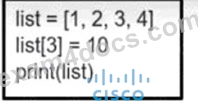
Refer to the exhibit. What is the value of the variable list after the code is run?
- A. [1, 10, 10, 10]
- B. [1, 2, 3, 10]
- C. [1, 2, 10]
- D. [1, 2, 10, 4]
Answer: B
NEW QUESTION # 396
What are two differences between the RIB and the FIB? (Choose two.)
- A. The FIB is derived from the control plane, and the RIB is derived from the FIB.
- B. The RIB is a database of routing prefixes, and the FIB is the Information used to choose the egress interface for each packet.
- C. The RIB is derived from the control plane, and the FIB is derived from the RIB.
- D. FIB is a database of routing prefixes, and the RIB is the information used to choose the egress interface for each packet.
- E. The FIB is derived from the data plane, and the RIB is derived from the FIB.
Answer: B,C
Explanation:
Reference:
The Forwarding Information Base (FIB) contains destination reachability information as well as next hop information. This information is then used by the router to make forwarding decisions. The FIB allows for very efficient and easy lookups
NEW QUESTION # 397
What is a characteristics of VXLAN?
- A. It has a 12-byt packet header.
- B. It frame encapsulation is performed by MAC-In-UDP
- C. It extends Layer 2 and Layer 3 overlay networks over a Layer 2 underlay.
- D. It uses TCP for transport
Answer: B
NEW QUESTION # 398
......
350-401 Braindumps Real Exam Updated on Jun 23, 2024 with 910 Questions: https://www.exam4docs.com/350-401-study-questions.html
Latest 350-401 PDF Dumps & Real Tests Free Updated Today: https://drive.google.com/open?id=1mwDdmyVrNYCTmgwnhCXEsRPS3wXnMiRm
