

100% Reliable Microsoft DSA-C03 Exam Dumps Test Pdf Exam Material
Based on Official Syllabus Topics of Actual Snowflake DSA-C03 Exam
NEW QUESTION # 165
You are tasked with building a model to predict customer churn. You have a table named in Snowflake with the following relevant columns: 'customer_id', 'login_date', , 'orders_placed', , and 'churned' (binary indicator). You want to engineer features that capture customer engagement over time using Snowpark for Python. Which of the following feature engineering steps, applied sequentially, are MOST effective in creating features indicative of churn risk?
- A. 1. Calculate the total 'page_views' and 'orders_placed' for each customer without considering time. 2. Use one-hot encoding for the 'subscription_type' column.
- B. 1. Calculate the number of days since the customer's last login, and use nulls instead of negative numbers to indicate inactivity. 2. Calculate the rolling 7-day average of 'orders_placed' using a window function, partitioning by 'customer_id' and ordering by 'login_date'. 3. Calculate the slope of a linear regression of page_views' over time for each customer, indicating the trend in engagement using Snowpark ML. 4. Calculate the percentage of weeks the customer logged in. 5. Create a feature showing standard deviation of page_views per customer over the last 90 days.
- C. 1. Calculate the average 'page_views' per week for each customer over the last 3 months using a window function. 2. Calculate the recency of the last order (days since last order) for each customer. 3. Create a feature indicating the change in average daily page views over the last month compared to the previous month. 4. Create a feature showing standard deviation of page_views per customer over the last 90 days.
- D. 1. Calculate the maximum 'page_views' in a single day for each customer. 2. Calculate the total number of days with no 'login_date' for each customer. 3. Create a feature indicating if a customer has ever placed an order. 4. Use a simple boolean for the 'subscription_type' column.
- E. 1. Calculate the average 'page_views' per day for each customer. 2. Calculate the total number of for each customer. 3. Create a feature indicating whether the customer has a premium subscription ('subscription_type' = 'premium').
Answer: B,C
Explanation:
Options B and E are the MOST effective because they incorporate time-based features and indicators of engagement trends. Recency (days since last order) captures the time elapsed since the customer's last interaction. Calculating changes in page views, the number of login days and linear regression slope identifies trends in engagement. Rolling averages smooth out daily fluctuations and capture longer-term patterns. Standard deviation of page views indicates a trend in page view variance, and thus overall customer engagement variance. Option A lacks recency and trend information. Option C misses temporal analysis. Option D has less relevance features and can be used however it is more useful to compare how well a customer is engaged with previous activity.
NEW QUESTION # 166
You have trained a fraud detection model using scikit-learn and want to deploy it in Snowflake using the Snowflake Model Registry. You've registered the model as 'fraud _ model' in the registry. You need to create a Snowflake user-defined function (UDF) that loads and executes the model. Which of the following code snippets correctly creates the UDF, assuming the model is a serialized pickle file stored in a stage named 'model_stage'?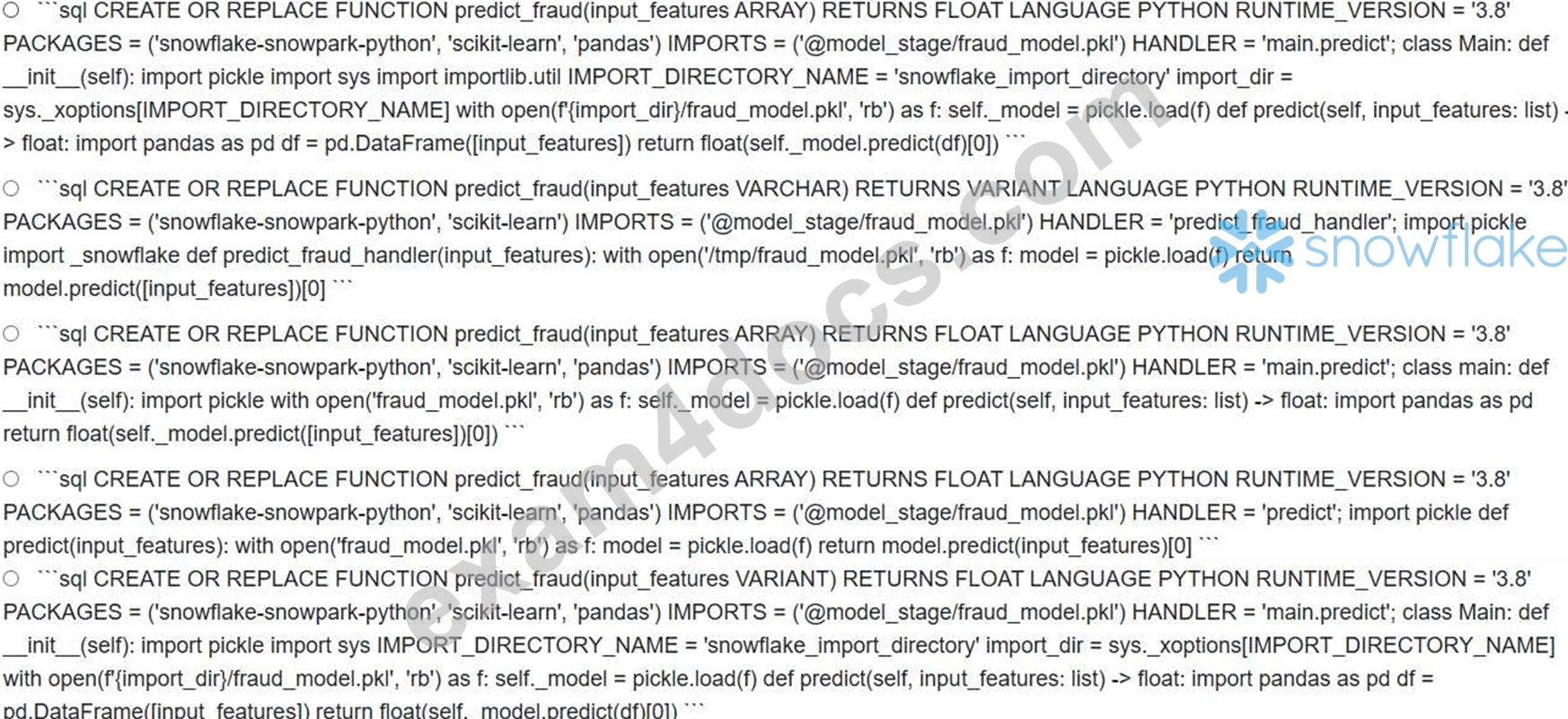
- A. Option B
- B. Option D
- C. Option E
- D. Option C
- E. Option A
Answer: C
Explanation:
Option E is the most correct. It includes the correct Snowflake UDF syntax, specifies the required packages (snowflake-snowpark- python, scikit-learn, pandas), imports the model from the stage, and defines a handler class with a 'predict' method that loads the model using pickle and performs the prediction. It also correctly utilizes the to access files from the stage. Other options have errors in syntax, file access within the UDF environment or how input features are handled.
NEW QUESTION # 167
You've deployed a fraud detection model in Snowflake. The model is implemented as a Python UDF that uses a pre-trained scikit-learn model stored as a stage file. Your goal is to enable near real-time fraud detection on incoming transactions. Due to regulatory requirements, you need to maintain a detailed audit trail of all predictions, including the input features, model version, prediction scores, and any errors encountered during the prediction process. Which of the following approaches are valid and efficient for storing these audit logs and predictions in Snowflake?
- A. Utilize Snowflake's Streams and Tasks to automatically capture changes to the transaction table and trigger the prediction UDF, storing the audit logs in a separate table with similar structure as described in option A.
- B. Create a dedicated table with columns for transaction ID, input features (as a JSON VARIANT), model version, prediction score, error message (if any), and prediction timestamp. Use a Snowflake Sequence to generate unique log IDs.
- C. Use Snowflake's 'SYSTEM$QUERY LOG' table to extract information about the UDF execution and join it with the transaction data to reconstruct the audit trail.
- D. Log the audit information to an external logging service (e.g., Splunk) using an external function called from within the UDF.
- E. Store the audit logs as unstructured text files in an external stage (e.g., AWS S3) and periodically load them into a Snowflake table using COPY INTO command.
Answer: A,B
Explanation:
Options A and C are the most valid and efficient approaches. Option A provides a structured and readily queryable format for the audit logs, making it easy to analyze and report on fraud detection performance. Using a SEQUENCE ensures unique and ordered log IDs. Option C leverages Snowflake's Streams and Tasks to automate the prediction process and audit logging, ensuring that all transactions are processed and logged in near real-time. This is particularly suitable for continuous fraud detection. Option B is less efficient due to the overhead of loading unstructured data and parsing it. It lacks real-time processing capabilities. Option D introduces external dependencies and potential latency. While external logging services can be valuable, storing the audit data natively in Snowflake provides better integration and performance. Option E is not reliable for recreating the full audit trail, as primarily captures query execution metadata and may not contain all the necessary information (e.g., input features, model version). Also SYSTEM$QUERY LOG data availability can be delayed.
NEW QUESTION # 168
You've built a machine learning model in scikit-learn and want to deploy it to Snowflake for real-time inference. You have the following options for deploying the model. Select all that apply and are considered a best practice for cost and time optimization:
- A. Package the scikit-learn model using 'joblib' or 'pickle' , store it in a Snowflake stage, and create a Snowflake UDF (User-Defined Function) in Python to load the model from the stage and perform inference.
- B. Migrate your entire Snowflake data warehouse to a different platform which better supports real-time ML inference.
- C. Implement a custom microservice that reads data from Snowflake, performs inference using the scikit-learn model, and writes the predictions back to Snowflake.
- D. Create a Snowflake external function that calls a cloud-based (AWS SageMaker, Azure Machine Learning, GCP Vertex A1) endpoint for inference, passing the input data to the endpoint and receiving the prediction back.
- E. Use Snowflake's Snowpark Python API to directly load the model from a stage and execute inference using Snowpark DataFrames, which will implicitly handle the distributed processing of the data.
Answer: A,E
Explanation:
Options A and B are the recommended approaches. Option A leverages Snowflake UDFs for inference, which minimizes data transfer and leverages Snowflake's compute. Option B, using Snowpark, provides a more seamless integration with Snowflake's distributed processing capabilities. Option C introduces external dependencies and latency. Option D requires managing and maintaining a separate microservice and data transfer and Option E is not viable.
NEW QUESTION # 169
A data scientist is developing a model within a Snowpark Python environment to predict customer churn. They have established a Snowflake session and loaded data into a Snowpark DataFrame named 'customer data'. The feature engineering pipeline requires a custom Python function, 'calculate engagement_score', to be applied to each row. This function takes several columns as input and returns a single score representing customer engagement. The data scientist wants to apply this function in parallel across the entire DataFrame using Snowpark's UDF capabilities. The following code snippet is used to define and register the UDF:
When the UDF is called the above error is observed. What change needs to be applied to make the UDF work as expected?
- A. Redefine the function to accept string arguments and cast them to the correct data types within the function.
- B. Wrap the Python function inside a stored procedure using @F.sproc' and call that stored procedure instead of the plain python function.
- C. Add '@F.sproc' decorator before the function definition.
- D. Remove argument from 'session.udf.register' call. Snowpark can infer the input types automatically.
- E. Change the function call to use the Snowpark DataFrame's 'select' function with column objects: 'customer_data.select(engagement_score_udf(F.col('num_transactions'), F.col('avg_transaction_value'),
Answer: E
Explanation:
The error message 'UDFArgumentException: Invalid argument types for function 'calculate_engagement_score_udf. Expected arguments: ONT, FLOAT, INT], actual arguments: [COLUMN_NAME, COLUMN_NAME, COLUMN_NAME]' indicates that the UDF is receiving column objects instead of the actual data values. This is because when calling the UDF on a Snowpark DataFrame, you need to explicitly reference the columns using The correct way to apply the UDF to the DataFrame is to use the 'select' function with ' F.col()' to pass the column objects as arguments to the UDF.
NEW QUESTION # 170
You are building a binary classification model in Snowflake to predict customer churn based on historical customer data, including demographics, purchase history, and engagement metrics. You are using the SNOWFLAKE.ML.ANOMALY package. You notice a significant class imbalance, with churn representing only 5% of your dataset. Which of the following techniques is LEAST appropriate to handle this class imbalance effectively within the SNOWFLAKE.ML framework for structured data and to improve the model's performance on the minority (churn) class?
- A. Using the 'sample_weight' parameter in the 'SNOWFLAKE.ML.ANOMALY.FIT function to assign higher weights to the minority class instances during model training.
- B. Downsampling the majority class to create a more balanced training dataset within Snowflake using SQL before feeding the data to the modeling function.
- C. Applying a SMOTE (Synthetic Minority Over-sampling Technique) or similar oversampling technique to generate synthetic samples of the minority class before training the model outside of Snowflake, and then loading the augmented data into Snowflake for model training.
- D. Adjusting the decision threshold of the trained model to optimize for a specific metric, such as precision or recall, using a validation set. This can be done by examining the probability outputs and choosing a threshold that maximizes the desired balance.
- E. Using a clustering algorithm (e.g., K-Means) on the features and then training a separate binary classification model for each cluster to capture potentially different patterns of churn within different customer segments.
Answer: E
Explanation:
E is the LEAST appropriate. While clustering and training separate models per cluster can be a useful strategy for improving overall model performance by capturing heterogeneous patterns, it doesn't directly address the class imbalance problem within each cluster's dataset. Applying clustering does nothing about the class imbalance and adds unnecessary complexity. A, B, C, and D are all standard methods for handling class imbalance. A uses weighted training. B and D address resampling of the training set. C addresses the classification threshold.
NEW QUESTION # 171
You have trained a complex Random Forest model in Snowflake to predict loan default risk. You wish to understand the individual and combined effects of 'credit_score' and 'debt_to_income_ratio' on the predicted probability of default. Which approach is MOST suitable for visualizing and interpreting these relationships?
- A. Examine the model's overall accuracy (e.g., AUC) and assume the relationships are well-represented.
- B. Generate individual Partial Dependence Plots (PDPs) for 'credit_score' and 'debt_to_income_ratio'.
- C. Create a two-way Partial Dependence Plot (PDP) showing the interaction between 'credit_score' and 'debt_to_income_ratio'.
- D. Fit a simpler linear model (e.g., Logistic Regression) to the data and interpret its coefficients.
- E. Calculate feature importance using SNOWFLAKE.ML.FEATURE IMPORTANCE and focus on the features with the highest scores.
Answer: C
Explanation:
The correct answer is C. While individual PDPs (option B) provide insights into the individual effects of each feature, a two-way PDP specifically visualizes and helps interpret the interaction between 'credit_score' and 'debt_to_income_ratio'. This is crucial for understanding how the combined effect of these features influences the predicted probability of default. Feature importance (option A) indicates feature relevance but doesn't show the nature of the relationship. Simplifying the model (option D) sacrifices the complexity captured by the Random Forest. Overall accuracy (option E) doesn't provide specific insights into feature relationships.
NEW QUESTION # 172
You are building a predictive model for customer churn using linear regression in Snowflake. You have identified several features, including 'CUSTOMER AGE', 'MONTHLY SPEND', and 'NUM CALLS'. After performing an initial linear regression, you suspect that the relationship between 'CUSTOMER AGE and churn is not linear and that older customers might churn at a different rate than younger customers. You want to introduce a polynomial feature of "CUSTOMER AGE (specifically, 'CUSTOMER AGE SQUARED') to your regression model within Snowflake SQL before further analysis with python and Snowpark. How can you BEST create this new feature in a robust and maintainable way directly within Snowflake?
- A. Option B
- B. Option D
- C. Option C
- D. Option A
- E. Option E
Answer: C
Explanation:
Creating a VIEW (option C) is the BEST approach for several reasons. It doesn't modify the underlying data, which is crucial for data govemance and prevents unintended side effects. The feature is calculated on-the-fly whenever the view is queried, ensuring that the feature is always up-to-date if the underlying changes. Options A, D, and E permanently alter the table, potentially leading to data redundancy and requiring manual updates if the column changes. Option B creates a temporary table, which is suitable for short-lived experiments but not ideal for a feature that will be used repeatedly. Using 2) is equivalent to CUSTOMER_AGE CUSTOMER_AGE. Views are efficient because Snowflake's query optimizer can often push down computations into the underlying table. Option C also avoids needing to manage the lifecycle of updated calculated columns.
NEW QUESTION # 173
You have a table in Snowflake named 'CUSTOMER DATA' with columns 'CUSTOMER D', 'PURCHASE AMOUNT', and 'RECENCY'. You want to perform feature scaling on 'PURCHASE AMOUNT' using Min-Max scaling and store the scaled values in a new column named 'SCALED PURCHASE _ AMOUNT'. Which of the following Snowflake SQL code snippets correctly implements this feature scaling? Note: Assume there are no NULL values in PURCHASE AMOUNT and you have privileges to create temporary tables and UDFs if necessary.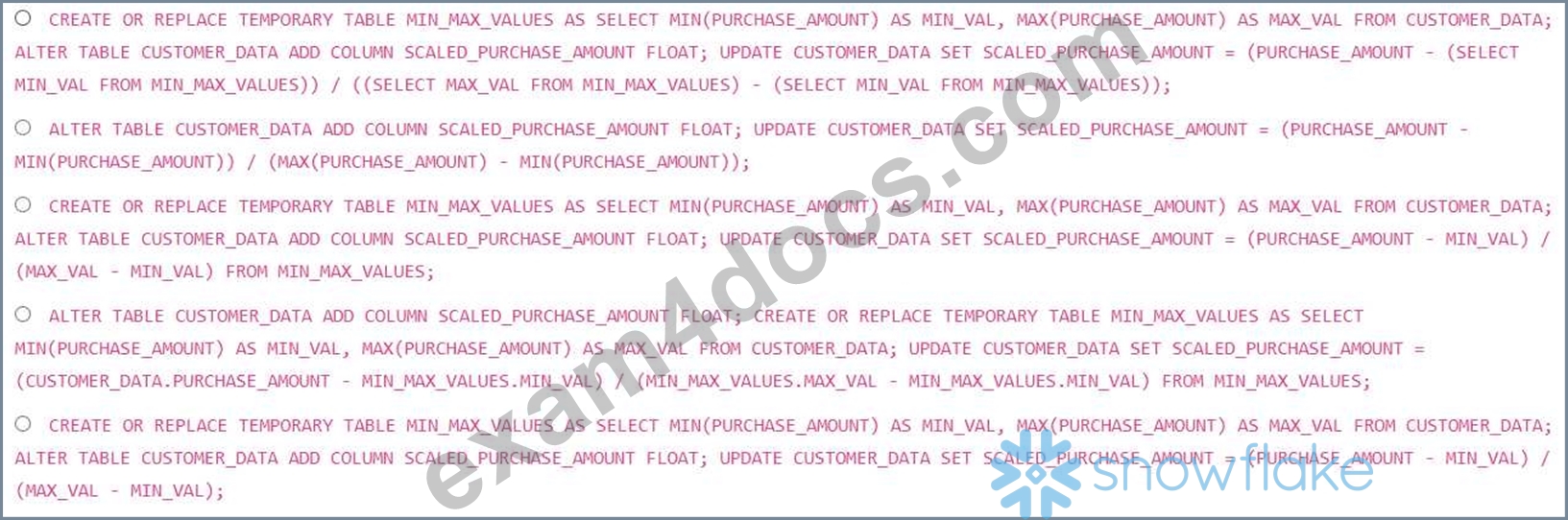
- A. Option B
- B. Option C
- C. Option D
- D. Option A
- E. Option E
Answer: C
Explanation:
Option D is correct because it calculates the min and max purchase amounts from the CUSTOMER_DATA table and stores them in a temporary table It then adds a new column to the CUSTOMER_DATA table and updates this column with the Min-Max scaled values, properly joining the temporary table to access the min and max values during the update. Option A is syntactically correct but executes multiple subqueries within the UPDATE statement, which can be less efficient than joining with a temporary table. Option B is syntactically incorrect as aggregate functions (MIN, MAX) cannot be used directly in the UPDATE statement without a GROUP BY clause. Option C does not work as MIN_VAL and MAX VAL are column aliases that cannot be directly referenced as variables within the UPDATE statement. Option E is syntactically correct, but assumes that MIN VAL and MAX VAL variables are directly available during update, which is not how Snowflake SQL works.
NEW QUESTION # 174
A data scientist uses bootstrapping to estimate the sampling distribution of a statistic calculated from a dataset stored in Snowflake. They observe that the bootstrap distribution is significantly different from the original data distribution. Which of the following statements best describes the possible reasons for this difference, considering both the theoretical underpinnings of bootstrapping and potential limitations?
- A. Bootstrapping always provides accurate estimates of sampling distributions, any significant difference indicates an error in the code implementation.
- B. The difference is unexpected; the bootstrap distribution should always closely resemble the original data distribution, regardless of the statistic being estimated.
- C. The statistic being estimated is inherently unstable and has a high variance, causing the bootstrap distribution to be wider and potentially different in shape compared to the original data distribution. This is a normal outcome when dealing with such statistics.
- D. The original sample may not be representative of the population, and the bootstrap procedure is simply amplifying the biases present in the original sample. Additionally, the statistic itself may be highly sensitive to outliers or specific data points, leading to a distorted bootstrap distribution.
- E. Bootstrapping is only appropriate for normally distributed data; if the original data is not normal, the bootstrap distribution will inevitably differ significantly.
Answer: C,D
Explanation:
Options B and C are correct. Bootstrapping relies on the assumption that the original sample is representative of the population. If it isn't, the bootstrap distribution will reflect the biases of the sample. Also certain statistics, particularly those sensitive to outliers or with high variance, can produce bootstrap distributions that differ significantly from the original data distribution. Option A is incorrect because the bootstrap distribution doesn't necessarily have to be same as sample distribution. Option D is incorrect since Bootstrapping makes no assumptions regarding the distribution of original dataset and can be used for any data distribution. Option E is not correct. Bootstrapping is not always accurate and relies on assumptions to perform correctly.
NEW QUESTION # 175
You've built a model in Snowflake to predict the likelihood of a customer clicking on an advertisement. The model outputs a probability score between 0 and 1. You want to determine the optimal threshold to use for converting these probabilities into binary predictions (click/no-click). Your business stakeholders have provided the following information: Cost of showing an ad: $0.10; Revenue generated from a click: $1.00; You have access to a table 'AD_PREDICTIONS' with columns 'CUSTOMER_ID', 'PREDICTED_PROBABILITY' , and 'ACTUAL CLICK' (1 for click, 0 for no click). Which of the following approaches would be the MOST appropriate for selecting the optimal probability threshold to maximize profit, and why?
- A. Select a threshold of 0.5, as this is a common default threshold for binary classification problems.
- B. Calculate the point on the ROC curve closest to the top-left corner (perfect classification) and use the corresponding threshold. This optimizes for both sensitivity and specificity.
- C. Use the precision-recall curve to find the threshold that maximizes the F1 -score, balancing precision and recall.
- D. Select a very high probability threshold (e.g., 0.9) to ensure that only the most likely clicks are targeted, minimizing wasted ad spend.
- E. Iterate through a range of probability thresholds (e.g., 0.01 to 0.99), and for each threshold, calculate the profit using SQL in Snowflake: 'SELECT SUM(CASE WHEN PREDICTED PROBABILITY threshold THEN CASE WHEN ACTUAL CLICK = 1 THEN 0.9 ELSE -0.1 END ELSE O END) AS Profit FROM AD_PREDICTIONS;' Choose the threshold that maximizes the profit.
Answer: E
Explanation:
Option C is the most appropriate approach. While other options might seem reasonable in isolation, they don't directly optimize for profit, which is the ultimate business goal. Option C directly calculates the profit for each threshold, taking into account the cost of showing an ad and the revenue from a click. It correctly models the profit calculation: if the predicted probability is above the threshold, and there's an actual click, the profit is $1.00 (revenue) - $0.10 (cost) = $0.90. If the predicted probability is above the threshold, but there's no actual click, the loss is $0.10 (cost). All other approaches don't optimize directly for profit, based on the costs and revenues given.
NEW QUESTION # 176
You are performing exploratory data analysis on a dataset of customer transactions in Snowflake to prepare for a linear regression model that predicts transaction value based on several customer-related features (e.g., age, location, number of previous transactions). You suspect a non-linear relationship between 'customer_age' and 'transaction_value'. Which of the following Snowflake SQL techniques is MOST appropriate for exploring and potentially transforming the 'customer_age' variable to better fit a linear regression model?
- A. Apply a logarithmic transformation to 'customer_age' if a scatter plot of 'customer_age' vs 'transaction_value' shows a curve that flattens out as 'customer_age' increases.
- B. Calculate the Pearson correlation coefficient between 'customer_age' and 'transaction_value' using the function. If the correlation is low, discard the 'customer_age' variable.
- C. Use the window function to bin 'customer_age' into quartiles and treat each quartile as a categorical variable in the linear regression model.
- D. Implement a Box-Cox transformation in Snowpark Python, select a suitable transformation parameter based on the data, and apply the transformation on 'customer_age' feature.
- E. Create polynomial features by adding 'customer_ageA2' and 'customer_ageA3' as new columns to the table, without checking for interaction effects.
Answer: A
Explanation:
Logarithmic transformation is a suitable method when the relationship flattens as the value increases. Creating polynomial features blindly without checking for interaction effects is generally not a good practice. Binning 'customer_age' into quartiles is also a potential solution, it discretizes the continuous data and might lose information, also it's only suitable after confirming its the best option available. A low correlation does not necessarily mean the variable should be discarded; it could indicate a non-linear relationship that a linear model cannot capture directly. Box-Cox transformation is a good approach but may overcomplicate the task. Since Box-Cox transformations are generally harder than Log transformations.
NEW QUESTION # 177
You are tasked with developing a Snowpark Python function to identify and remove near-duplicate text entries from a table named 'PRODUCT DESCRIPTIONS. The table contains a 'PRODUCT ONT) and 'DESCRIPTION' (STRING) column. Near duplicates are defined as descriptions with a Jaccard similarity score greater than 0.9. You need to implement this using Snowpark and UDFs. Which of the following approaches is most efficient, secure, and correct to implement?
- A. Define a Python UDF that calculates the Jaccard similarity. Use 'GROUP BY to group descriptions by the 'PRODUCT ID. Apply the UDF on this grouped data to remove duplicates with similarity score greater than threshold.
- B. Define a Python UDF that calculates the Jaccard similarity. Create a new table, 'PRODUCT DESCRIPTIONS NO DUPES , and insert the distinct descriptions based on the similarity score. Rows in the original table with similar product description must be inserted with lowest product id into new table.
- C. Use the function directly in a SQL query without a UDF. Partition the data by 'PRODUCT_ID' and remove near duplicates where the approximate Jaccard index is above 0.9.
- D. Define a Python UDF to calculate Jaccard similarity. Create a temporary table with a ROW NUMBER() column partitioned by a hash of the DESCRIPTION column. Calculate the Jaccard similarity between descriptions within each partition. Filter and remove near duplicates based on a tie-breaker (smallest PRODUCT_ID).
- E. Define a Python UDF that calculates the Jaccard similarity between all pairs of descriptions in the table. Use a cross join to compare all rows, then filter based on the Jaccard similarity threshold. Finally, delete the near-duplicate rows based on a chosen tie-breaker (e.g., smallest PRODUCT_ID).
Answer: D
Explanation:
Option D is the most efficient, secure, and correct approach for removing near-duplicate text entries using Snowpark and UDFs. It correctly addresses both the computational complexity and the security implications of the task. - It create a temporary table because we are doing operations of delete and create a table which is best done via temporary table. - It uses bucketing (hashing descriptions) to reduce the number of comparisons. This significantly improves performance compared to comparing all possible pairs of descriptions which is what options A and B do. - Use ROW_NUMBER() to flag duplicate for deletion with threshold. Option A is not optimal due to the complexity of cross join. Option B is incorrect because there is data and functionality that is lost with the insertion of distinct entries based on score. Also, it would be inefficient as it required re-evaluation of score on insertion. Option C is incorrect because Grouping by Product ID will not allow for similarity calculation across different product IDs. Option E is not applicable because Snowflake does not have a built-in 'APPROX JACCARD INDEX' function to apply directly in a SQL query.
NEW QUESTION # 178
You are working with a Snowflake table named 'CUSTOMER DATA' that contains personally identifiable information (PII), including customer names, email addresses, and phone numbers. Your team needs to perform exploratory data analysis on this data to understand customer demographics and behavior. However, you must ensure that the PII is protected and that only authorized personnel can access the sensitive information. Which of the following strategies should you implement in Snowflake to achieve secure EDA?
- A. Use transient tables to store the customer data after PII is obfuscated, drop the table and reload new data daily.
- B. Create a view on top of that excludes the PII columns (e.g., name, email, phone). Grant 'SELECT privileges on this view to data scientists. Also implement data masking policies on the 'CUSTOMER DATA' table for the PII columns and grant 'SELECT on the table to specific roles requiring access to the masked values.
- C. Create a copy of the 'CUSTOMER DATA table without the PII columns and grant 'SELECT' privileges on this copy to the data scientists. Use masking policies on the original table.
- D. Apply dynamic data masking to the entire 'CUSTOMER_DATA' table, masking all columns by default, and provide decryption keys only to authorized users.
- E. Grant 'SELECT privileges on the 'CUSTOMER DATA' table to all data scientists, and rely on them to avoid querying PII columns directly.
Answer: B,C
Explanation:
Options B and E are both valid strategies. Option B provides a view with non-PII data, while using masking policies on the table. Option E creates a copy of the 'CUSTOMER_DATR table and leverages masking on original table. Option A is insecure. Option C while obfuscating the PII, will lead to data loss and will be costly to move the data. Option D isn't practical, it would overly restrict access.
NEW QUESTION # 179
You are tasked with performing data profiling on a large customer dataset in Snowflake to identify potential issues with data quality and discover initial patterns. The dataset contains personally identifiable information (PII). Which of the following Snowpark and SQL techniques would be most appropriate to perform this task while minimizing the risk of exposing sensitive data during the exploratory data analysis phase?
- A. Directly query the raw customer data using SQL and Snowpark, computing descriptive statistics like mean, median, and standard deviation for all numeric columns and frequency counts for categorical columns. Store the results in a temporary table for further analysis.
- B. Create a masked view of the customer data using Snowflake's dynamic data masking features. This view masks sensitive PII columns while allowing you to compute aggregate statistics and identify patterns using SQL and Snowpark functions. Columns like 'email' are masked using and columns like are masked using .
- C. Apply differential privacy techniques using Snowpark to add noise to the summary statistics generated from the customer data, masking the individual contributions of each customer while revealing overall trends.
- D. Utilize Snowpark to create a sampled dataset (e.g., 1% of the original data) and perform all exploratory data analysis on the sample to reduce the data volume and potential exposure of PII.
- E. Export the entire customer dataset to an external data lake for exploratory analysis using Spark and Python. Apply data masking in Spark before analysis.
Answer: B,C
Explanation:
Options C and D provide the most secure and effective ways to perform exploratory data analysis while protecting PII. Differential privacy (C) ensures that aggregate statistics do not reveal too much information about individuals. Masked views (D) prevent direct access to sensitive data, replacing it with masked values during the analysis. A is dangerous because it exposes the raw data. B while reduces the volume, still exposes raw data. E is risky because it involves exporting sensitive data outside of Snowflake.
NEW QUESTION # 180
You are working on a fraud detection model and need to prepare transaction data'. You have two tables: 'transactions' (transaction_id, customer_id, transaction_date, amount, merchant_id) and (merchant_id, city, state). You need to perform the following data cleaning and feature engineering steps using Snowpark: 1. Remove duplicate transactions based on 'transaction_id'. 2.
Join the 'transactions' table with the 'merchant_locations table to add city and state information to each transaction. 3. Create a new feature called 'amount_category' based on the transaction amount, categorized as 'Low', 'Medium', or 'High'. 4. The categorization thresholds are defined as follows: 'LoW: amount < 50 'Medium': 50 amount < 200 'High': amount >= 200 Which of the following statements about performing these operations using Snowpark are accurate?
- A. Removing duplicate transactions can be efficiently done using the method on the Snowpark DataFrame, specifying 'transaction_id' as the subset. Creating the amount categories requires use of a User-Defined Function (UDF) as the logic can't be efficiently embedded in a single 'when' clause.
- B. Removing duplicate transactions can be efficiently done using the method on the Snowpark DataFrame, specifying 'transaction_id' as the subset. Creating the amount categories can be completed using the 'when' clause with multiple 'otherwise' clauses.
- C. You can register SQL UDF to calculate the 'amount_category' using 'CASE WHEN' statement
- D. The construct in Snowpark can be used to create the 'amount_category' feature directly within the DataFrame transformation without needing a UDF
- E. A LEFT JOIN should be used to join the 'transactions' and 'merchant_location' tables to ensure that all transactions are included, even if some merchant IDs are not present in the 'merchant_location' table.
Answer: B,C,D
Explanation:
Options C, D and E are correct. Option C is correct because Snowpark's construct allows creating new features based on conditional logic directly within DataFrame transformations, avoiding the need for a UDF for simple categorizations like this. Option D is correct because SQL UDF can be used to create a function that returns Option E is also correct because the method efficiently removes duplicates, and the 'when' clauses enables easy categorization of in snowflake. Option A is incorrect, the categorization doesn't necessarily require UDF. Option B is incorrect since a RIGHT or INNER join is valid as well.
NEW QUESTION # 181
You are building a machine learning pipeline that uses data stored in Snowflake. You want to connect a Jupyter Notebook running on your local machine to Snowflake using Snowpark. You need to securely authenticate to Snowflake and ensure that you are using a dedicated compute resource for your Snowpark session. Which of the following approaches is the MOST secure and efficient way to achieve this?
- A. Use the Snowflake Python connector with username and password and execute SQL commands to create a Snowpark DataFrame.
- B. Hardcode a role with 'ACCOUNTADMIN' privileges in your Jupyter Notebook using username and password.
- C. Store your Snowflake username and password directly in the Jupyter Notebook and create a Snowpark session using these credentials and the default Snowflake warehouse.
- D. Configure OAuth authentication for your Snowflake account and use the OAuth token to establish a Snowpark session with a dedicated virtual warehouse.
- E. Use key pair authentication to connect to Snowflake, storing the private key securely on your local machine. Specify a dedicated virtual warehouse during session creation.
Answer: E
Explanation:
Option D is the most secure. Key pair authentication is more secure than username/password. Specifying a dedicated virtual warehouse ensures dedicated compute. Option A is highly insecure. Option B doesn't directly create a Snowpark session. Option C, while using OAuth, requires proper setup and key pair provides more control. Option E is highly insecure and grants excessive privileges.
NEW QUESTION # 182
......
Free DSA-C03 Dumps are Available for Instant Access: https://www.exam4docs.com/DSA-C03-study-questions.html
View All DSA-C03 Actual Exam Questions Answers and Explanations for Free: https://drive.google.com/open?id=1d8TGMqDI3zCq2vEaqIdZZmdjc-coPAVl
