

Pass Your MCIA-Level-1 Exam Easily With 100% Exam Passing Guarantee [2025]
MCIA-Level-1 Dumps are Available for Instant Access from Exam4Docs
MuleSoft mcia - Level 1: MuleSoft Certified Integration Architect - Level 1 Certification Path
MuleSoft mcia - Level 1: MuleSoft Certified Integration Architect - Level 1 exam is foundation level Certification. As such, there is no prerequisite for this course. Anyone who is having a keen interest and familiar with MuleSoft technology is well invited to pursue this certification.
NEW QUESTION # 91
An Order microservice and a Fulfillment microservice are being designed to communicate with their clients through message-based integration (and NOT through API invocations).
The Order microservice publishes an Order message (a kind of command message) containing the details of an order to be fulfilled. The intention is that Order messages are only consumed by one Mule application, the Fulfillment microservice.
The Fulfillment microservice consumes Order messages, fulfills the order described therein, and then publishes an OrderFulfilled message (a kind of event message). Each OrderFulfilled message can be consumed by any interested Mule application, and the Order microservice is one such Mule application.
What is the most appropriate choice of message broker(s) and message destination(s) in this scenario?
- A. Order messages are sent to an Anypoint MQ exchange
OrderFulfilled messages are sent to an Anypoint MQ queue
Both microservices interact with Anypoint MQ as the message broker, which must therefore scale to support the load of both microservices - B. Order messages are sent to a JMS queue
OrderFulfilled messages are sent to a JMS topic
Both microservices interact with the same JMS provider (message broker) instance, which must therefore scale to support the load of both microservices - C. Order messages are sent directly to the Fulfillment microservices
OrderFulfilled messages are sent directly to the Order microservice
The Order microservice interacts with one AMQP-compatible message broker and the Fulfillment microservice interacts with a different AMQP-compatible message broker, so that both message brokers can be chosen and scaled to best support the load of each microservice - D. Order messages are sent to a JMS queue
OrderFulfilled messages are sent to a JMS topic
The Order microservice interacts with one JMS provider (message broker) and the Fulfillment microservice interacts with a different JMS provider, so that both message brokers can be chosen and scaled to best support the load of each microservice
Answer: D
NEW QUESTION # 92
What API policy would LEAST likely be applied to a Process API?
- A. Client ID enforcement
- B. JSON threat protection
- C. Rate limiting
- D. Custom circuit breaker
Answer: B
Explanation:
Key to this question lies in the fact that Process API are not meant to be accessed directly by clients. Lets analyze options one by one. Client ID enforcement : This is applied at process API level generally to ensure that identity of API clients is always known and available for API-based analytics Rate Limiting : This policy is applied on Process Level API to secure API's against degradation of service that can happen in case load received is more than it can handle Custom circuit breaker : This is also quite useful feature on process level API's as it saves the API client the wasted time and effort of invoking a failing API. JSON threat protection : This policy is not required at Process API and rather implemented as Experience API's. This policy is used to safeguard application from malicious attacks by injecting malicious code in JSON object. As ideally Process API's are never called from external world , this policy is never used on Process API's Hence correct answer is JSON threat protection MuleSoft Documentation Reference : https://docs.mulesoft.com/api-manager/2.x/policy-mule3-json-threat
NEW QUESTION # 93
A global organization operates datacenters in many countries. There are private network links between these datacenters because all business data (but NOT metadata) must be exchanged over these private network connections.
The organization does not currently use AWS in any way.
The strategic decision has Just been made to rigorously minimize IT operations effort and investment going forward.
What combination of deployment options of the Anypoint Platform control plane and runtime plane(s) best serves this organization at the start of this strategic journey?
- A. MuleSoft-hosted Anypoint Platform control plane Customer-hosted runtime plane in each datacenter
- B. MuleSoft-hosted Anypoint Platform control plane Customer-hosted runtime plane in multiple AWS regions
- C. MuleSoft-hosted Anypoint Platform control plane CloudHub Shared Worker Cloud in multiple AWS regions
- D. Anypoint Platform - Private Cloud Edition Customer-hosted runtime plane in each datacenter
Answer: D
NEW QUESTION # 94
An XA transaction Is being configured that involves a JMS connector listening for Incoming JMS messages. What is the meaning of the timeout attribute of the XA transaction, and what happens after the timeout expires?
- A. The time that Is allowed to pass without the transaction being ended explicitly After the timeout, the transaction Is forcefully rolled-back
- B. The time that is allowed to pass between committing the transaction and the completion of the Mule flow After the timeout, flow processing triggers an error
- C. The time that Is allowed to pass between receiving JMS messages on the same JMS connection After the timeout, a new JMS connection Is established
- D. The time that Is allowed to pass for state JMS consumer threads to be destroyed After the timeout, a new JMS consumer thread is created
Answer: A
NEW QUESTION # 95
An organization has an HTTPS-enabled Mule application named Orders API that receives requests from another Mule application named Process Orders.
The communication between these two Mule applications must be secured by TLS mutual authentication (two-way TLS).
At a minimum, what must be stored in each truststore and keystore of these two Mule applications to properly support two-way TLS between the two Mule applications while properly protecting each Mule application's keys?
- A. Orders API truststore: The Orders API private key and public key
Process Orders keystore: The Process Orders private key public key - B. Orders API truststore: The Process Orders public key
Orders API keystore: The Orders API private key
Process Orders truststore: The Orders API public key
Process Orders keystore: The Process Orders private key - C. Orders API truststore: The Orders API public key
Process Orders keystore: The Process Orders private key and public key - D. Orders API truststore: The Process Orders public key
Orders API keystore: The Orders API private key and public key
Process Orders truststore: The Orders API public key
Process Orders keystore: The Process Orders private key and public key
Answer: D
NEW QUESTION # 96
What comparison is true about a CloudHub Dedicated Load Balancer (DLB) vs. the CloudHub Shared Load Balancer (SLB)?
- A. Only a DLB allows the configuration of a custom TLS server certificate
- B. Only the SLB can forward HTTP traffic to the VPC-internal ports of the CloudHub workers
- C. Both a DLB and the SLB implement load balancing by sending HTTP requests to workers with the lowest workloads
- D. Both a DLB and the SLB allow the configuration of access control via IP whitelists
Answer: A
Explanation:
* Shared load balancers don't allow you to configure custom SSL certificates or proxy rules
* Dedicated Load Balancer are optional but you need to purchase them additionally if needed.
* TLS is a cryptographic protocol that provides communications security for your Mule app. TLS offers many different ways of exchanging keys for authentication, encrypting data, and guaranteeing message integrity.
* The CloudHub Shared Load Balancer terminates TLS connections and uses its own server-side certificate.
* Only a DLB allows the configuration of a custom TLS server certificate
* DLB enables you to define SSL configurations to provide custom certificates and optionally enforce two-way SSL client authentication.
* To use a DLB in your environment, you must first create an Anypoint VPC. Because you can associate multiple environments with the same Anypoint VPC, you can use the same dedicated load balancer for your different environments.
* MuleSoft Reference: https://docs.mulesoft.com/runtime-manager/dedicated-load-balancer-tutorial Additional Info on SLB Vs DLB:
Table Description automatically generated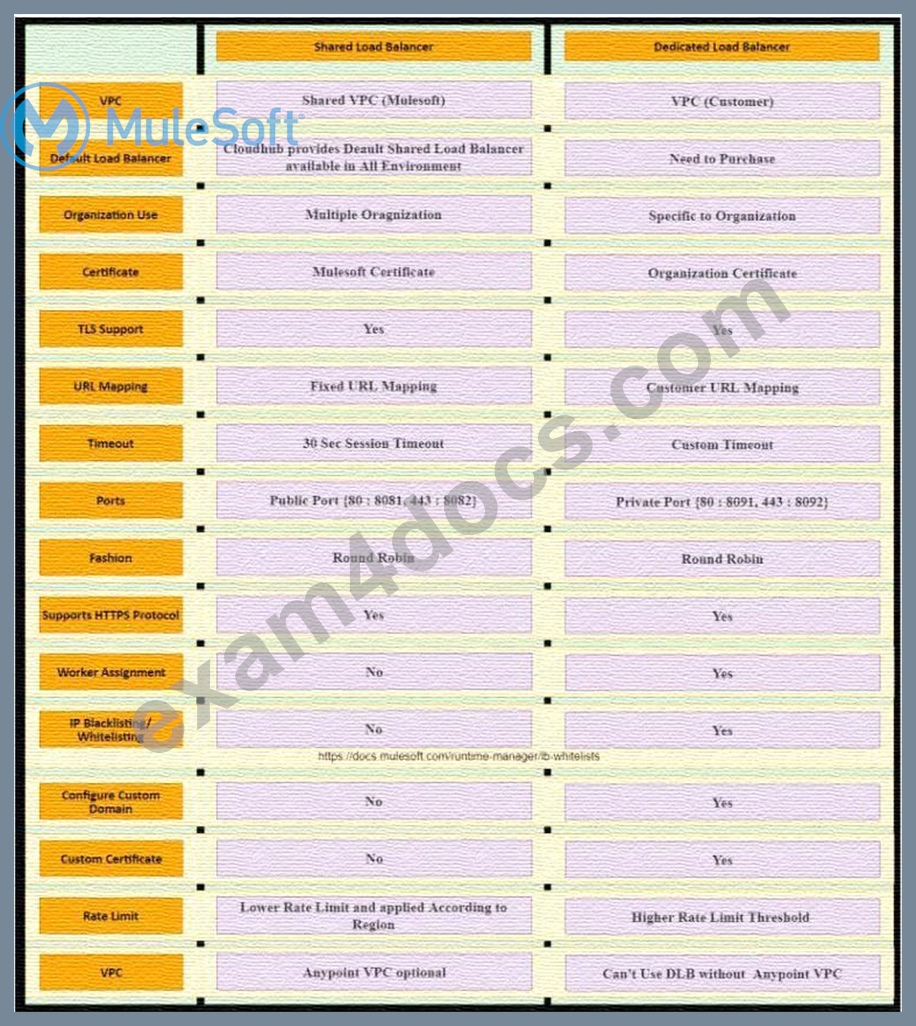
NEW QUESTION # 97
According to the Internet Engineering Task Force (IETF), which supporting protocol does File Transfer Protocol (FTP) use for reliable communication?
- A. A Secure Sockets Layer (SSL)
- B. Hypertext Transfer Protocol (HTTP)
- C. Lightweight Directory Access Protocol (LDAP)
- D. B Transmission Control Protocol (TCP)
Answer: D
Explanation:
The File Transfer Protocol (FTP) uses the Transmission Control Protocol (TCP) for reliable communication.
TCP is one of the core protocols of the Internet Protocol Suite and provides reliable, ordered, and error-checked delivery of a stream of data between applications running on hosts communicating via an IP network. FTP relies on TCP to ensure that all data packets are delivered accurately and in the correct sequence, which is essential for the reliable transfer of files between a client and server.
References
* IETF RFC 959 - File Transfer Protocol (FTP)
* TCP/IP Protocol Suite Documentation
NEW QUESTION # 98
What is true about the network connections when a Mule application uses a JMS connector to interact with a JMS provider (message broker)?
- A. To receive messages into the Mule application, the JMS provider initiates a network connection to the JMS connector and pushes messages along this connection
- B. The AMQP protocol can be used by the JMS connectorto portably establish connections to various types of JMS providers
- C. To complete sending a JMS message, the JMS connector must establish a network connection with the JMS message recipient
- D. The JMS connector supports both sending and receiving of JMS messages over the protocol determined by the JMS provider
Answer: D
NEW QUESTION # 99
When using Anypoint Platform across various lines of business with their own Anypoint Platform business groups, what configuration of Anypoint Platform is always performed at the organization level as opposed to at the business group level?
- A. Identity management setup
- B. Role and permission setup
- C. Dedicated Load Balancer setup
- D. Environment setup
Answer: A
Explanation:
* Roles are business group specific. Configure identity management in the Anypoint Platform master organization. As the Anypoint Platform organization administrator, you can configure identity management in Anypoint Platform to set up users for single sign-on (SSO). * Roles and permissions can be set up at business group and organization level also. But Identity Management setup is only done at Organization level * Business groups are self-contained resource groups that contain Anypoint Platform resources such as applications and APIs. Business groups provide a way to separate and control access to Anypoint Platform resources because users have access only to the busine
NEW QUESTION # 100
A DevOps team has adequate observability of individual system behavior and performance, but it struggles to track the entire lifecycle of each request across different microservices.
Which additional observability approach should this team consider adopting?
- A. Tracing
- B. Data mining
- C. Metrics
- D. Analytics
Answer: C
NEW QUESTION # 101
What is true about the network connections when a Mule application uses a JMS connector to interact with a JMS provider (message broker)?
- A. To receive messages into the Mule application, the JMS provider initiates a network connection to the JMS connector and pushes messages along this connection
- B. The AMQP protocol can be used by the JMS connector to portably establish connections to various types of JMS providers
- C. To complete sending a JMS message, the JMS connector must establish a network connection with the JMS message recipient
- D. The JMS connector supports both sending and receiving of JMS messages over the protocol determined by the JMS provider
Answer: D
Explanation:
* To send message or receive JMS (Java Message Service) message no separate network connection need to be established. So option A, C and D are ruled out.
Correct answer: The JMS connector supports both sending and receiving of JMS messages over the protocol determined by the JMS provider.
* JMS Connector enables sending and receiving messages to queues and topics for any message service that implements the JMS specification.
* JMS is a widely used API for message-oriented middleware.
* It enables the communication between different components of a distributed application to be loosely coupled, reliable, and asynchronous.
MuleSoft Doc Reference: https://docs.mulesoft.com/jms-connector/1.7/
Diagram, text Description automatically generated
NEW QUESTION # 102
A Mule application contains a Batch Job with two Batch Steps (Batch_Step_1 and Batch_Step_2). A payload with 1000 records is received by the Batch Job.
How many threads are used by the Batch Job to process records, and how does each Batch Step process records within the Batch Job?
- A. Each Batch Job uses SEVERAL THREADS for the Batch Steps
Each Batch Step instance receives ONE record at a time as the payload, and BATCH STEP INSTANCES execute IN PARALLEL to process records and Batch Steps in ANY order as fast as possible - B. Each Batch Job uses SEVERAL THREADS for the Batch Steps
Each Batch Step instance receives ONE record at a time as the payload, and RECORDS are processed IN PARALLEL within and between the two Batch Steps - C. Each Batch Job uses a SINGLE THREAD to process a configured block size of record Each Batch Step instance receives A BLOCK OF records as the payload, and BLOCKS of records are processed IN ORDER
- D. Each Batch Job uses a SINGLE THREAD for all Batch Steps
Each Batch Step instance receives ONE record at a time as the payload, and RECORDS are processed IN ORDER, first through Batch_Step_1 and then through Batch_Step_2
Answer: A
Explanation:
Explanation/Reference: https://docs.mulesoft.com/mule-runtime/3.8/batch-processing
NEW QUESTION # 103
What is true about automating interactions with Anypoint Platform using tools such as Anypoint Platform REST API's, Anypoint CLI or the Mule Maven plugin?
- A. Access to Anypoint Platform API;s and Anypoint CLI can be controlled separately thruough the roles and permissions in Anypoint platform, so that specific users can get access to Anypoint CLI while others get access to the platform API's
- B. By default, the Anypoint CLI and Mule Maven plugin are not included in the Mule runtime
- C. Anypoint Platform API's can only automate interactions with CloudHub while the Mule maven plugin is required for deployment to customer hosted Mule runtimes
- D. API policies can be applied to the Anypoint platform API's so that only certain LOS's has access to specific functions
Answer: B
Explanation:
Correct answer is By default, the Anypoint CLI and Mule Maven plugin are not included in the Mule runtime Maven is not part of runtime though it is part of studio. You do not need it to deploy in order to deploy your app. Same is the case with CLI.
NEW QUESTION # 104
What is not true about Mule Domain Project?
- A. Only available Anypoint Runtime Fabric
- B. Expose multiple services within the Mule domain on the same port
- C. This allows Mule applications to share resources
- D. Send events (messages) to other Mule applications using VM queues
Answer: A
Explanation:
* Mule Domain Project is ONLY available for customer-hosted Mule runtimes, but not for Anypoint Runtime Fabric
* Mule domain project is available for Hybrid and Private Cloud (PCE). Rest all provide application isolation and can't support domain project.
What is Mule Domain Project?
* A Mule Domain Project is implemented to configure the resources that are shared among different projects.
These resources can be used by all the projects associated with this domain. Mule applications can be associated with only one domain, but a domain can be associated with multiple projects. Shared resources allow multiple development teams to work in parallel using the same set of reusable connectors. Defining these connectors as shared resources at the domain level allows the team to: - Expose multiple services within the domain through the same port. - Share the connection to persistent storage. - Share services between apps through a well-defined interface. - Ensure consistency between apps upon any changes because the configuration is only set in one place.
* Use domains Project to share the same host and port among multiple projects. You can declare the http connector within a domain project and associate the domain project with other projects. Doing this also allows to control thread settings, keystore configurations, time outs for all the requests made within multiple applications. You may think that one can also achieve this by duplicating the http connector configuration across all the applications. But, doing this may pose a nightmare if you have to make a change and redeploy all the applications.
* If you use connector configuration in the domain and let all the applications use the new domain instead of a default domain, you will maintain only one copy of the http connector configuration. Any changes will require only the domain to the redeployed instead of all the applications.
You can start using domains in only three steps:
1) Create a Mule Domain project
2) Create the global connector configurations which needs to be shared across the applications inside the Mule Domain project
3) Modify the value of domain in mule-deploy.properties file of the applications Graphical user interface Description automatically generated
NEW QUESTION # 105
An organization has strict unit test requirement that mandate every mule application must have an MUnit test suit with a test case defined for each flow and a minimum test coverage of 80%.
A developer is building Munit test suit for a newly developed mule application that sends API request to an external rest API.
What is the effective approach for successfully executing the Munit tests of this new application while still achieving the required test coverage for the Munit tests?
- A. Mark the rest API invocations in the Munits and then call the mocking service flow that simulates standard responses from the REST API
- B. Create a mocking service flow to simulate standard responses from the rest API and then configure the mule flows to call the marking service flow
- C. Invoke the external endpoint of the rest API from the mule floors
- D. Mock the rest API invocation in the Munits and return a mock response for those invocations
Answer: D
Explanation:
* Mocking REST API Invocations:
* To ensure the unit tests do not make actual calls to external REST APIs, which can be unreliable and slow, it is best to mock these invocations. Mocking allows you to simulate the behavior of the external API and provide predefined responses.
* Achieving Test Coverage:
* By mocking the REST API invocations in your MUnit tests, you can focus on testing the logic
* within the Mule application itself. This ensures high test coverage and isolates your tests from external dependencies.
* Execution of MUnit Tests:
* Configure MUnit to return mock responses for the API calls. This enables the MUnit tests to run quickly and consistently, as they are not dependent on the external system's availability or performance.
References:
* MuleSoft Documentation on MUnit Testing
* Best practices for Mocking in MUnit
NEW QUESTION # 106
Mule application A receives a request Anypoint MQ message REQU with a payload containing a variable- length list of request objects. Application A uses the For Each scope to split the list into individual objects and sends each object as a message to an Anypoint MQ queue.
Service S listens on that queue, processes each message independently of all other messages, and sends a response message to a response queue.
Application A listens on that response queue and must in turn create and publish a response Anypoint MQ message RESP with a payload containing the list of responses sent by service S in the same order as the request objects originally sent in REQU.
Assume successful response messages are returned by service S for all request messages.
What is required so that application A can ensure that the length and order of the list of objects in RESP and REQU match, while at the same time maximizing message throughput?
- A. Perform all communication involving service S synchronously from within the For Each scope, so objects in RESP are in the exact same order as request objects in REQU
- B. Keep track of the list length and all object indices in REQU, both in the For Each scope and in all communication involving service. Use persistent storage when creating RESP
- C. Use a Scatter-Gather within the For Each scope to ensure response message order Configure the Scatter-Gather with a persistent object store
- D. Use an Async scope within the For Each scope and collect response messages in a second For Each scope in the order in which they arrive, then send RESP using this list of responses
Answer: C
NEW QUESTION # 107
An integration Mute application consumes and processes a list of rows from a CSV file. Each row must be read from the CSV file, validated, and the row data sent to a JMS queue, in the exact order as in the CSV file.
If any processing step for a row falls, then a log entry must be written for that row, but processing of other rows must not be affected.
What combination of Mute components is most idiomatic (used according to their intended purpose) when Implementing the above requirements?
- A. Scatter-Gather component On Error Continue scope
- B. VM connector first Successful scope On Error Propagate scope
- C. For Each scope On Error Continue scope
- D. Async scope On Error Propagate scope
Answer: C
Explanation:
* On Error Propagate halts execution and sends error to the client. In this scenario it's mentioned that "processing of other rows must not be affected" so Option B and C are ruled out.
* Scatter gather is used to club multiple responses together before processing. In this scenario, we need sequential processing. So option A is out of choice.
* Correct answer is For Each scope & On Error Continue scope Below requirement can be fulfilled in the below way
1) Using For Each scope , which will send each row from csv file sequentially. each row needs to be sent sequentially as requirement is to send the message in exactly the same way as it is mentioned in the csv file
2) Also other part of requirement is if any processing step for a row fails then it should log an error but should not affect other record processing . This can be achieved using On error Continue scope on these set of activities. so that error will not halt the processing. Also logger needs to be added in error handling section so that it can be logged.
* Attaching diagram for reference. Here it's try scope, but similar would be the case with For Each loop.
NEW QUESTION # 108
Refer to the exhibit.
A shopping cart checkout process consists of a web store backend sending a sequence of API invocations to an Experience API, which in turn invokes a Process API. All API invocations are over HTTPS POST. The Java web store backend executes in a Java EE application server, while all API implementations are Mule applications executing in a customer -hosted Mule runtime.
End-to-end correlation of all HTTP requests and responses belonging to each individual checkout Instance is required. This is to be done through a common correlation ID, so that all log entries written by the web store backend, Experience API implementation, and Process API implementation include the same correlation ID for all requests and responses belonging to the same checkout instance.
What is the most efficient way (using the least amount of custom coding or configuration) for the web store backend and the implementations of the Experience API and Process API to participate in end-to-end correlation of the API invocations for each checkout instance?
A)
The web store backend, being a Java EE application, automatically makes use of the thread-local correlation ID generated by the Java EE application server and automatically transmits that to the Experience API using HTTP-standard headers No special code or configuration is included in the web store backend, Experience API, and Process API implementations to generate and manage the correlation ID
B)
The web store backend generates a new correlation ID value at the start of checkout and sets it on the X-CORRELATlON-lt HTTP request header In each API invocation belonging to that checkout No special code or configuration is included in the Experience API and Process API implementations to generate and manage the correlation ID
C)
The Experience API implementation generates a correlation ID for each incoming HTTP request and passes it to the web store backend in the HTTP response, which includes it in all subsequent API invocations to the Experience API.
The Experience API implementation must be coded to also propagate the correlation ID to the Process API in a suitable HTTP request header
D)
The web store backend sends a correlation ID value in the HTTP request body In the way required by the Experience API The Experience API and Process API implementations must be coded to receive the custom correlation ID In the HTTP requests and propagate It in suitable HTTP request headers
- A. Option A
- B. Option D
- C. Option B
- D. Option C
Answer: C
NEW QUESTION # 109
According to MuleSoft's API development best practices, which type of API development approach starts with writing and approving an API contract?
- A. Design-first
- B. Implement-first
- C. Catalyst
- D. Agile
Answer: A
NEW QUESTION # 110
An organization is migrating all its Mule applications to Runtime Fabric (RTF). None of the Mule applications use Mule domain projects.
Currently, all the Mule applications have been manually deployed to a server group among several customer hosted Mule runtimes.
Port conflicts between these Mule application deployments are currently managed by the DevOps team who carefully manage Mule application properties files.
When the Mule applications are migrated from the current customer-hosted server group to Runtime Fabric (RTF), fo the Mule applications need to be rewritten and what DevOps port configuration responsibilities change or stay the same?
- A. Yes, the Mule applications Must be rewritten
DevOps Must Still Manage port conflicts. - B. NO, the Mule applications do NO need to be rewritten DevOps NO LONGER needs to manage port conflicts between the Mule applications.
- C. Yes, the Mule applications Must be rewritten
DevOps No Longer needs to manage port conflicts between the Mule applications - D. NO, The Mule applications do NOT need to be rewritten
DevOps MUST STILL manage port conflicts
Answer: D
Explanation:
* Anypoint Runtime Fabric is a container service that automates the deployment and orchestration of your Mule applications and gateways.
* Runtime Fabric runs on customer-managed infrastructure on AWS, Azure, virtual machines (VMs) or bare-metal servers.
* As none of the Mule applications use Mule domain projects. applications are not required to be rewritten.
Also when applications are deployed on RTF, by default ingress is allowed only on 8081.
* Hence port conflicts are not required to be managed by DevOps team
NEW QUESTION # 111
......
The MCIA-Level-1 exam covers a wide range of topics, including MuleSoft's Anypoint Platform, integration patterns, API-led connectivity, integration with Salesforce, and other enterprise applications. It requires the candidate to have a deep understanding of MuleSoft's Anypoint Platform, including its features, components, and capabilities. MCIA-Level-1 exam also tests the candidate's ability to design and implement scalable and reliable integration solutions.
Study resources for the Valid MCIA-Level-1 Braindumps: https://www.exam4docs.com/MCIA-Level-1-study-questions.html
