

MS-500 Exam Brain Dumps - Study Notes and Theory [Aug-2022]
100% Guaranteed Results MS-500 Unlimited 285 Questions
Why Take Microsoft MS-500 Certification?
This certification will give the individual a good start for their career in the field of computer networking/security. Walk-in jobs will be available after gaining this certification. Most companies require this certification to hire individuals who are seeking jobs in this field, so they have to take it. In addition to that, this certification is beneficial to the individual who would like to work in the field. This certification shows that the individual has a lot of experience in this field, which will give them an edge over other candidates that are applying for jobs that they are interested in. Most companies require this certification to hire individuals who are seeking jobs in this field, so they have to take it. Explanations and knowledge that they acquire from this certification will be useful to them during their career. This certification shows that the individual has a lot of experience in this field, which will give them an edge over other candidates that are applying for jobs that they are interested in.
The Need for Microsoft MS-500 Exam
The current job market for professionals implementing Windows Server has grown considerably because of the various functionalities built into it. However, the number of candidates who are technically experienced with the features is limited. This limitation has led to smaller numbers of candidates eligible for promotion to advanced roles that require advanced technical skills.
With the increased availability of training resources and an improved exam format, candidates will find it easier to learn about the operating system and its various features. Candidates also will find it easier to prepare for these exams since they can use different training resources available on this subject matter. MS-500 Dumps is one of them. Community-based training learning can help candidates easily prepare for the exams. To worry about the exam is simply to start studying for this exam. It helps you to prepare for the exam since you know the exam is coming.
Target Audience and Prerequisites
MS-500 exam is designed for both beginners and practitioners in the field who need more skills in the profession. The applicants should have background knowledge of data protection, identity protection, data loss prevention, system security management, and the governance of data in an organization. Also, familiarity with Microsoft 365 workloads is recommended.
NEW QUESTION 22
You have a Microsoft 365 subscription that contains a user named User.
You enroll devices in Microsoft Intune as shown in the following table.
Each device has two line of business apps named App1 and App2 installed.
You create application control policies targeted to all the app types in Microsoft Endpoint Manager as shown in the following table.
For each of the following statements, Select Yes if the statement is true. Otherwise, select No.
NOTE: Each correct selection is worth one point.
Answer:
Explanation:
NEW QUESTION 23
You have a Microsoft 365 subscription.
A customer requests that you provide her with all documents that reference her by name.
You need to provide the customer with a copy of the content.
Which four actions should you perform in sequence? To answer, move the appropriate actions from the list of actions to the answer area and arrange them in the correct order.
Answer:
Explanation:
Explanation
Reference:
https://docs.microsoft.com/en-us/microsoft-365/compliance/gdpr-dsr-office365
NEW QUESTION 24
You have a Microsoft 365 subscription that contains 20 data loss prevention (DLP) policies.
You need to identify the following:
* Rules that are applied without Triggering a policy alert
* The top 10 files that have matched DLP policies
* Alerts that are miscategorized
Which report should you use for each requirement? To answer, drag the appropriate reports to the correct requirements. Each report may be used once, more than once, or not at all. You may need to drag the split bar between panes or scroll to view content.
NOTE: Each correct selection is worth one point.
Answer:
Explanation:
NEW QUESTION 25
You have a Microsoft 365 subscription.
All computers run Windows 10 Enterprise and are managed by using Microsoft Intune.
You plan to view only security-related Windows telemetry data.
You need to ensure that only Windows security data is sent to Microsoft.
What should you create from the Intune admin center?
- A. a device compliance policy that has the Device Health settings configured
- B. a device configuration profile that has the Endpoint Protection settings configured
- C. a device compliance policy that has the System Security settings configured
- D. a device configuration profile that has device restrictions configured
Answer: D
Explanation:
Explanation/Reference:
https://docs.microsoft.com/en-us/intune/device-restrictions-windows-10#reporting-and-telemetry
NEW QUESTION 26
Which role should you assign to User1?
- A. User administrator
- B. Global administrator
- C. Privileged role administrator
- D. Security administrator
Answer: C
NEW QUESTION 27
Note: This question is part of series of questions that present the same scenario. Each question in the series contains a unique solution that might meet the stated goals. Some question sets might have more than one correct solution, while others might not have a correct solution.
After you answer a question in this section, you will NOT be able to return to it. As a result, these questions will not appear in the review screen.
You have a Microsoft 365 E5 subscription that is associated to a Microsoft Azure Active Directory (Azure AD) tenant named contoso.com.
You use Active Directory Federation Services (AD FS) to federate on-premises Active Directory and the tenant. Azure AD Connect has the following settings:
* Source Anchor: objectGUID
* Password Hash Synchronization: Disabled
* Password writeback: Disabled
* Directory extension attribute sync: Disabled
* Azure AD app and attribute filtering: Disabled
* Exchange hybrid deployment: Disabled
* User writeback: Disabled
You need to ensure that you can use leaked credentials detection in Azure AD Identity Protection.
Solution: You modify the Password Hash Synchronization settings.
Does that meet the goal?
- A. No
- B. Yes
Answer: B
Explanation:
Explanation
References:
https://docs.microsoft.com/en-us/azure/security/azure-ad-secure-steps
NEW QUESTION 28
You plan to add a file named ConfidentialHR.docx to a Microsoft SharePoint library.
You need to ensure that a user named Megan Bowen is notified when another user accesses ConfidentialHR.xlsx.
To complete this task, sign in to the Microsoft 365 portal.
Answer:
Explanation:
See explanation below.
Explanation
You need to configure an alert policy.
* Go to the Security & Compliance Admin Center.
* Navigate to Alerts > Alert Policies.
* Click on + New alert policy to create a new policy.
* Give the policy a name and select a severity level. For example: Medium.
* In the Category section, select Information Governance and click Next.
* In the Select an activity section, select Any file or folder activity.
* Click Add a condition and select File name.
* Type in the filename ConfidentialHR.xlsx and click Next.
* In the email recipients section, add Megan Bowen and click Next.
* Click Finish to create the alert policy.
NEW QUESTION 29
You configure Microsoft Azure Active Directory (Azure AD) Connect as shown in the following exhibit.
Use the drop-down menus to select the answer choice that completes each statement based on the information presented in the graphic.
NOTE: Each correct selection is worth one point.
Answer:
Explanation:
Explanation
Reference:
https://docs.microsoft.com/en-us/azure/active-directory/hybrid/how-to-connect-device-writeback
NEW QUESTION 30
You have a Microsoft 365 subscription. From the Security & Compliance admin center, you create the retention policies shown in the following table.
Policy1 if configured as showing in the following exhibit.
Policy2 is configured as shown in the following exhibit.
For each of the following statements, select Yes if the statement is true. Otherwise, select No.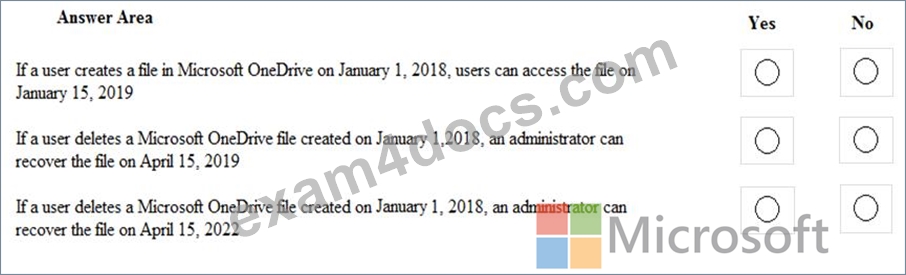
Answer:
Explanation:
Reference:
https://docs.microsoft.com/en-us/office365/securitycompliance/retention-policies?redirectSourcePath=%252fen-us%252farticle%252fOverview-of-retention-policies-5e377752-700d-4870-9b6d-12bfc12d2423#the-principles-of-retention-or-what-takes-precedence
NEW QUESTION 31
You have a Microsoft 365 subscription. You need to ensure that users can apply retention labels to individual documents in their Microsoft SharePoint libraries.
Which two actions should you perform? Each correct answer presents part of the solution.
NOTE: Each correct selection is worth one point.
- A. From the SharePoint admin center, modify the Site Settings.
- B. From the SharePoint admin center, modify the records management settings.
- C. From the Security admin center, publish a label.
- D. From the Security admin center, create a label.
- E. From the Cloud App Security admin center, create a file policy.
Answer: C,D
Explanation:
Explanation/Reference:
https://docs.microsoft.com/en-us/office365/securitycompliance/protect-sharepoint-online-files-with-office-365- labels-and-dlp
NEW QUESTION 32
You have a Microsoft 365 subscription.
You are creating a retention policy named Retention1 as shown in the following exhibit.
You apply Retention1 to SharePoint sites and OneDrive accounts.
Use the drop-down menus to select the answer choice that completes each statement based on the information presented in the graphic.
NOTE: Each correct selection is worth one point.
Answer:
Explanation:
NEW QUESTION 33
You have a Microsoft 365 subscription that has Enable Security defaults set to No in Azure Active Directory (Azure AD).
You have a custom compliance manager template named Regulation1.
You have the assessments shown in the following table.
Assessment1 has the improvement actions shown in the following table.
Assessment2 has the improvement actions shown in the following table.
You perform the following actions:
For Assessment2, change the Test status of Establish a threat intelligence program to Implemented.
Enable multi-factor authentication (MFA) for all users.
Configure a privileged access policy.
For each of the following statements, select Yes if the statement is true. Otherwise, select No.
NOTE: Each correct selection is worth one point.
Answer:
Explanation:
Reference:
https://docs.microsoft.com/en-us/microsoft-365/compliance/compliance-manager-setup?view=o365-worldwide
https://docs.microsoft.com/en-us/microsoft-365/compliance/compliance-manager-improvement-actions?view=o365-worldwide
NEW QUESTION 34
Note: This question is part of a series of questions that present the same scenario. Each question in the series contains a unique solution that might meet the stated goals. Some question sets might have more than one correct solution, while others might not have a correct solution.
After you answer a question in this section, you will NOT be able to return to it. As a result, these questions will not appear in the review screen.
You have a Microsoft 365 subscription that contains the users shown in the following table.
You discover that all the users in the subscription can access Compliance Manager reports.
The Compliance Manager Reader role is not assigned to any users.
You need to recommend a solution to prevent a user named User5 from accessing the Compliance Manager reports.
Solution: You recommend modifying the licenses assigned to User5.
Does this meet the goal?
- A. No
- B. Yes
Answer: A
Explanation:
Explanation/Reference:
Reference:
https://docs.microsoft.com/en-us/office365/securitycompliance/working-with-compliance-manager
NEW QUESTION 35
Please wait while the virtual machine loads. Once loaded, you may proceed to the lab section. This may take a few minutes, and the wait time will not be deducted from your overall test time.
When the Next button is available, click it to access the lab section. In this section, you will perform a set of tasks in a live environment. While most functionality will be available to you as it would be in a live environment, some functionality (e.g., copy and paste, ability to navigate to external websites) will not be possible by design.
Scoring is based on the outcome of performing the tasks stated in the lab. In other words, it doesn't matter how you accomplish the task, if you successfully perform it, you will earn credit for that task.
Labs are not timed separately, and this exam may more than one lab that you must complete. You can use as much time as you would like to complete each lab. But, you should manage your time appropriately to ensure that you are able to complete the lab(s) and all other sections of the exam in the time provided.
Please note that once you submit your work by clicking the Next button within a lab, you will NOT be able to return to the lab.
Username and password
Use the following login credentials as needed:
To enter your username, place your cursor in the Sign in box and click on the username below.
To enter your password, place your cursor in the Enter password box and click on the password below.
Microsoft 365 Username:
admin@[email protected]
Microsoft 365 Password: &=Q8v@2qGzYz
If the Microsoft 365 portal does not load successfully in the browser, press CTRL-K to reload the portal in a new browser tab.
The following information is for technical support only:
Lab instance: 11032396
You need to ensure that email messages in Exchange Online and documents in SharePoint Online are retained for eight years.
To complete this task, sign in to the Microsoft Office 365 admin center.
Answer:
Explanation:
See explanation below.
Explanation
NB: For our purposes, the retention period will be 8 years.
For retaining email messages in Exchange Online:
Step 1: Create a retention tag
1. Navigate to the Exchange Admin Center
2. Navigate to Compliance management +
3. Select one of the following options:
* Applied automatically to entire mailbox (default): Select this option to create a default policy tag (DPT). You can use DPTs to create a default deletion policy and a default archive policy, which applies to all items in the mailbox.
* Applied automatically to a specific folder: Select this option to create a retention policy tag (RPT) for a default folder such as Inbox or Deleted Items.
* Applied by users to items and folders (Personal): Select this option to create personal tags. These tags allow Outlook and Outlook on the web (formerly known as Outlook Web App) users to apply archive or deletion settings to a message or folders that are different from the settings applied to the parent folder or the entire mailbox.
4. The New retention tag page title and options will vary depending on the type of tag you selected. Complete the following fields:
* Name: Enter a name for the retention tag. The tag name is for display purposes and doesn't have any impact on the folder or item a tag is applied to. Consider that the personal tags you provision for users are available in Outlook and Outlook on the web.
* Apply this tag to the following default folder: This option is available only if you selected Applied automatically to a specific folder.
* Retention action: Select one of the following actions to be taken after the item reaches its retention period:
* Delete and Allow Recovery: Select this action to delete items but allow users to recover them using the Recover Deleted Items option in Outlook or Outlook on the web. Items are retained until the deleted item retention period configured for the mailbox database or the mailbox user is reached.
* Permanently Delete: Select this option to permanently delete the item from the mailbox database.
* Move to Archive: This action is available only if you're creating a DPT or a personal tag. Select this action to move items to the user's In-Place Archive.
* Retention period: Select one of the following options:
* Never: Select this option to specify that items should never be deleted or moved to the archive.
* When the item reaches the following age (in days): Select this option and specify the number of days to retain items before they're moved or deleted. The retention age for all supported items except Calendar and Tasks is calculated from the date an item is received or created. Retention age for Calendar and Tasks items is calculated from the end date.
* Comment: User this optional field to enter any administrative notes or comments. The field isn't displayed to users.
Step 2: Create a retention policy
1. Navigate to Compliance management Add +
2. In New Retention Policy, complete the following fields:
* Name: Enter a name for the retention policy.
* Retention tags: Click Add + to select the tags you want to add to this retention policy.
A retention policy can contain the following tags:
* One DPT with the Move to Archive action.
* One DPT with the Delete and Allow Recovery or Permanently Delete actions.
* One DPT for voice mail messages with the Delete and Allow Recovery or Permanently Delete actions.
* One RPT per default folder such as Inbox to delete items.
* Any number of personal tags.
Step 3: Apply a retention policy to mailbox users
After you create a retention policy, you must apply it to mailbox users. You can apply different retention policies to different set of users.
* Navigate to Recipients > Mailboxes.
* In the list view, use the Shift or Ctrl keys to select multiple mailboxes.
* In the details pane, click More options.
* Under Retention Policy, click Update.
* In Bulk Assign Retention Policy, select the retention policy you want to apply to the mailboxes, and then click Save.
For retaining documents in SharePoint Online
Access Security & Compliance Admin Center
1. Navigate to the Office 365 Admin Centers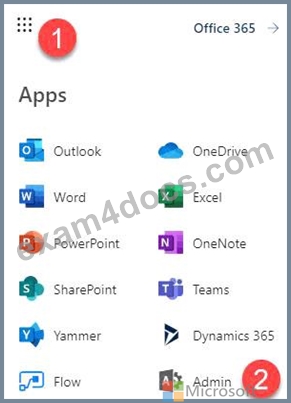
2. From the list of available Admin Centers, click on Security & Compliance
How to create and publish a Retention Policy on a SharePoint site
Now that we are in the Security & Compliance Admin Center, we are ready to create and publish a Retention Policy on a SharePoint site.Under
1. Hit Create button to create new Retention Policy
2. Give your policy a name and description.
3. On the next screen is where you set up the logic. You can configure how many days, months, or years to retain the content for, specify whether you want the math (retention period) to be calculated from the Created Date or Last Modified Date. Lastly, you can also specify whether you want to keep or delete content after the Retention period expires. Hit Next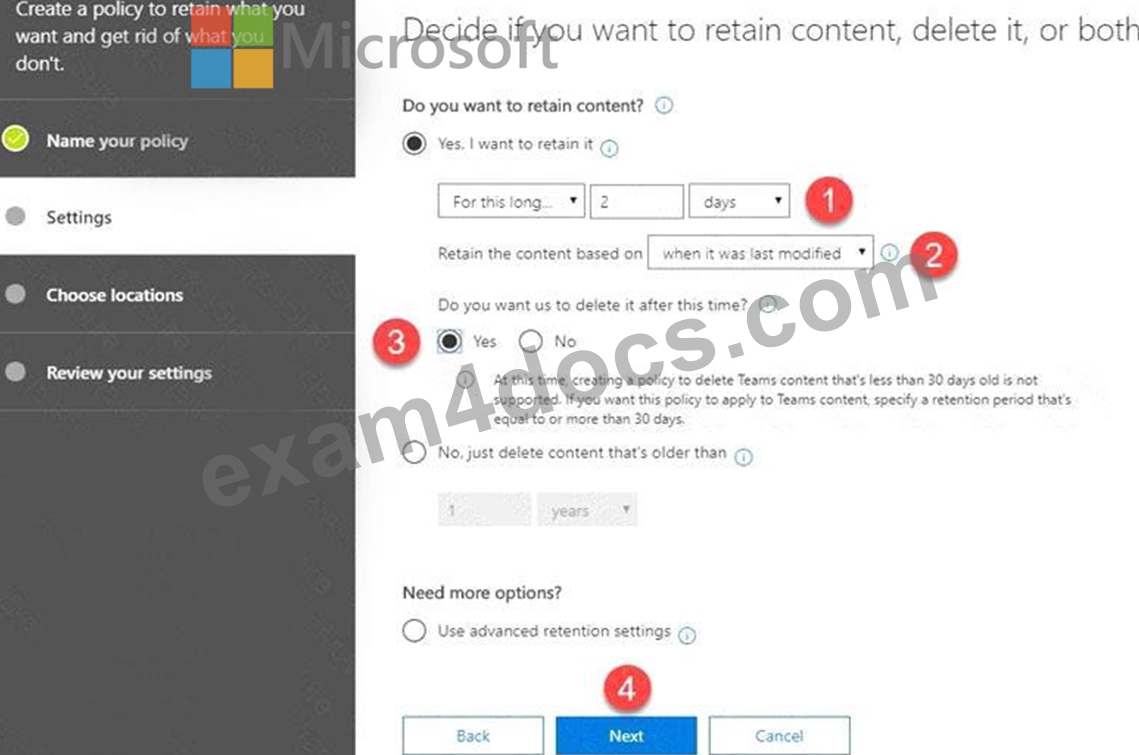
4. On the next screen, you get to choose where to apply the policy. You can apply it to email (Exchange), SharePoint sites, OneDrive accounts as well as Office 365 Groups.
5. In my case, I applied a policy to a single Office 365 Group Site
6. On a final screen, you need to review and confirm the settings and click Create this policy button. It is imperative to note the message you get to see at the bottom. It warns you that content might be deleted as soon as the policy takes effect according to the logic you set up in previous steps.
References:
https://docs.microsoft.com/en-us/exchange/security-and-compliance/messaging-records-management/create-a-re
https://docs.microsoft.com/en-us/exchange/security-and-compliance/messaging-records-management/apply-reten
https://sharepointmaven.com/how-to-set-a-retention-policy-on-a-sharepoint-site/
NEW QUESTION 36
You have a Microsoft 365 tenant.
User attributes are synced from your company's human resources (HR) system to Azure Active Directory (Azure AD).
The company has four departments that each has its own Microsoft SharePoint Online site. Each site must be accessed only by the users from its respective department.
You are designing an access management solution that has the following requirements:
Users must be added automatically to the security group of their department.
All security group owners must verify once quarterly that only the users in their department belong to their group.
Which components should you recommend to meet the requirements? To answer, drag the appropriate components to the correct requirements. Each component may only be used once, more than once, or not at all. You may need to drag the split bar between panes or scroll to view content.
NOTE: Each correct selection is worth one point.
Answer:
Explanation:
Reference:
https://cloudbuild.co.uk/tag/create-a-dynamic-security-group-in-azure-ad/
https://docs.microsoft.com/en-us/azure/active-directory/governance/access-reviews-overview
NEW QUESTION 37
You have a Microsoft 365 subscription.
A security manager receives an email message every time a data loss prevention (DLP) policy match occurs.
You need to limit alert notifications to actionable DLP events.
What should you do?
- A. From the Security & Compliance admin center, modify the matched activities threshold of an alert policy.
- B. From the Security & Compliance admin center, modify the Policy Tips of a DLP policy.
- C. From the Security & Compliance admin center, modify the User overrides settings of a DLP policy.
- D. From the Cloud App Security admin center, apply a filter to the alerts.
Answer: A
Explanation:
References:
https://docs.microsoft.com/en-us/office365/securitycompliance/alert-policies
NEW QUESTION 38
You view Compliance Manager as shown in the following exhibit.
Use the drop-down menus to select the answer choice that completes each statement based on the information presented in the graphic.
NOTE: Each correct selection is worth one point.
Answer:
Explanation:
Reference:
https://docs.microsoft.com/en-us/office365/securitycompliance/meet-data-protection-and-regulatory-reqs-using-microsoft-cloud
NEW QUESTION 39
Please wait while the virtual machine loads. Once loaded, you may proceed to the lab section. This may take a few minutes, and the wait time will not be deducted from your overall test time.
When the Next button is available, click it to access the lab section. In this section, you will perform a set of tasks in a live environment. While most functionality will be available to you as it would be in a live environment, some functionality (e.g., copy and paste, ability to navigate to external websites) willnot be possible by design.
Scoring is based on the outcome of performing the tasks stated in the lab. In other words, it doesn't matter how you accomplish the task, if you successfully perform it, you will earn credit for that task.
Labs are nottimed separately, and this exam may more than one lab that you must complete. You can use as much time as you would like to complete each lab. But, you should manage your time appropriately to ensure that you are able to complete the lab(s) and all other sections of the exam in the time provided.
Please note that once you submit your work by clicking the Next button within a lab, you will NOT be able to return to the lab.
Username and password
Use the following login credentials as needed:
To enteryour username, place your cursor in the Sign in box and click on the username below.
To enter your password, place your cursor in the Enter password box and click on the password below.
Microsoft 365 Username:
admin@[email protected]
Microsoft365 Password:#HSP.ug?$p6un
If the Microsoft 365 portal does not load successfully in the browser, press CTRL-K to reload the portal in a new browser tab.
The following information is for technical support only:
Lab instance:11122308


You need to ensure that all the email messages in the mailbox of a user named Allan Deyoung are retained for a period of 90 days, even if the messages are deleted.
To complete this task, sign in to the Microsoft 365 admin center.
Answer:
Explanation:
See explanation below.
Explanation
1. Navigate to theExchange Admin Center
2. Navigate toCompliance management>Retention tags, and then clickAdd+
3. Select theApplied automatically to entire mailbox (default)option.
4. TheNew retention tagpage title and options will vary depending on the type of tag you selected. Complete the following fields:
Name: Enter a name for the retention tag.
Retention action: SelectDelete and Allow Recoveryoption.
Retention period: SelectWhen the item reachesthe following age (in days)option.
Comment: User this optional field to enter any administrative notes or comments. The field isn't displayed to users.
5. Navigate toCompliance management>Retention policies, and then clickAdd+
6. InNew Retention Policy, complete the following fields:
Name: Enter a name for the retention policy.
Retention tags: ClickAdd+to select the tags you want to add to this retention policy.
After you create a retention policy, you must apply it.
1. Navigate toRecipients>Mailboxes
2. In the list view, select the mailbox to which you want to apply the retention policy, and then clickEdit.
3. InUser Mailbox, clickMailbox features
4. In theRetention policylist, select the policy you want to apply to the mailbox, and then clickSave.
Reference:
https://docs.microsoft.com/en-us/exchange/security-and-compliance/messaging-records-management/create-a-r
https://docs.microsoft.com/en-us/exchange/security-and-compliance/messaging-records-management/apply-rete
NEW QUESTION 40
You have a Microsoft 365 subscription.
You create a retention label named Label1 as shown in the following exhibit.
You publish Label1 to SharePoint sites.
Use the drop-down menus to select the answer choice that completes each statement based on the information presented in the graphic.
NOTE: Each correct selection is worth one point.
Answer:
Explanation:
Explanation
References:
https://docs.microsoft.com/en-us/office365/securitycompliance/labels
NEW QUESTION 41
You need to recommend an email malware solution that meets the security requirements.
What should you include in the recommendation? To answer, select the appropriate options in the answer area.
NOTE: Each correct selection is worth one point.
Answer:
Explanation:
NEW QUESTION 42
You have a Microsoft 365 subscription that uses a default domain name of contoso.com.
The multi-factor authentication (MFA) service settings are configured as shown in the exhibit. (Clock the Exhibit tab.)
In contoso.com, you create the users shown in the following table.
What is the effect of the configuration? To answer, select the appropriate options in the answer area.
NOTE: Each correct selection is worth one point.
Answer:
Explanation:
Explanation
NEW QUESTION 43
Your network contains an on-premises Active Directory domain. The domain contains servers that run Windows Server and have advanced auditing enabled.
The security logs of the servers are collected by using a third-party SIEM solution.
You purchase a Microsoft 365 subscription and plan to deploy Azure Advanced Threat Protection (ATP) by using standalone sensors.
You need to ensure that you can detect when sensitive groups are modified and when malicious services are created.
What should you do?
- A. Integrate SIEM and Azure ATP.
- B. Turn off Delayed updates for the Azure ATP sensors.
- C. Configure auditing in the Office 365 Security & Compliance center.
- D. Turn on Delayed updates for the Azure ATP sensors.
Answer: A
Explanation:
Note:
There are several versions of this question in the exam. The questions in the exam have two different correct answers:
1. Integrate SIEM and Azure ATP.
2. Configure Event Forwarding on the domain controllers
Other incorrect answer options you may see on the exam include the following:
1. Configure Azure ATP notifications
2. Modify the Domain synchronizer candidate settings on the Azure ATP sensors
3. Enable the Audit account management Group Policy setting for the servers.
Reference:
https://docs.microsoft.com/en-us/azure-advanced-threat-protection/configure-event-forwarding
NEW QUESTION 44
You have a Microsoft 365 E5 subscription.
Users and device objects are added and removed daily. Users in the sales department frequently change their device.
You need to create three following groups:
The solution must minimize administrative effort.
What is the minimum number of groups you should create for each type of membership? To answer, select the appropriate options in the answer area.
NOTE: Each correct selection is worth one point.
Answer:
Explanation:
References:
https://github.com/MicrosoftDocs/azure-docs/blob/master/articles/active-directory/users-groups-roles/groups-dynamic-membership.md
NEW QUESTION 45
......
MS-500 Dumps PDF - Want To Pass MS-500 Fast: https://www.exam4docs.com/MS-500-study-questions.html
MS-500 Practice Exam Dumps Exam: https://drive.google.com/open?id=1AHLRZqJT6DbXH1cMtXb8mWN5GCD_LuHL
