

Get Perfect Results with Premium 300-410 Dumps Updated 530 Questions
Free 300-410 Exam Study Guide for the NEW Dumps Test Engine
Cisco 300-410 exam is a challenging test that requires thorough preparation and understanding of the concepts. Cisco offers a range of resources to help candidates prepare, including online courses, study materials, and practice exams. Candidates can also participate in the Cisco Learning Network community to connect with other professionals and gain insights from experts.
Earning the Cisco Certified Specialist - Enterprise Advanced Infrastructure Implementation certification can be a valuable addition to an IT professional's resume, as it demonstrates their expertise in advanced routing technologies and services. In addition to validating their skills and knowledge, this certification can also help professionals advance their careers and pursue new opportunities in enterprise networking and infrastructure implementation.
NEW QUESTION # 27
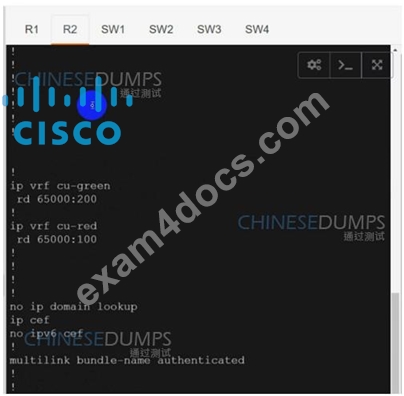
Configure individual VRFs for each customer according to the topology to achieve these goals :

R1


R2


SW1


SW2


SW3


Answer:
Explanation:
Solution:
Use cu-red under interfaces facing SW1 & SW3:
On R1:
interface Ethernet0/0
ip vrf forwarding cu-red
ip address 192.168.1.254 255.255.255.0
Check reachability to SW1:
R1#ping vrf cu-red 192.168.1.1
Type escape sequence to abort.
Sending 5, 100-byte ICMP Echos to 192.168.2.1, timeout is 2 seconds:
!!!!!
Success rate is 100 percent (5/5), round-trip min/avg/max = 1/1/1 ms
On R2:
interface Ethernet0/0
ip vrf forwarding cu-red
ip address 192.168.2.254 255.255.255.0
Check reachability to SW3:
R2#ping vrf cu-red 192.168.2.1
Type escape sequence to abort.
Sending 5, 100-byte ICMP Echos to 192.168.1.1, timeout is 2 seconds:
!!!!!
Use vrf cu-green for SW2 & SW4:
On R1:
interface Ethernet0/1
ip vrf forwarding cu-green
ip address 192.168.20.254 255.255.255.0
Test reachability to SW2:
R1#ping vrf cu-green 192.168.20.1
Type escape sequence to abort.
Sending 5, 100-byte ICMP Echos to 192.168.22.1, timeout is 2 seconds:
!!!!!
Success rate is 100 percent (5/5), round-trip min/avg/max = 1/1/1 ms
On R2:
interface Ethernet0/1
ip vrf forwarding cu-green
ip address 192.168.22.254 255.255.255.0
Test reachability to SW4:
R2#ping vrf cu-green 192.168.22.1
Type escape sequence to abort.
Sending 5, 100-byte ICMP Echos to 192.168.20.1, timeout is 2 seconds:
!!!!!
Success rate is 100 percent (5/5), round-trip min/avg/max = 1/1/1 ms
On R1:
interface Ethernet0/2.100
mpls ip
!
interface Ethernet0/2.200
mpls ip
!
Configure BGP:
router bgp 65000
neighbor 10.10.10.2 remote-as 65000
neighbor 10.10.20.2 remote-as 65000
!
address-family vpnv4
neighbor 10.10.10.2 activate
neighbor 10.10.20.2 activate
exit-address-family
!
address-family ipv4 vrf cu-green
redistribute connected
exit-address-family
!
address-family ipv4 vrf cu-red
redistribute connected
exit-address-family
!
R1(config)#ip vrf cu-red
R1(config-vrf)#route-target both 65000:100
!
R1(config)#ip vrf cu-green
R1(config-vrf)#route-target both 65000:200
On R2:
interface Ethernet0/2.100
mpls ip
!
interface Ethernet0/2.200
mpls ip
!
router bgp 65000
neighbor 10.10.10.1 remote-as 65000
neighbor 10.10.20.1 remote-as 65000
!
address-family vpnv4
neighbor 10.10.10.1 activate
neighbor 10.10.20.1 activate
exit-address-family
!
address-family ipv4 vrf cu-green
redistribute connected
exit-address-family
!
address-family ipv4 vrf cu-red
redistribute connected
exit-address-family
R2(config)#ip vrf cu-red
R2(config-vrf)#route-target both 65000:100
!
R2(config)#ip vrf cu-green
R2(config-vrf)#route-target both 65000:200
Verification:
From SW1 to SW3:
SW1#ping 192.168.1.1
Type escape sequence to abort.
Sending 5, 100-byte ICMP Echos to 192.168.1.1, timeout is 2 seconds:
!!!!!
Success rate is 100 percent (5/5), round-trip min/avg/max = 1/1/1 ms
But can't Reach SW2 or SW4 in VRF cu-green:
SW1#ping 192.168.22.1
Type escape sequence to abort.
Sending 5, 100-byte ICMP Echos to 192.168.22.1, timeout is 2 seconds:
U. U.U
Success rate is 0 percent (0/5)
SW1#ping 192.168.20.1
Type escape sequence to abort.
Sending 5, 100-byte ICMP Echos to 192.168.20.1, timeout is 2 seconds:
U. U.U
Success rate is 0 percent (0/5)
Same Test for SW2:
From SW2 to SW4:
SW2#ping 192.168.20.1
Type escape sequence to abort.
Sending 5, 100-byte ICMP Echos to 192.168.20.1, timeout is 2 seconds:
!!!!!
Success rate is 100 percent (5/5), round-trip min/avg/max = 1/1/1 ms
But can't Reach SW3 or SW1 in VRF cu-red:
SW2#ping 192.168.1.1
Type escape sequence to abort.
Sending 5, 100-byte ICMP Echos to 192.168.1.1, timeout is 2 seconds:
U. U.U
Success rate is 0 percent (0/5)
SW2#ping 192.168.2.1
Type escape sequence to abort.
Sending 5, 100-byte ICMP Echos to 192.168.2.1, timeout is 2 seconds:
U. U.U
Success rate is 0 percent (0/5)
Both R1 & R2 has separate tables for VRFs cu-red and cu-green.
NEW QUESTION # 28 
Refer to the exhibit. an engineer is trying to get 192.168.32.100 forwarded through 10.1.1.1, but it was forwarded through 10.1.1.2. What action forwards the packets through 10.1.1.1?
- A. Configure EIGRP to receive 192.168.32.0 route with lower admin distance.
- B. Configure EIGRP to receive 192.168.32.0 route with lower metric.
- C. Configure EIGRP to receive 192.168.32.0 route with equal or longer prefix than /24.
- D. Configure EIGRP to receive 192.168.32.0 route with longer prefix than /19.
Answer: C
NEW QUESTION # 29
Refer to the exhibit.
A router receiving BGP routing updates from multiple neighbors for routers in AS 690. What is the reason that the router still sends traffic that is destined to AS 690 to a neighbor other than 10.222.1.1?
- A. The local preference value in another neighbor statement is higher than 250.
- B. The weight value in another neighbor statement is higher than 200.
- C. The route map is applied in the wrong direction.
- D. The local preference value should be set to the same value as the weight in the route map.
Answer: C
NEW QUESTION # 30
Refer to the exhibit.
A network administrator configured an IPv6 access list to allow TCP return frame only, but it is not working as expected. Which changes resolve this issue?
- A. Option D
- B. Option B
- C. Option C
- D. Option A
Answer: C
Explanation:
Explanation
https://www.cisco.com/c/en/us/td/docs/switches/lan/catalyst3750/software/release/122_55_se/configuration/guid
NEW QUESTION # 31
Drag and drop the LDP features from the left onto the descriptions on the right
Answer:
Explanation:
Reference:
https://www.cisco.com/c/en/us/td/docs/ios-xml/ios/mp_ldp/configuration/15-sy/mp-ldp-15-sy-boo
NEW QUESTION # 32
How is VPN routing information distributed in an MPLS network?
- A. It is controlled through the use of RD.
- B. It is controlled using of VPN target communities.
- C. It is established using VPN IPsec peers.
- D. The top level of the customer data packet directs it to the correct CE device
Answer: B
NEW QUESTION # 33
Refer to the exhibit.
A network is under a cyberattack. A network engineer connected to R1 by SSH and enabled the terminal monitor via SSH session to find the source and destination of the attack. The session was flooded with messages, which made it impossible for the engineer to troubleshoot the issue. Which command resolves this issue on R1?
- A. (config)#terminal no monitor
- B. (config)#no terminal monitor
- C. no terminal monitor
- D. #terminal no monitor
Answer: D
NEW QUESTION # 34
Refer to the exhibit.
A user cannot SSH to the router. What action must be taken to resolve this issue?
- A. Configure transport input ssh
- B. Configure transport output ssh
- C. Configure ip ssh version 2
- D. Configure ip ssh source-interface loopback0
Answer: A
Explanation:
https://www.cisco.com/c/en/us/td/docs/switches/lan/catalyst2960x/software/15-0_2_EX/security/configuration_guide/b_sec_152ex_2960-x_cg/b_sec_152ex_2960-x_cg_chapter_01001.html
NEW QUESTION # 35
Refer to the exhibits.
Phase-3 tunnels cannot be established between spoke-to-spoke in DMVPN. Which two commands are missing? (Choose two.)
- A. The ip nhrp redirect command is missing on the spoke routers.
- B. The ip nhrp command is missing on the hub router.
- C. The ip redirect commands is missing on the hub router.
- D. The ip shortcut commands is missing on the hub router.
- E. The ip nhrp shortcut command is missing on the spoke routers.
Answer: C,E
NEW QUESTION # 36
Refer to the exhibit.
An IP SLA was configured on router R1 that allows the default route to be modified in the event that Fa0/0 loses reachability with the router R3 Fa0/0 interface. The route has changed to flow through router R2. Which debug command is used to troubleshoot this issue?
- A. debug ip sla error
- B. debug ip packet
- C. debug ip routing
- D. debug ip flow
Answer: C
Explanation:
Explanation
debug ip routing This command enables debugging messages related to the routing table.
NEW QUESTION # 37
How is a preshared key "Test'' for all the remote VPN rooters configured In a DMVPN using GRE over IPsec set up?
- A. authentication pre-share Test address 0.0.0.0 0.0.0.0
- B. crypto Ipsec key Test address 0.0.0.0 0.0.0.0
- C. set pre-share Test address 0.0.0.0 0.0.0.0
- D. crypto isakmp key Test address 0.0.0.0 0.0.0.0
Answer: D
NEW QUESTION # 38
Refer to the exhibit.
When the FastEthemet0/1 goes down, the route to 172.29.0 0/16 via 192.168.253 2 is not installed in the RIB. Which action resolves the issue?
- A. Configure feasible distance greater than the successor's feasible distance.
- B. Configure feasible distance greater than the reported distance
- C. Configure reported distance greater than the feasible distance
- D. Configure reported distance greater than the successor's feasible distance.
Answer: B
Explanation:
From the exhibit, we notice network 172.29.0.0/16 was learned via two routes:
+ From 192.168.254.2 with FD = 307200 and AD = 281600
+ From 192.168.253.2 with FD = 410200 and AD = 352300
The first route is installed into the RIB as the successor route because of lower FD.
When the first route fails, router will not use the second route as it does not satisfy the feasibility condition. The feasibility condition states that, the Advertised Distance (AD, also called the reported distance) of a route must be lower than the feasible distance of the current successor route.
NEW QUESTION # 39
Drag and drop the packet types from the left onto the correct descriptions on the right.
Answer:
Explanation:
Explanation
Unlike legacy network technologies such as ISDN, Frame Relay, and ATM that defined separate data and control channels, IP carries all packets within a single pipe. Thus, IP network devices such as routers and switches must be able to distinguish between data plane, control plane, and management plane packets to treat each packet appropriately.From an IP traffic plane perspective, packets may be divided into four distinct, logical groups:1. Data plane packets - End-station, user-generated packets that are always forwarded by network devices to other end-station devices. From the perspective of the network device, data plane packets always have a transit destination IP address and can be handled by normal, destination IP address-based forwarding processes.2. Control plane packets - Network device generated or received packets that are used for the creation and operation of the network itself. From the perspective of the network device, control plane packets always have a receive destination IP address and are handled by the CPU in the network device route processor. Examples include protocols such as ARP, BGP, OSPF, and other protocols that glue the network together.3. Management plane packets - Network device generated or received packets, or management station generated or received packets that are used to manage the network. From the perspective of the network device, management plane packets always have a receive destination IP address and are handled by the CPU in the network device route processor. Examples include protocols such as Telnet, Secure Shell (SSH), TFTP, SNMP, FTP, NTP, and other protocols used to manage the device and/or network.4. Services plane packets - A special case of data plane packets, services plane packets are also user-generated packets that are also forwarded by network devices to other end-station devices, but that require high-touch handling by the network device (above and beyond normal, destination IP address-based forwarding) to forward the packet. Examples of high-touch handling include such functions as GRE encapsulation, QoS, MPLS VPNs, and SSL/IPsec encryption/decryption, etc. From the perspective of the network device, services plane packets may have a transit destination IP address, or may have a receive destination IP address (for example, in the case of a VPN tunnel endpoint).
NEW QUESTION # 40
Refer to the exhibit.
Refer to the exhibit. An engineer noticed that the router log messages do not have any information about when the event occurred. Which action should the engineer take when enabling service time stamps to improve the logging functionality at a granular level?
- A. Configure the tog uptime option
- B. Configure the msec option
- C. Configure the debug uptime option
- D. Configure the timezone option
Answer: A
NEW QUESTION # 41
Refer to the exhibit.
The R1 and R2 configurations are:
The neighbor is not coming up. Which two sets of configurations bring the neighbors up? (Choose two.)
- A. R2
ip route 10.1.1.2 255.255.255.255 192.168.1.2
router bgp 100neighbor 10.1.1.2 ttl-security hops 1
neighbor 10.1.1.2 update-source loopback 0 - B. R1
ip route 10.1.1.2 255.255.255.255 192.168.1.2
router bgp 100
neighbor 10.1.1.2 disable-connected-check
neighbor 10.1.1.2 update-source Loopback0 - C. R2
ip route 10.1.1.1 255.255.255.255 192.168.1.1
router bgp 200
neighbor 10.1.1.1 tti-security hops 1
neighbor 10.1.1.1 update-source loopback 0 - D. R2
ip route 10.1.1.1 255.255.255.255 192.168.1.1
router bgp 200
neighbor 10.1.1.1 disable-connected-check
neighbor 10.1.1.1 update-source loopback 0 - E. R1
ip route 10.1.1.2 255.255.255.255 192.168.1.2
router bgp 100
neighbor 10.1.1.1 ttl-security hops 1
neighbor 10.1.1.2 update-source loopback 0
Answer: B,D
Explanation:
NEW QUESTION # 42
Which IGPs are supported by the MPLS LDP autoconfiguration feature?
- A. ISIS and RIPv2
- B. OSPF and EIGRP
- C. OSPF and ISIS
- D. RIPv2 and OSPF
Answer: C
Explanation:
NEW QUESTION # 43
Drag and drop the packet types from the left onto the correct descriptions on the right.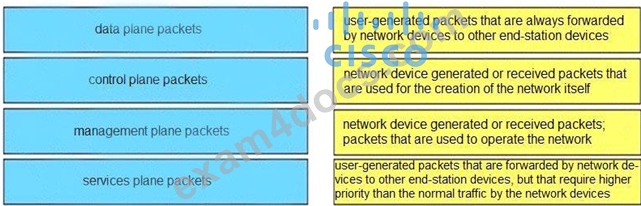
Answer:
Explanation:
Explanation
Unlike legacy network technologies such as ISDN, Frame Relay, and ATM that defined separate data and control channels, IP carries all packets within a single pipe. Thus, IP network devices such as routers and switches must be able to distinguish between data plane, control plane, and management plane packets to treat each packet appropriately.From an IP traffic plane perspective, packets may be divided into four distinct, logical groups:1. Data plane packets - End-station, user-generated packets that are always forwarded by network devices to other end-station devices. From the perspective of the network device, data plane packets always have a transit destination IP address and can be handled by normal, destination IP address-based forwarding processes.2. Control plane packets - Network device generated or received packets that are used for the creation and operation of the network itself. From the perspective of the network device, control plane packets always have a receive destination IP address and are handled by the CPU in the network device route processor. Examples include protocols such as ARP, BGP, OSPF, and other protocols that glue the network together.3. Management plane packets - Network device generated or received packets, or management station generated or received packets that are used to manage the network. From the perspective of the network device, management plane packets always have a receive destination IP address and are handled by the CPU in the network device route processor. Examples include protocols such as Telnet, Secure Shell (SSH), TFTP, SNMP, FTP, NTP, and other protocols used to manage the device and/or network.4. Services plane packets - A special case of data plane packets, services plane packets are also user-generated packets that are also forwarded by network devices to other end-station devices, but that require high-touch handling by the network device (above and beyond normal, destination IP address-based forwarding) to forward the packet. Examples of high-touch handling include such functions as GRE encapsulation, QoS, MPLS VPNs, and SSL/IPsec encryption/decryption, etc. From the perspective of the network device, services plane packets may have a transit destination IP address, or may have a receive destination IP address (for example, in the case of a VPN tunnel endpoint).
NEW QUESTION # 44
Which option is the best for protecting CPU utilization on a device?
- A. ICMP redirects
- B. fragmentation
- C. ICMP unreachable messages
- D. COPP
Answer: D
NEW QUESTION # 45
Refer to the exhibit.
A network administrator configured mutual redistribution on R1 and R2 routers, which caused instability in the network. Which action resolves the issue?
- A. Apply a prefix list of EIGRP network routes in OSPF domain on R1 to propagate back into the EIGRP routing domain.
- B. Set a tag in the route map when redistributing EIGRP into OSPF on R1, and match the same tag on R2 to deny when redistributing OSPF into EIGRP.
- C. Advertise summary routes of EIGRP to OSPF and deny specific EIGRP routes when redistributing into OSPF.
- D. Set a tag in the route map when redistributing EIGRP into OSPF on R1. and match the same tag on R2 to allow when redistributing OSPF into EIGRP.
Answer: B
Explanation:
https://www.cisco.com/c/en/us/support/docs/ip/enhanced-interior-gateway-routing-protocol-eigrp/8606-redist.html
NEW QUESTION # 46
An engineer is troubleshooting on the console session of a router and turns on multiple debug commands. The console screen is filled with scrolling debug messages that none of the commands can be verified if entered correctly or display any output. Which action allows the engineer to see entered console commands while still continuing the analysis of the debug messages?
- A. Configure the logging synchronous command
- B. Configure the term no mon command globally
- C. Configure the logging synchronous level all command
- D. Configure the no logging console debugging command globally
Answer: A
Explanation:
Let's see how the "logging synchronous" command affect the typing command:
Without this command, a message may pop up and you may not know what you typed if that message is too long. When trying to erase (backspace) your command, you realize you are erasing the message instead.
With this command enabled, when a message pops up you will be put to a new line with your typing command which is very
NEW QUESTION # 47
Refer to the exhibit.
After redistribution is enabled between the routing protocols, PC2, PC3, and PC4 cannot reach PC1. Which action can be engineer take to solve the issue so that all the PCs are reachable?
- A. Filter the prefix 10.1.1.0/24 when redistributed from OSPF to EIGRP.
- B. Redistribute the directly connected interfaces on R2.
- C. Filter the prefix 10.1.1.0/24 when redistributed from RIP to EIGRP.
- D. Set the administrative distance 100 under the process on R2.
Answer: B
NEW QUESTION # 48
Refer to the exhibit.
A loop occurs between R1, R2, and R3 while EIGRP is run with poison reverse enabled. Which action prevents the loop between R1, R2, and R3?
- A. Configure R2 as stub receive-only
- B. Enable split horizon
- C. Configure route tagging
- D. Configure route filtering
Answer: B
NEW QUESTION # 49
Drag and drop the MPLS VPN device types from the left onto the definitions on the right.
Answer:
Explanation:
NEW QUESTION # 50
......
Cisco 300-410 exam, also known as Implementing Cisco Enterprise Advanced Routing and Services, is a certification exam that validates the knowledge and skills of candidates in implementing and managing advanced routing technologies and services in enterprise networks. 300-410 exam is designed to test the ability of candidates to configure, troubleshoot, and optimize complex enterprise network infrastructures. It is one of the most popular certification exams offered by Cisco and is highly valued in the industry.
300-410 PDF Dumps Extremely Quick Way Of Preparation: https://www.exam4docs.com/300-410-study-questions.html
Download 300-410 Dumps (2023) - Free PDF Exam Demo: https://drive.google.com/open?id=1wVlH35TAghHWbKDLHEzOL0HpbIl3LmsG
