

300-730 Pre-Exam Practice Tests | (Updated 177 Questions)
Valid 300-730 Exam Q&A PDF - One Year Free Update
CCNP Security Certificate
As stated above, the Cisco 300-730 exam is a partial requirement for the CCNP Security certification. Moreover, getting a passing score in 300-730 exam will get you a step closer to earning the Network Security VPN Implementation designation. The CCNP Security certification, in particular, is a professional-level validation that focuses on validating the candidate's skill in security solutions. This means the interested candidate needs to have expertise in securing networks, configuring Cisco identity services engine, securing web with Cisco web security appliance, etc. Earning the CCNP Security certification will allow the learner to get professional-level jobs in the field of security technologies. Besides test 300-730, candidates will also need to ace the mandatory exam coded 350-701 to fully obtain the CCNP Security qualification.
Preparation Phase
Numerous resources are available to the applicants who are looking to ace the Cisco 300-730 exam. The specialists can find both the official training materials and various learning tools by other reputable platforms to help them to achieve success in the test. To get started with their preparation phase, the students can check the official training course: Implementing Secure Solutions with Virtual Private Networks. It explores the steps involved in setting, implementing, supporting, and monitoring enterprise VPN solutions. It combines practical experiences and instructor-led lessons to equip the learners with the knowledge and skills that are required for troubleshooting and deploying IPsec, DMVPN, remote access VPN, and FLexVPN for creating encrypted and secure data increased privacy and remote accessibility. After completing this training option, the individuals will get 40 CE credits toward recertification.
NEW QUESTION # 25
Which two statements about the Cisco ASA Clientless SSL VPN solution are true? (Choose two.)
- A. The rewriter enable command under the global webvpn configuration enables the rewriter functionality because that feature is disabled by default.
- B. Clientless SSLVPN provides Layer 3 connectivity into the secured network.
- C. When a client connects to the Cisco ASA WebVPN portal and tries to access HTTP resources through the URL bar, the client uses the local DNS to perform FQDN resolution.
- D. When a client connects to the Cisco ASA WebVPN portal and tries to access HTTP resources through the URL bar, the ASA uses its configured DNS servers to perform FQDN resolution.
- E. A Cisco ASA can simultaneously allow Clientless SSL VPN sessions and AnyConnect client sessions.
Answer: D,E
Explanation:
https://www.cisco.com/c/en/us/td/docs/security/asa/asa72/configuration/guide/conf_gd/webvpn.html
NEW QUESTION # 26
Which redundancy protocol must be implemented for IPsec stateless failover to work?
- A. VRRP
- B. SSO
- C. HSRP
- D. GLBP
Answer: C
NEW QUESTION # 27
What are two differences between ECC and RSA? (Choose two.)
- A. Key generation in ECC is slower and more CPU intensive than RSA.
- B. ECC cannot have the same security as RSA, even with an increased key size.
- C. Key generation in ECC is faster and less CPU intensive than RSA.
- D. ECC can have the same security as RSA but with a shorter key size.
- E. ECC lags in performance when compared with RSA.
Answer: C,D
NEW QUESTION # 28
Which two features are valid backup options for an IOS FlexVPN client? (Choose two.)
- A. tunnel pivot
- B. reactivate primary peer
- C. DNS-based hub resolution
- D. need distractor
- E. HSRP stateless failover
Answer: B,C
NEW QUESTION # 29
Which requirement is needed to use local authentication for Cisco AnyConnect Secure Mobility Clients that connect to a FlexVPN server?
- A. use of certificates instead of username and password
- B. EAP query-identity
- C. EAP-AnyConnect
- D. AnyConnect profile
Answer: D
Explanation:
Section: Remote access VPNs
Explanation
Explanation/Reference: https://www.cisco.com/c/en/us/support/docs/security/flexvpn/200555-FlexVPN-AnyConnect-IKEv2- Remote-Access.html
NEW QUESTION # 30
Which two commands help determine why the NHRP registration process is not being completed even after the IPsec tunnel is up? (Choose two.)
- A. show crypto ipsec sa
- B. show dmvpn detail
- C. show ip nhrp traffic
- D. show ip traffic
- E. show crypto isakmp sa
Answer: C,E
NEW QUESTION # 31
What are two functions of ECDH and ECDSA? (Choose two.)
- A. key exchange
- B. encryption
- C. revocation
- D. nonrepudiation
- E. digital signature
Answer: A,E
NEW QUESTION # 32
What is a requirement for smart tunnels to function properly?
- A. Stateful failover must not be configured.
- B. The user on the client machine must have admin access.
- C. Java or ActiveX must be enabled on the client machine.
- D. Applications must be UDP.
Answer: C
Explanation:
Section: Secure Communications Architectures
Explanation/Reference: https://www.cisco.com/c/en/us/support/docs/security/asa-5500-x-series-next-generation- firewalls/111007-smart-tunnel-asa-00.html
NEW QUESTION # 33
A Cisco AnyConnect client establishes a SSL VPN connection with an ASA at the corporate office. An engineer must ensure that the client computer meets the enterprise security policy. Which feature can update the client to meet an enterprise security policy?
- A. Advanced Endpoint Assessment
- B. Endpoint Assessment
- C. Cisco Secure Desktop
- D. Basic Host Scan
Answer: A
NEW QUESTION # 34
A router is being configured for IKEv2 AnyConnect using AnyConnect-EAP. How would the administrator separate profiles for administrators and employees so that authorization differs when they connect?
- A. Define key-ids on the headend and create two XML profiles to match the administrator and user key-ids.
- B. Define group aliases on the headend and have the user pick the appropriate alias when they connect
- C. Define group-urls on the headend and create two XML profiles to match the administrator and user group urls
- D. Create a certificate map and match on the appropriate certificate fields
Answer: B
Explanation:
When configuring IKEv2 AnyConnect using AnyConnect-EAP, the administrator can define group aliases on the headend and have the user pick the appropriate alias when they connect. This allows the administrator to separate profiles for administrators and employees so that authorization differs when they connect.
NEW QUESTION # 35
Refer to the exhibit.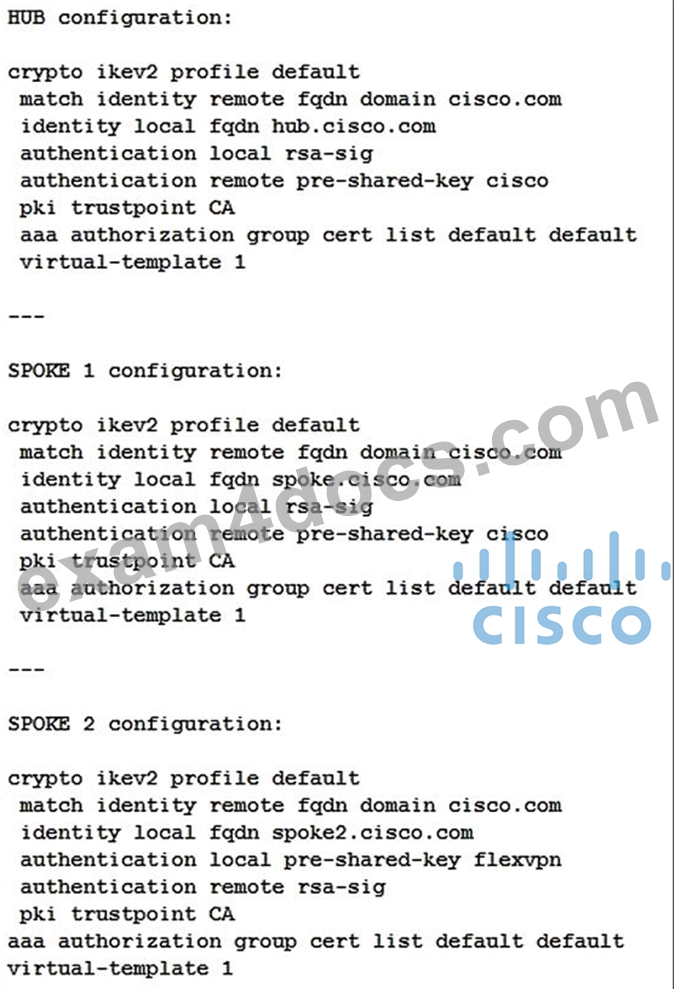
What is a result of this configuration?
- A. Spoke 2 passes the authentication to the hub and successfully proceeds to phase 2.
- B. Spoke 1 fails the authentication because the authentication methods are incorrect.
- C. Spoke 2 fails the authentication because the remote authentication method is incorrect.
- D. Spoke 1 passes the authentication to the hub and successfully proceeds to phase 2.
Answer: B
NEW QUESTION # 36
The corporate network security policy requires that all internet and network traffic must be tunneled to the corporate office. Remote workers have been provided with printers to use locally at home while they are remotely connected to the corporate network. Which two steps must be executed to allow printing to the local printers? (Choose two.)
- A. Check the Allow Local LAN access checkbox in the Cisco AnyConnect client.
- B. Configure the split-tunnel-policy on the Cisco ASA to tunnelall.
- C. Add a persistent static route in the client OS for the local LAN network.
- D. Configure the split-tunnel-policy on the Cisco ASA to excludespecified.
- E. Configure the split-tunnel-policy on the Cisco ASA to tunnelspecified.
Answer: A,D
Explanation:
https://www.cisco.com/c/en/us/support/docs/security/asa-5500-x-series-next-generation-firewalls/70847-local-lan-pix-asa.html
NEW QUESTION # 37
Refer to the exhibit.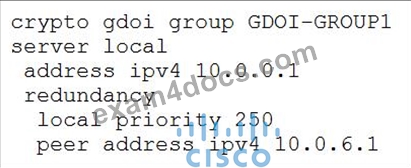
Which type of VPN is being configured, based on the partial configuration snippet?
- A. GET VPN with dual group member
- B. FlexVPN backup gateway
- C. FlexVPN load balancer
- D. GET VPN with COOP key server
Answer: D
NEW QUESTION # 38
A network engineer must expand a company's Cisco AnyConnect solution. Currently, a Cisco ASA is set up in North America and another will be installed in Europe with a different IP address. Users should connect to the ASA that has the lowest Round Trip Time from their network location as measured by the AnyConnect client. Which solution must be implemented to meet this requirement?
- A. DNS Load Balancing
- B. IP SLA
- C. VPN Load Balancing
- D. Optimal Gateway Selection
Answer: D
Explanation:
Optimal Gateway Selection (OGS). OGS is a feature that can be used in order to determine which gateway has the lowest Round Trip Time (RTT) and connect to that gateway. One can use the OGS feature in order to minimize latency for Internet traffic without user intervention. With OGS, Cisco AnyConnect Secure Mobility Client (AnyConnect) identifies and selects which secure gateway is best for connection or reconnection. OGS begins upon first connection or upon a reconnection at least four hours after the previous disconnection.
NEW QUESTION # 39
Which configuration construct must be used in a FlexVPN tunnel?
- A. IKEv2 profile
- B. IKEv1 policy
- C. EAP configuration
- D. multipoint GRE tunnel interface
Answer: A
NEW QUESTION # 40
Which two remote access VPN solutions support SSL? (Choose two.)
- A. FlexVPN
- B. Cisco AnyConnect
- C. EZVPN
- D. clientless
- E. L2TP
Answer: B,D
NEW QUESTION # 41
What uses an Elliptic Curve key exchange algorithm?
- A. ECDHE
- B. ECDSA
- C. SHA
- D. AES-GCM
Answer: A
NEW QUESTION # 42
Refer to the exhibit.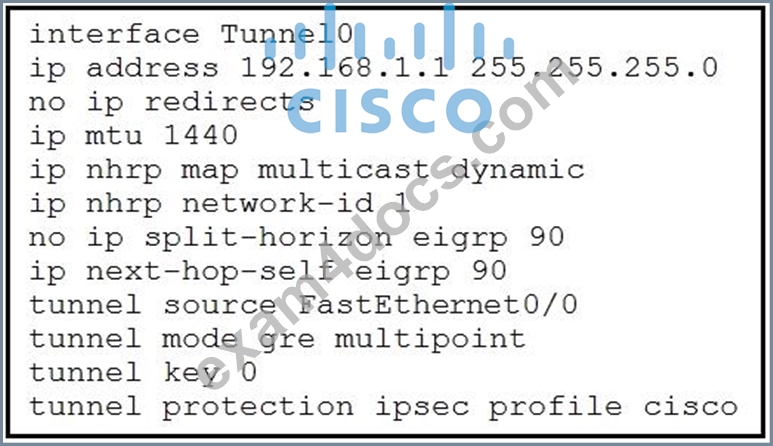
DMVPN spoke-to-spoke traffic works, but it passes through the hub, and never sends direct spoke-to-spoke traffic. Based on the tunnel interface configuration shown, what must be configured on the hub to solve the issue?
- A. Enable split horizon.
- B. Enable NHRP shortcut.
- C. Enable IP redirects.
- D. Enable NHRP redirect.
Answer: B
NEW QUESTION # 43 
Refer to the exhibit. Which type of mismatch is causing the problem with the IPsec VPN tunnel?
- A. transform set
- B. crypto access list
- C. preshared key
- D. Phase 1 policy
Answer: C
Explanation:
Section: Troubleshooting using ASDM and CLI
Explanation/Reference: https://www.cisco.com/c/en/us/support/docs/security-vpn/ipsec-negotiation-ike-protocols/5409- ipsec-debug-00.html#ike
NEW QUESTION # 44
Which benefit of FlexVPN is a limitation of DMVPN using IKEv1?
- A. GRE encapsulation allows for forwarding of non-IP traffic.
- B. Dynamic routing protocols can be configured.
- C. NHRP authentication provides enhanced security.
- D. IKE implementation can install routes in routing table.
Answer: D
Explanation:
Section: Secure Communications Architectures
NEW QUESTION # 45 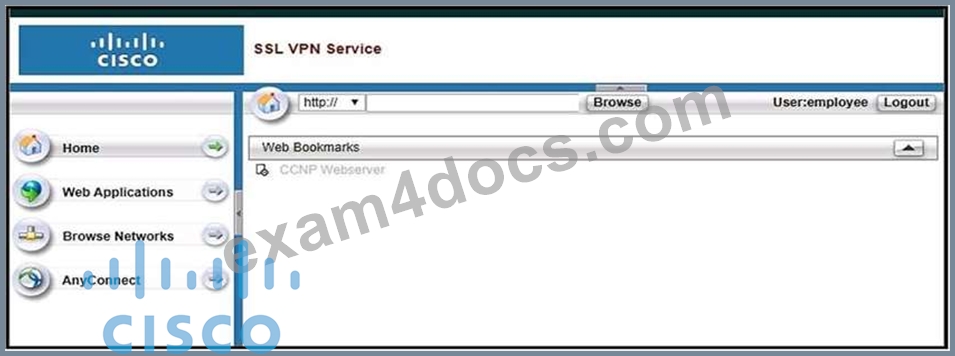
Refer to the exhibit. Based on the exhibit, why are users unable to access CCNP Webserver bookmark?
- A. The URL is being blocked by a WebACL.
- B. The bookmark has been disabled.
- C. The ASA cannot resolve the URL.
- D. The user cannot access the URL.
Answer: B
Explanation:
Section: Remote access VPNs
NEW QUESTION # 46
A network engineer must design a remote access solution to allow contractors to access internal servers. These contractors do not have permissions to install applications on their computers. Which VPN solution should be used in this design?
- A. Clientless
- B. Port forwarding
- C. SSL AnyConnect
- D. IKEv2 AnyConnect
Answer: A
NEW QUESTION # 47
Refer to the exhibit.
Which type of mismatch is causing the problem with the IPsec VPN tunnel?
- A. transform set
- B. crypto access list
- C. preshared key
- D. Phase 1 policy
Answer: C
NEW QUESTION # 48
......
The Cisco 300-730 exam covers a wide range of topics related to VPN technologies, including site-to-site VPNs, remote access VPNs, and SSL VPNs. It also covers different VPN deployment models, such as hub-and-spoke, full mesh, and partial mesh. 300-730 exam also covers VPN security policies and protocols, such as IPSec, SSL/TLS, and IKEv2.
Implementing Secure Solutions with Virtual Private Networks Free Update Certification Sample Questions: https://www.exam4docs.com/300-730-study-questions.html
Trend for Cisco 300-730 pdf dumps before actual exam: https://drive.google.com/open?id=1z-bPOx4GnKfNxsFvTu-LdFME-H2gPMf2
