

2024 Latest OGB-001 dumps - Instant Download PDF
Updated Verified OGB-001 Downloadable Printable Exam Dumps
NEW QUESTION # 16
Whichof the following best describes a TOGAF Business Scenario?
- A. A method forensuring that the business processes deliver the required outcomes.
- B. A technique for constructing business models in a form enabling reasoning, insight, and clarity.
- C. A complete description of a business problem in both business and architectural terms.
- D. A specification of the conventions for a particular kindof business architecture view.
Answer: C
Explanation:
Explanation
This answer is based on the definition of a TOGAF Business Scenario as "a technique for articulating, developing, and validating the requirements of the business" 1. A TOGAF Business Scenario is a complete description of a business problem in both business and architectural terms, which enables individual requirements to be viewed in relation to one another in the context of the overall problem. A TOGAF Business Scenario consists of six elements: business environment, actors, roles, business process, desired outcome, and quality attributes. The other options are not correct, as they do not describe a TOGAF Business Scenario.
NEW QUESTION # 17
Which of the following is a purpose of mapping capabilities to value stream stages?
- A. To Identity which business capabilities are critical to deliver value
- B. To describe the business in terms of services provided and consumed.
- C. To classify, group, and align capacities into categories for a deeper understanding
- D. To provide a self-contained business that is Independent of the organizational structure.
Answer: A
Explanation:
Explanation
This answer is based on the TOGAF Series Guide: Business Capabilities 3, which states that "Mapping capabilities to value stream stages allows an organization to identify which capabilities are critical to deliver value to stakeholders and which capabilities are less important or even unnecessary." Mapping capabilities to value stream stages helps to assess the alignment and impact of the business capabilities on the value delivery process. It also helps to prioritize and optimize the capabilities based on their contribution to value creation.
The other options are not correct, as they are not purposes of mapping capabilities to value stream stages.
NEW QUESTION # 18
Consider the following business capability model. there cells of a model are given different colors to represent desired maturity levels (Green (G)- level achieved, yellow (Y) =one level away, red (R) -two more more levels away, purple (P)=missing capability):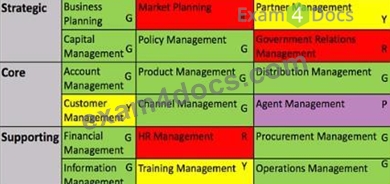
Which of the following best describes what this model shows?
- A. Customer Management, Training Management and Partner Management need immediate attention.
Market Planning. HR Management and Government Relations Management need attention. Agent Management exists as a new Corecapabilitybut has not yet been assessed. - B. The Strategic capabilities need more attention in three areas Market Planning, Government Relations Management, and Partner Management. Agent Management Is missing as a Coro capability. Training Management needs the most attention as a Supporting Capability.
- C. Market Planning. Government Relations Management and HR Management need immediate attention.
Partner Management, Customer Management, and Training Management have issues but are of lower priority.
Agent Management is a new business capabilitythat does not exist. - D. Policy Management. Government Relations Management, and HR Management need immediate attention. Partner Management, Account Management, and Training Management have issues but are of tower priority. Agent Management is o now business capability that Goes not exist.
Answer: A
Explanation:
Explanation
This answer is based on the color-coding of the business capability model, which indicates the desired maturity levels of each capability. Red cells mean that the capability is two or more levels away from the desired maturity level, yellow cells mean that the capability is one level away, green cells mean that the capability has achieved the desired maturity level, and purple cells mean that the capability is missing or not defined. According to this logic, the capabilities that need immediate attention are those that are red, which are Customer Management, Training Management and Partner Management. The capabilities that need attention are those that are yellow, which are Market Planning, HR Management and Government Relations Management. The capability that is missing as a Core capability is Agent Management, which ispurple. The rest of the capabilities are green, which means they have reached the desired maturity level.
NEW QUESTION # 19
Which of the following are two concepts used for structuring a business capability model?
- A. Mapping. Sorting
- B. Categorizing, Grouping
- C. Aligning. Layering
- D. Stratification, Leveling
Answer: B
Explanation:
Explanation
This answer is based on the TOGAF Series Guide: Business Capabilities , which states that "A business capability model is a structured representation of the capabilities of an organization. It is typically structured using two concepts: categorizing and grouping." Categorizing is the process of assigning capabilities to different categories based on their nature, purpose, or function. Grouping is the process of arranging capabilities into different levels or layers based on their granularity, abstraction, or dependency. The other options are not correct, as they are not concepts used for structuring a business capability model.
NEW QUESTION # 20
What fundamental business architecture concepts should be considered when creating an Architecture Vision?
- A. Business capabilities. organization maps, value streams
- B. Business use-cases, event diagrams, class models
- C. Business data model, business roles, business processes
- D. Information exchange matrix, class models, node connectivity diagrams
Answer: A
Explanation:
Explanation
This answer is based on the TOGAF Series Guide: Business Capabilities , which states that "The fundamental concepts that should be considered when creating an Architecture Vision are business capabilities, organization maps, and value streams." These concepts help to define and communicate the essence of what a business does or can do, how it is organized and structured, and how it delivers value to its stakeholders. The other options are not correct, as they are not fundamental business architecture concepts that should be considered when creating an Architecture Vision.
NEW QUESTION # 21
Which of me following is a benefit of Value Stream Mapping?
- A. It helps to ensure that investments and project initiatives are prioritized and funded at a level matching with their value.
- B. It helps to assess an organization s effectiveness at creating, capturing, and delivering value for different stakeholders.
- C. It highlights the value of Individual work packages needed to develop the business architecture.
- D. It helps to identify value. duplication and redundancy across the enterprise.
Answer: B
Explanation:
Explanation
This answer is based on the definition and purpose of value stream mapping as "a technique for modeling, measuring, and analyzing the flow of value from the provider to the consumer through a value stream" . Value stream mapping helps to assess an organization's effectiveness at creating, capturing, and delivering value for different stakeholders, as it shows how value is generated and delivered by the organization's processes, activities, resources, and capabilities. It also helps to identify the sources of waste, inefficiency, and variation in the value delivery process. The other options are not correct, as they are not benefits of value stream mapping.
NEW QUESTION # 22
What Business Architecture concept is most related to an Information Map?
- A. Business Capability Map
- B. Organization Map
- C. Heal Map
- D. Value Stream Map
Answer: A
Explanation:
Explanation
This answer is based on the relationship between information maps and business capability maps as described in the TOGAF Series Guide: Information Mapping 1. According to this guide, "Information Maps are a part of the core set of artifacts that provide a powerful representation of the business. Information Maps are also a high-level description of the informational requirements of a business and are a key input into its Information Systems Architecture design." Therefore, information maps are most related to business capability maps, which define "what" a business does at its core. The other options are not as closely related to information maps, as they focus on different aspects of the business architecture.
NEW QUESTION # 23
Complete the sentence. A business capability is_____________________________________.
- A. a representation of an end-to-end collection of business activities
- B. a description of the architectural approach to realize a particular business solution
- C. a qualitative statement of intent that should be met by the business architecture
- D. an ability that a business possesses to achieve a specific outcome
Answer: D
Explanation:
Explanation
This answer is based on the definition of a business capability as "an ability that a business possesses to achieve a specific outcome" 1. A business capability is an elemental building block of what a business does or can do 3. It is an abstraction of the underlying functionality and flows expressed as a noun form 3. A business capability is not a description of the architectural approach, a representation of the end-to-end activities, or a qualitative statement of intent, which are different concepts in business analysis or architecture.
NEW QUESTION # 24
In what TOGAF ADM phase is the Information map translated into data models?
- A. Phase E
- B. Phase C
- C. Preliminary Phase
- D. Phase A
Answer: B
Explanation:
Explanation
his answer is based on the TOGAF Standard, Version 9.2 - Phase C: Information Systems Architectures 2, which states that "The objective of Phase C is to develop Target Information Systems (Data and Application) Architecture descriptions that will enable the enterprise to address the Request for Architecture Work and stakeholder concerns." In this phase, the Information Map is translated into data models that describe the structure and relationships of the data entities required by the enterprise. The data models are part of the Data Architecture, which is one of the two components of the Information Systems Architecture. The other options are not correct, as they are not phases where the Information Map is translated into data models.
NEW QUESTION # 25
Consider the following extract of a model showing relationships between Business Architecture concepts: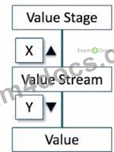
What is the relationship labeled Y?
- A. Creates
- B. Receives
- C. Consists of
- D. Enables
Answer: D
Explanation:
Explanation
This answer is based on the definition of the enables relationship in the ArchiMate 3.1 Specification 1, which states that "An enabling relationship describes how an element (e.g., a node, device, or system software) enables another element (e.g., a business process, service, or function) to function." In this case, the value stream stage enables the business capability to function, as it provides the necessary inputs, outputs, and resources for the capability to deliver value. The other options are not correct, as they do not describe the relationship between a value stream stage and a business capability.
NEW QUESTION # 26
Which of the following is an end product of business capability modeling?
- A. A business process model.
- B. A business capability map.
- C. A value stream stages catalog.
- D. An organizational map.
Answer: B
Explanation:
Explanation
This answer is based on the definition and purpose of a business capability map as "a technique for the representation of an organization's business anchor model, independent of the organization's structure, processes, people, or domains" . A business capability map is an end product of business capability modeling, as it shows the complete set of capabilities thatan organization possesses or requires to achieve its goals and objectives. A business capability map provides a high-level and stable view of what a business does or can do, regardless of how or where it does it. The other options are not correct, as they are not end products of business capability modeling.
NEW QUESTION # 27
Which of the following describes how to define a business capability?
- A. Identifying and articulating the business problem, enabling the business requirements to be fully documented.
- B. Identifying and documenting a set of statements that outline what the business architecture project must do.
- C. Identifying human and computer actors. their roles, and their place in the business.
- D. Identifying and describing what needs to be done by the business in support of Its overall mission
Answer: D
Explanation:
Explanation
This answer is based on the definition of a business capability as "an ability that a business possesses to achieve a specific outcome" 1. A business capability defines "what" a business does at its core, not "how" or
"where" it does it 2. Therefore, to define a business capability, one needs to identify and describe what needs to be done by the business in support of its overall mission, which is the ultimate outcome that the business seeks to achieve. The other options are not correct because they describe different aspects of business analysis or architecture, such as defining the business problem, identifying the actors and roles, or documenting the project scope.
NEW QUESTION # 28
Which Mop duringdevelopment of a business scenario ensures that eachiteration is managed as a mini-project?
- A. Reviewing Step
- B. Gathering Step
- C. Planning Step
- D. Documenting Step
Answer: C
Explanation:
Explanation
This answer is based on the TOGAF Standard, Version 9.2 - Business Scenarios , which states that "The Planning Step ensures that each iteration is managed as a mini-project. It involves defining the scope of work for each iteration; identifying the participants; scheduling the activities; allocating resources; defining deliverables; establishing quality criteria; and setting up communication channels." The Planning Step is part of the development process of a business scenario, which consists of four steps: Planning, Gathering, Documenting, and Reviewing. The other options are not correct, as they are not steps that ensure that each iteration is managed as a mini-project.
NEW QUESTION # 29
......
The Ultimate The Open Group OGB-001 Dumps PDF Review: https://www.exam4docs.com/OGB-001-study-questions.html
Achieve The Utmost Performance In OGB-001 Exam Pass Guaranteed: https://drive.google.com/open?id=1fLldib0WRCQSBMGNyn9HGLpak29Y6yv6
