

[2026] New L4M8 exam dumps Use Updated CIPS Exam
Verified L4M8 Dumps Q&As - L4M8 Test Engine with Correct Answers
CIPS L4M8 exam covers various topics related to procurement and supply chain management, such as supplier selection, contract negotiation, risk management, and ethical considerations. L4M8 exam is designed to test a candidate's ability to apply these concepts in real-world scenarios and make informed decisions that align with their organization's objectives.
NEW QUESTION # 81
Which Incoterm applies here?
The supplier is responsible for delivering the goods to the buyer's premises, bearing all risk up until this point.
- A. DDP - Delivery Duty Paid
- B. FAS - Free Alongside Ship
- C. DAP - Delivered At Place
- D. DAT - Delivered At Terminal
Answer: C
NEW QUESTION # 82
What is business case?
Answer:
Explanation:
See the answer in explanation.
Explanation:
A business case is a document containing the justification and the commercial benefits achievable for a potential project or an identified need, for example, the purchase of a capital equipment, con-struction of an additional warehouse or procuring more innovative software to replace the current on in use.
The essence of the business case is to obtain support and get buy-in from senior management.
In order to gain authority to apply whole life asset management a business case will need to be created and presented. A developed business case will cover the following element.
1) Introduction: Outline of what the business case is all about
2) Objective: Explanation of what the business case desired outcome is.
3) Approach that will be undertaken
4) List of resources required
5) Benefits of achieving the objective
* Refer to the question column for response
NEW QUESTION # 83
What are the four quadrants within the Kraljic portfolio matrix?
Answer:
Explanation:
At the early stages In procurement and supply cycle, buyers begin segmenting current supplies in the categories, depending on their level of integration into the organization. To help get this done, the buyer may use the Kraljic portfolio matrix. The kraljic portfolio matrix segment suppliers into four categories, which are;
1) Routine 2) Bottleneck 3) Leverage 4)strategic supplier
* Refer to the question column for response
NEW QUESTION # 84
Describe two ways in which an organization with which you are familiar could use continuous im-provement as part of whole life asset management.
Answer:
Explanation:
See the answer in explanation.
Explanation:
Continuous improvement relates to removing waste from the supply chain and improving processes to increase efficiency within whole life asset management in a full power project (a flour producing firm) can benefit from continuous improvement in the following ways;
1) Reduce cost of spears by recondition parts, instead of disposing them out rightly.
2) Can reduce down time by conducting routine maintenance after hours.
3) Can reducing accident by up skilling operators on safety
4) Can reduce waste oil by following owner's manual instead of relying on experience.
5) Create efficiencies by operating a 24/7 shift pattern.
* Refer to the question column for response
NEW QUESTION # 85
Describe what should be considered when creating damages terms in a contract.
Answer:
Explanation:
Damages are 'sum of money that the supplier pays if it fails to carry out its contractual obligation.
When creating terms for damages in the contract, it should be considered that Damages are categorized into two types (liquidated and un-liquidated). And which or if both are applicable to the contract in hand.
Liquidate Damages are fixed amount of money agreed between the parties that is payable if a contract is breached. For example, knowing that supplier not being able to install a device properly in a power transformer may destroy the device and going ahead to include a fee in the contract if the device was destroyed.
Un-liquidated damages are unfixed amount of money. It is used when the amount of money that will compensate the injured party cannot be known in advance. A court decides the amount when the damages occur. For example, knowing that supplier not being able to install a device properly in a power transformer may destroy the device, other appliances and equipment unknown, cause the buyer delay in the process and reputational damage as in customer dissatisfaction. Yet, unquantifiable as both parties are unable to fix a fee in advance on the damages and leaving it to the court to decide the damage if it may occur.
NEW QUESTION # 86
What are the eight elements of whole life asset management?
Answer:
Explanation:
See the answer in explanation.
Explanation:
Whole life asset management is the process of evaluating the total price and all associated costs of a product to make an informed decision as to which option will provide the organization with the best value for money option: To achieve this the organization works at the following eight elements.
1. Identify need/objectives/risk: The first stage of the whole life asset management is the same as the first stage in the CIPS procurement and supply cycle: identify the need prior to any asset being procured; the need could be competition in the marketplace, raised/reduced demands or financial concern. Once this need has been identified, the objectives of the new assets need to be set, and this may include being more energy efficient, reducing cost or saving money.
Risk also needs to be explored. When investing in a new asset there are factors to be considered that may or may not be advantageous to the investment. These include; downtime, lost sale/revenue or associated cost.
2. Procurement: Procurement professional would have to source and arrange supply of the asset.
3. Construction: ones the supply has being arranged, then the designing and the manufacturing of the asset begins.
4. Commissioning
5. Deterioration/maintenance
6. Condition performance monitoring
7. Decommissioning
8. Renewal/replacement
* Refer to the question column for response
NEW QUESTION # 87
Explain which company you would award the contract to base on the weighted score card in table below.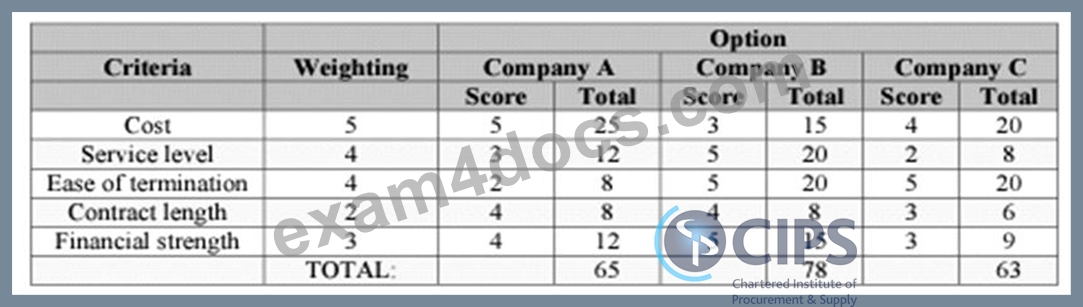
Answer:
Explanation:
A weighted score card is a tool with a systematic and a fair process for selecting supplier, based on predetermined criteri a. This tool can help make the decision by presenting a fair display of how all suppliers did in the process. The values of these weights are based on their importance. The supplier with the highest score card is considered the most suitable to be awarded the contract.
In the table above, cost is considered more than all other criteria. Contract length is the lowest which is weighted 2 Base on the weighted score card as presented above, company B scored 78 while company A and company C scored 65 and 63 respectively.
Company A, having scored the highest (78) should be awarded the contract.
*
Refer to the question column for response
NEW QUESTION # 88
Write all of factors that contribute towards value for a product that you regularly purchase.
Answer:
Explanation:
See the answer in explanation.
Explanation:
Factors that contribute towards value for clothe gum in a fashion firm;
1) How much money does the gum cost?
2) How much is the benefits of using the clothe gum?
3) Does customers prefer clothe gum at the bottom of their garment?
4) Is the clothe gum difficult to use?
5) Does the clothe gum beautifies the fabric when placed properly?
6) Does it give a better finishing?
7) Is it ethical to use?
8) Is it from a sustainable source?
9) is it environmental friendly?
10) Does using clothe gum suggest innovation in fashion?
Refer to the question column for response
NEW QUESTION # 89
What matrix helps to define how to manage stakeholders?
Answer:
Explanation:
See the answer in explanation.
Explanation:
Stakeholders are individuals or organizations who are directly affected by a decision for example, community, shareholders, employees, suppliers, distributors, customers etc. stakeholders can be internal (employers, staffs), connected (such as suppliers, shareholders, financers and customers) external (Government, pressure groups, and community).
The matrix that helps define how to manage stakeholders is mendelow's stakeholders manage-ment matrix.
This matrix is based on the theory that the level of management stakeholders require depends on the level of their power and interest within the project or organization The matrix groups stakeholders in to four quadrants according to their power and interest and ad-vice how to manage them.
1) Low power - Low interest (minimum effort)
2) Low power - High interest (keep inform)
3) High power - Low interest (keep satisfied)
4) High power - high interest (manage closely)
* Refer to the question column for response
NEW QUESTION # 90
Describe three types of fraud that could occur within the supply chain of an organization with which you are familiar.
Answer:
Explanation:
See the answer in explanation.
Explanation:
Fraud occurs when a person acts deliberately to secure monies from another party through dishonest method.
Within the supply chain of an organization, fraud can represent itself in the following ways:
1. Kickbacks: e.g. (commission given to a bribe taker for service perform)
2. Corrupt influence (e.g ordering more than what is required)
3. Collusion: (group of suppliers working together to submit multiple bids and split profit.
4. Bid Rigging (a contract is informally agreed with a chosen supplier prior to the official process
5. invoicing fraud
6. Substitution (submitting products that are below the required quality
7. False claims (files false document)
Case Study
A series of news stories reporting events such as the collapse of the Rana Plaza building in 2013 have drawn attention to the poor conditions in garment factories across India and South East Asia. Human rights groups have long be critical of the excessive hours and poor wages workers are forced to endure, as well as the abuse they receive from supervisor. With consumers becoming increasingly aware of these conditions, more pressure is being put on global brands and retailers to ensure their supply chains are fair and ethical.
Certain areas have been notorious for the mistreatment of workers. In India's textile valley', young women are been bound into contracts where they work for two to three years, in exchange for a lump sum of money that they can then put towards a dowry. This is known as the 'Sumangali [a married woman] Thittam' scheme. These women are forced to live in hostels under restrictions that prevent them from moving, and are denied the opportunity to improve their living conditions. Retailers including Walmart and H & M are known to source garments from factories in the 'textile valley'.
Reports by organizations including the Asia Floor Wage Alliance (AFWA), Central Combodia, Global Labor Justice, Sedane Labour Resource Centre (LIPS) Indonesia, and Society for Labour and Development (SLD) India have exposed unethically run factories that supply garments to H & M, Gap and Walmart. However, retailers will continue to benefit from expensive labour until mounting customers pressure causes them to change.
NEW QUESTION # 91
What information should be included on a purchase requisition?
Answer:
Explanation:
A purchase requisition should contain the following information
1) Date of the requisition
2) Description of what is required
3) Supplier if known
4) The quantity
5) when the need is required
6) why the need is required
7) who identified the need
8) who approved the need
9) if it's a re-buy
NEW QUESTION # 92
Describe the seven stages of the Tender Process and explain the reasons why the stages must be followed.
Answer:
Explanation:
See the answer in explanation.
Explanation:
The purpose of the tendering process is to invite potential suppliers to bid to supply a product or service to the buying organization. Then buying organization select suitable suppliers, award con-tract and manage. The process is selected mostly when the need is a large or complex project or the law mandates it or it is in the company's policies to do so. The stages of the tendering process includes; Stage 1: decide which style of tender to use. There are four types of tendering used within pro-curement and this include; 1) open 2) Restricted 3) Negotiated 4) Competitive Dialogue Stage 2: Prepare invitation to tender (ITT): this stage is to prepare the document that will be made available to potential supplier. It should contain everything potential bidders will need to know to fully understand the need and to prepare and send a suitable RESPONSE it may likely in-clude; open letter, company details, overview of a project, evaluation criteria, submission date and so on.
Stage 3: send ITT: With fairness, transparency and equality, buyer will provide the documents to all potential suppliers at the same time and also provide exactly the same information/documents to all suppliers. If after receiving the ITT and some suppliers seek clarifications on anything in the documentation, buyers must give same response to identical questions to keep the process transparent and fair. Also, the response to each query to all bidders in the process.
Failure to this may result in bidders who feel disadvantaged or discriminated in any form to submit a legal challenge. Supplier submitting a Legal challenge may cause delay in the process and eventually increase administrative cost for the buyer.
Stage 4: Buying organization receives responses to the Invitation to tender from suppliers (bids). Suppliers must adhere to the bid submission dead line included in the invitation to tender document. Any bid that arrives after the deadline must be left out of the process, or else this may result to other suppliers legally challenging the process.
Stage 5: Evaluate bid. The buying organization can now evaluate the bids based on the criteria in the ITT document. It is always thorough that cross-functional team evaluates the bids to guarantee complete fairness and ensure that the chosen bid is fit for purpose. In evaluating the bids, the cross-functional team will consider the bids in the following areas; supplier organization, ethics, price, sustainability, quality, payment, disposal, service level, location, warranty and risk.
Stage 6: Award contract and give feedback hence the buying organization wards the contract to the winning supplier. This can take place by a formal communication like a letter or an e-mail.
Stage 7: Contract management. Contracts must be evaluated against the criteria in the invitation to tender.
The reasons why these stages must be followed includes;
1. Knowing the right TYPE of tender to use, reduces administration cost, for example, deciding to do restricted tendering to reduce the interest that are going to be sent in have already cut down on administrative cost.
2. The supplier can know what exactly the buyer's intentions are by developing description and the required specification.
3. To ensure that objectives of resorting to use the tendering style and the tendering process is achieved
4. To ensure that the organization generates added value by going through the stages.
5. To ensure that there are none unethical issues like fraud, bribes etc are not part of the system.
6. To ensure that the tendering process becomes transparent to all suppliers. These stages must be followed for transparency and fairness. Just like in stage 3: buyer send out the ITT to potential suppliers at the same time and providing them same information. Failure to this and bidders who feel disadvantaged or discriminated in any form may submit a legal challenge. Supplier submitting a Legal challenge may cause delay in the process and eventually increase administrative cost for the buyer.
* Refer to the question column for response
NEW QUESTION # 93
Why do some specifications need to adapt?
Answer:
Explanation:
Specification is a detailed description of what is required or needed. Due to certain reasons, needs sometimes increase in importance or lose their essence, therefore specifications need to adapt and develop to reflect the changing requirements of the consumer and also to comply with regulations and legislatures as this are amended.
Standard, regulations and legislation are continually evolving and new updated versions of existing guideline, as well as completely new initiatives one being released.
NEW QUESTION # 94
Why is it important to keep ethical codes of practice up to date?
Answer:
Explanation:
See the answer in explanation.
Explanation:
A code of ethics is a set of morals and principle set out by an organization to state what it deems to be acceptable conduct and behavior An ethical code of practice is a continually changing and developing document with society changing and different suppliers coming to market, the document has to remain current Suppliers should continually monitor their codes of ethics to ensure that;
1. They are looking after the interest of the supply chain
2. That potential customers can be reassured that they are conforming to the required regulation, e.g. ISO
14001.
Ethical code of conduct should be constantly monitored and updated in accordance with the changes organization faces. This include 1) Define (2) prevent (3) detect (4) reprove (5) evaluate.
* Refer to the question column for response
NEW QUESTION # 95
Describe what should be considered when creating damages terms in a contract.
Answer:
Explanation:
See the answer in explanation.
Explanation:
Damages are 'sum of money that the supplier pays if it fails to carry out its contractual obligation.
When creating terms for damages in the contract, it should be considered that Damages are categorized into two types (liquidated and un-liquidated). And which or if both are applicable to the contract in hand.
Liquidate Damages are fixed amount of money agreed between the parties that is payable if a contract is breached. For example, knowing that supplier not being able to install a device properly in a power transformer may destroy the device and going ahead to include a fee in the contract if the device was destroyed.
Un-liquidated damages are unfixed amount of money. It is used when the amount of money that will compensate the injured party cannot be known in advance. A court decides the amount when the damages occur. For example, knowing that supplier not being able to install a device properly in a power transformer may destroy the device, other appliances and equipment unknown, cause the buyer delay in the process and reputational damage as in customer dissatisfaction. Yet, unquantifiable as both parties are unable to fix a fee in advance on the damages and leaving it to the court to decide the damage if it may occur.
NEW QUESTION # 96
What is Decommissioning?
Answer:
Explanation:
When a fixed asset reaches the end of its life, it requires decommissioning before reconditioning or disposal.
Decommissioning is to observe all the safety measures and technical procedures and stop active machinery or an asset from operation (example; gas plant, power generator, transformer etc.
Decommissioning process include the following aspect
1) Preparation: Plan the process
2) Dismantle: Take the asset apart and remove hazardous waste
3) Processing: make safe any hazardous waste
4) Disposal: Ensure paper work is received to confirm removal and disposal
* Refer to the question column for response
NEW QUESTION # 97
Describe three ways that hidden cost could present themselves within the logistics operation
Answer:
Explanation:
See the answer in explanation.
Explanation:
Hidden costs are costs that do not always present themselves at the onset of the project.
Logistics can provide a hidden cost within global sourcing. The movement of goods can generate risk within a localized supply chain, but the risk is greater within global sourcing. Within global sourcing there are usually many more aspects to the logistics operation, hidden cost associated with the logistics process includes,;1) delays that can be experienced after placing orders, 2) unclear and poor/incorrect communication that might affect the successes of the transaction, also 3) goods could be confiscated by customs for unseen reasons.
NEW QUESTION # 98
What are five recognized types of modern slavery?
Answer:
Explanation:
See the answer in explanation.
Explanation:
Modern slavery is against ethical and responsible sourcing. Modern slavery is one of the areas to understudy for procurement professionals to carry out ethical and responsible sourcing and this is recognized in five ways.
1. Human trafficking: The process of seeking, recruiting, transporting and exploiting individuals to work against their will. Often human trafficking includes violence, deception, and coercion.
2. Bonded labour (debt bondage): This is an individual's promise to provide service through ex-ploitation as repayment, or part thereof, of a dept or other obligation.
3. Forced labour: Work that people are forced to do with the treat of punishment if it is not carried out.
4. Children labour: The exploitative and illegal employment of children.
5. Domestic slavery: Individuals exploited through working in private households for little or no money in return for living accommodation
NEW QUESTION # 99
What is a cross function team?
Answer:
Explanation:
A cross-function Team is the involvement of all departments that are in an organization to contribute knowledge, skills and innovation towards adding value to achieving the organization's strategic goal. Example, procurement, maintenance, marketing, finance, human resources working together in procurement activity to come up with the best strategy or selecting the supplier that best suit the organization.
When working in a cross-functional team, members of the organization give support by believing in the end goal, assist during difficult time, help troubleshoot any issue, providing the required resources and sharing information
NEW QUESTION # 100
......
Pass Your L4M8 Dumps as PDF Updated on 2026 With 198 Questions: https://www.exam4docs.com/L4M8-study-questions.html
CIPS L4M8 Real Exam Questions and Answers FREE: https://drive.google.com/open?id=1z2FS7DDDKAgbjo4h_W5VtLT-cFxd2KIz
