
Choose H31-161 most accurate study material

Pass your actual test with our Huawei H31-161 training material at first attempt
Last Updated: Nov 24, 2026
No. of Questions: 180 Questions & Answers with Testing Engine
Download Limit: Unlimited
Pass your H31-161 actual test with our valid H31-161 training material
We provide the most up to date and accurate H31-161 questions and answers which are the best for clearing the actual test. Instantly download of the Huawei HCIE-Carrier IP (Written) exam practice torrent is available for all of you. 100% pass is our guarantee of H31-161 valid questions.
100% Money Back Guarantee
Exam4Docs has an unprecedented 99.6% first time pass rate among our customers.  We're so confident of our products that we provide no hassle product exchange.
- Best exam practice material
- Three formats are optional
- 10 years of excellence
- 365 Days Free Updates
- Learn anywhere, anytime
- 100% Safe shopping experience
- Instant Download: Our system will send you the products you purchase in mailbox in a minute after payment. (If not received within 12 hours, please contact us. Note: don't forget to check your spam.)
Huawei H31-161 Practice Q&A's

- Printable H31-161 PDF Format
- Prepared by H31-161 Experts
- Instant Access to Download
- Study Anywhere, Anytime
- 365 Days Free Updates
- Free H31-161 PDF Demo Available
- Download Q&A's Demo
Huawei H31-161 Online Engine

- Online Tool, Convenient, easy to study.
- Instant Online Access
- Supports All Web Browsers
- Practice Online Anytime
- Test History and Performance Review
- Supports Windows / Mac / Android / iOS, etc.
- Try Online Engine Demo
Huawei H31-161 Self Test Engine

- Installable Software Application
- Simulates Real Exam Environment
- Builds H31-161 Exam Confidence
- Supports MS Operating System
- Two Modes For Practice
- Practice Offline Anytime
- Software Screenshots
Nobody should buy study materials blind. Exam4Docs opens the door first: the free demo shows real sample questions, the answer formats, and the software interface — everything a careful buyer wants to see.
Huawei H31-161 Exam Overview:
| Certification Vendor: | Huawei |
|---|---|
| Exam Name: | HCIE-Carrier IP (Written) H31-161 |
| Exam Number: | H31-161 |
| Real Exam Qty: | 60-70 |
| Available Languages: | English, Chinese |
| Exam Duration: | 120 minutes |
| Passing Score: | 600/1000 |
| Related Certifications: | HCIP-Carrier IP HCIA-Carrier HCIE-Carrier IP |
| Exam Format: | Single choice, Multiple choice |
| Certificate Validity Period: | 3 years |
| Exam Price: | USD 300 (varies by region) |
| Recommended Training: | Huawei Talent Online Learning Platform Huawei Authorized Training Centers |
| Exam Registration: | Huawei Talent Certification Portal Pearson VUE Huawei Exams (region dependent) |
| Sample Questions: | DOWNLOAD DEMO |
| Exam Way: | Online proctored exam or authorized test centers (delivery may vary by region and provider arrangement) |
| Pre Condition: | No strict mandatory prerequisite for the written exam, but HCIP-Carrier IP or equivalent knowledge is strongly recommended before attempting HCIE certification. |
| Official Syllabus URL: | https://e.huawei.com/en/talent/certification |
Huawei H31-161 Exam Syllabus Topics:
| Section | Objectives |
|---|---|
| Carrier Network Design and Optimization | - Large-Scale IP Network Design - High Availability and Redundancy |
| IP Network Fundamentals | - IPv4/IPv6 Addressing and Subnetting - Routing Principles and Convergence |
| Advanced Network Technologies | - IP Multicast - QoS Principles and Implementation |
| EGP Routing | - BGP Policy and Attributes - BGP Route Selection and Optimization |
| IGP Routing Protocols | - IS-IS - OSPF |
| MPLS and VPN Technologies | - L2VPN Services - L3VPN Implementation - MPLS Fundamentals |
| Network Operations and Troubleshooting | - Fault Detection and Diagnosis - Performance Optimization |
H31-161 Exam FAQ: Try It First
Online proctored exam or authorized test centers (delivery may vary by region and provider arrangement) Register for the Huawei HCIE-Carrier IP (Written) exam through these official channels:
After booking, Exam4Docs delivers your practice questions within 1 minute — preparation starts the same day.
Exam4Docs issues a full refund if you take the Huawei HCIE-Carrier IP (Written) exam within 60 days of purchase and do not pass. The policy does not apply if the exam is taken within 3 days of purchase, if the exam was never actually taken, or to free materials or expired orders, and the candidate name must match the payer name. Submit a scan of your enrollment slip and the official Score Report PDF within 2 days of the exam; claims are processed within 7 days. Alternatively, exchange for two free exam products of equal value and keep your original update service. Orders arrive by email within 1 minute — contact support if nothing arrives within 2 hours.
The Huawei HCIE-Carrier IP (Written) exam requires 600/1000 to pass, and registration costs USD 300 (varies by region). A failed attempt means paying the same fee again — a readiness check with the Exam4Docs engines before booking is the cheaper option.
The official Huawei HCIE-Carrier IP (Written) outline defines 7 domains. The leading three are MPLS and VPN Technologies, IP Network Fundamentals, and Network Operations and Troubleshooting. The full list is in the topics section above, and Exam4Docs's 180 practice questions cover each one.
The Huawei HCIE-Carrier IP (Written) exam contains 60-70 to complete within 120 minutes. Timed simulation in the Exam4Docs Desktop Test Engine teaches that rhythm before exam day does.
No strict mandatory prerequisite for the written exam, but HCIP-Carrier IP or equivalent knowledge is strongly recommended before attempting HCIE certification. Since requirements change over time, confirm the latest on the official Huawei exam page before scheduling.
Three versions of the same study materials: a printable, expert-prepared PDF with free demo download and instant access; a Desktop Test Engine for Windows that simulates the real exam with two practice modes and works offline; and an Online Test Engine for any browser on Windows, Mac, Android, and iOS with test history and performance review. All 180 practice questions are identical across versions. Every purchase includes 365 days of free updates, a 50% renewal discount afterward, and unlimited computer installations.
The H31-161 exam is a Huawei certification exam validating the Huawei HCIE-Carrier IP (Written) syllabus shown above. It belongs to these credential paths: HCIA-Carrier, HCIP-Carrier IP, HCIE-Carrier IP. Earning it in 2026 demonstrates ability in a form employers recognize — and Exam4Docs prepares candidates with 180 practice questions in PDF, Desktop Test Engine, and Online Test Engine formats.
Huawei recommends these training resources for the Huawei HCIE-Carrier IP (Written) exam:
Follow the training with steady self-testing — the 180 practice questions from Exam4Docs help you apply theory and fill any gaps the training leaves.
Huawei HCIE-Carrier IP (Written) Sample Questions:
As shown in the figure, MPLS, MPLS TE, and MPLS RSVP-TE are configured on RTA, RTB, RTC, and RTD. Tunnel1/0/0 and Tunnel2/0/0 are set up based on the explicit path RTA-RTB-RTC. Tunnel1/0/0 has a hot-standby path (RTA-RTD-RTC) and an FRR path: RTA-RTD-RTC, whereas Tunnel2/0/0 has an ordinary path (RTA-RTD-RTC) and an FRR path. Which of the following statements are true?
- A. When the link between RTA and RTB is faulty, the state of Tunnel1/0/0 is hotstanby inuse.
- B. When the link between RTB and RTC is faulty, the state of Tunnel2/0/0 is ordinary inuse.
- C. When the link between RTA and RTB is faulty, the state of Tunnel2/0/0 is FRR inuse.
- D. When the link between RTA and RTB is faulty, the state of Tunnel2/0/0 is ordinary inuse.
Correct Answer: A,C 🗳️
RTA is a leaf router that directly connects to host A through interface GigabitEthernet 1/0/0. The interface is configured as follows:
interface Ethernet1/0/0
undo shutdown
ip address 192.168.4.2 255.255.255.0
pim sm
igmp enable
igmp version 3
igmp ssm-mapping enable
Configurations in the IGMP view are as follows:
igmp
ssm-mapping 233.1.1.0 255.255.255.0 10.10.1.1
A user sends an IGMPv2 Report message on host A to join groups 232.1.1.1 and 233.1.1.1 but the user cannot receive (10.10.1.1, 232.1.1.1) and (10.10.1.1, 233.1.1.1) messages. To solve this problem, which of the following configurations are required?
- A. Configure ssm-policy in the PIM view and use the ACL to set the SSM group address range to 232.1.1.1.
- B. Configure ssm-policy in the PIM view and use the ACL to set the SSM group address range to 232.1.1.1 and 233.1.1.1.
- C. Configure ssm-mapping 232.1.1.0 255.255.255.0 10.10.1.1 in the IGMP view.
- D. Configure ssm-policy in the PIM view and use the ACL to set the SSM group address range to 233.1.1.1.
Correct Answer: B,C 🗳️
Exhibit:
As shown in the figure, virtual private LAN service (VPLS) is enabled on routers PE 1 and PE 2.CEs are connected to PEs through QinQ and PC A and PC B are connected to the two CEs. The two PCs belong to the same VPN and can communicate with each other properly. Which of the following statements about the communication process when you ping PC B from PC A are true?
- A. If the penultimate hop popping (PHP) feature of MPLS is enabled on PEs, a packet received by PE 2 from a P router has two VLAN tags one MPLS label.
- B. PE 1 add two MPLS labels to a packet before sending the packet to a router.
- C. A packet received by CE 2 from PE 2 has two VLAN tags CE 2 removed the outer tab and forwards the packets to PC B based on the inner tag
- D. PE 1 receives packets with a VLAN tag from CE 1 and adds a VLAN tag to these packets.
Correct Answer: A,B,D 🗳️
BFD for RSVP is a mechanism that uses BFD to check the connectivity of RSVP neighbors. As shown in the figure, TE FRR node protection is deployed to protect a node, the blue path is the primary LSP (RTA -> RTB -> RTC -> RTD -> RTE) and the red one is the bypass LSP (RTB -> RTF -> RTD). Which of the following statements about BFD for RSVP are true?
- A. TE FRR will be triggered only when the link between RTB (acting as the PLR) and RTC (the node under protection) is faulty or RTC is faulty but will not be triggered when the link between RTC and RTD (acting as the MP) is faulty. This problem can be solved by establishing a BFD session between RTB and RTD. In this case, faults may be reported falsely or be missed.
- B. Only RSVP HELLO needs to be enabled if RSVP GR instead of TE FRR is deployed on a network.
- C. BFD for RSVP needs to be enabled only on RTB if you expect to set up a BFD for RSVP session on RTB to check the connectivity between RTB and RTC.
- D. The BFD session triggered by RSVP is for the exclusive use of RSVP.
Correct Answer: A 🗳️
Exhibit: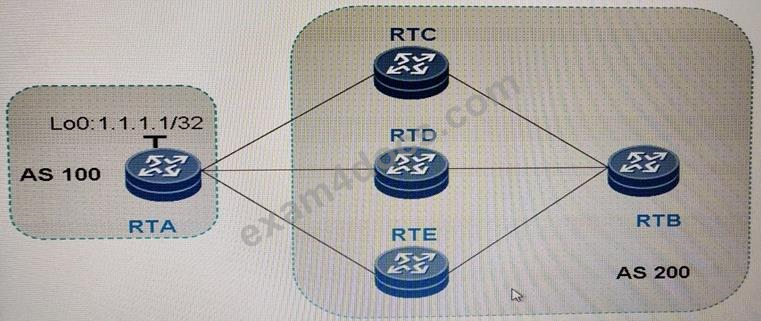
As shown in the figure, RTA belongs to AS 100 and has an EBGP neighbor relationship with RTC, RTD, and TTB is an IBGP neighbor of RTC, RTD, and RTE, and the four router all belong to AS 200.
(Note: The attributed not involved In the question use the default values)
1. Import route 1.1.1/32 from RTA and advertise this route to RTB by way of RTC, RTD, and RTE, respectively (suppose the three routers between is IGP, EGP, and INCOMPL:ETE, respectively. Which route will RTB prefer?
2. Suppose the preceding policy is retained. Apply inbound routing policies on RTC, RTD, and RTE so that the values of the MED attribute of route 1.1.1.32 learned by RTB are 40, and 20 respectively. Which route will RTB prefer?
3. Suppose the preceding policy is retained. Apply an inbound routing policy on RTB so that the values of the AS_ PATH attribute of route 1.1.1.1/32 Learned from RTC, RTD, and RTE are 10 20 30,and 10 20, respectively. Which route will RTB prefer?
4. Suppose the preceding policy is retained. Apply an inbound routing policy on RTB so that the values of the local-preference attribute of route 1.1.1.1.32 learned from RTC and RTE are 30 and 120 , respectively. Which route will RTB prefer.
5. Suppose the preceding policy is retained. Apply inbound policies on RTC. RTD and RTE so that the values of the preferred-value attribute of route 1.1.1.132 are 50.40 and 30 respectively. Which route will RTB prefer?
- A. RTC, RTC, RTD, RTE, RTE
- B. RTC., RTC, RTE, RTC, RTE
- C. RTC, RTC, RTD, RTC, RTE
- D. RTC, RTD, RTD, RTE. RTE
Correct Answer: B 🗳️
Viewing page 1 out of 36 pages.
Viewing questions 1-5 out of 180 questions.
 Michell
Hugh
Larry
Mortimer
Ralap
Tim
Exam4Docs is the world's largest certification preparation company with 99.6% Pass Rate History from 70123+ Satisfied Customers in 148 Countries.

Over 70123+ Satisfied Customers
Our Clients












Our study guide torrent covers most questions of real test and can help you pass exam certainly. The high pass rate bring help you pass at the first attempt.
Contact Us
From Monday to Saturday
Support: Contact now
If you have any question please leave me your email address, we will reply and send email to you in 12 hours.
Copyright © 2026 EXAM4DOCS.COM. All rights reserved. All trademarks are the property of their respective owners and we don't provide actual questions from any vendor. Privacy Policy