
Choose L6M2 most accurate study material
Pass your actual test with our CIPS L6M2 training material at first attempt
Last Updated: Nov 23, 2026
No. of Questions: 40 Questions & Answers with Testing Engine
Download Limit: Unlimited
Pass your L6M2 actual test with our valid L6M2 training material
We provide the most up to date and accurate L6M2 questions and answers which are the best for clearing the actual test. Instantly download of the CIPS L6M2 exam practice torrent is available for all of you. 100% pass is our guarantee of L6M2 valid questions.
100% Money Back Guarantee
Exam4Docs has an unprecedented 99.6% first time pass rate among our customers.  We're so confident of our products that we provide no hassle product exchange.
- Best exam practice material
- Three formats are optional
- 10 years of excellence
- 365 Days Free Updates
- Learn anywhere, anytime
- 100% Safe shopping experience
- Instant Download: Our system will send you the products you purchase in mailbox in a minute after payment. (If not received within 12 hours, please contact us. Note: don't forget to check your spam.)
CIPS L6M2 Practice Q&A's

- Printable L6M2 PDF Format
- Prepared by L6M2 Experts
- Instant Access to Download
- Study Anywhere, Anytime
- 365 Days Free Updates
- Free L6M2 PDF Demo Available
- Download Q&A's Demo
CIPS L6M2 Online Engine

- Online Tool, Convenient, easy to study.
- Instant Online Access
- Supports All Web Browsers
- Practice Online Anytime
- Test History and Performance Review
- Supports Windows / Mac / Android / iOS, etc.
- Try Online Engine Demo
CIPS L6M2 Self Test Engine

- Installable Software Application
- Simulates Real Exam Environment
- Builds L6M2 Exam Confidence
- Supports MS Operating System
- Two Modes For Practice
- Practice Offline Anytime
- Software Screenshots
Behind every order at Exam4Docs is a routine most buyers never see: our team checks for L6M2 exam updates every day, and the moment a revised version of the CIPS Global Commercial Strategy question bank is released, the system sends it to your email automatically. That is how your 40 practice questions stay current in 2026 and beyond.
CIPS L6M2 Exam Overview:
| Certification Vendor: | CIPS (Chartered Institute of Procurement & Supply) |
|---|---|
| Exam Name: | Global Commercial Strategy |
| Exam Number: | L6M2 |
| Certificate Validity Period: | 3 years |
| Exam Price: | £180 - £220 (approx., varies by region and membership status) |
| Available Languages: | English |
| Exam Format: | Constructed Response (Written Essay / Case Study), Open-book exam |
| Related Certifications: | MCIPS Chartered Membership Global Strategic Supply Chain Management (L6M3) Future Strategic Challenges of the Profession (L6M4) Strategic Ethical Leadership (L6M1) |
| Passing Score: | 50% |
| Real Exam Qty: | 4 constructed response questions |
| Exam Duration: | 180 minutes |
| Recommended Training: | L6M2 Official Study Guide CIPS Learning Resources |
| Exam Registration: | Official Registration |
| Sample Questions: | DOWNLOAD DEMO |
| Exam Way: | Onsite at approved exam centres; online proctored option available in some regions |
| Pre Condition: | Completion of CIPS Level 4 and Level 5 qualifications or relevant experience; no mandatory prior exam, but Level 6 is advanced level |
| Official Syllabus URL: | https://www.cips.org/qualifications/professional-diploma-in-procurement-supply/l6m2-global-commercial-strategy/ |
CIPS L6M2 Exam Syllabus Topics:
| Section | Weight | Objectives |
|---|---|---|
| Topic 1: Assess challenges and main elements of formulating global commercial strategy | 25% | - Strategic analysis and choice
|
| Topic 2: Evaluate methods to implement and manage global commercial strategy | 25% | - Strategy implementation frameworks
|
| Topic 3: Understand and apply the concept of commercial global strategy in organisations | 25% | - Characteristics of strategic decisions
|
| Topic 4: Understand financial aspects impacting global procurement and supply | 25% | - Financial analysis and decision making
|
L6M2 Exam Questions Answered: Format, Topics, and Prep
The L6M2 exam is the official assessment for the CIPS Global Commercial Strategy certification offered by CIPS. It checks whether you can apply the knowledge areas in the exam objectives to practical situations, and passing it earns a credential that employers across the industry recognize. For professionals who feel stuck in their current role, it is often the most concrete next step available.
Completion of CIPS Level 4 and Level 5 qualifications or relevant experience; no mandatory prior exam, but Level 6 is advanced level
The official outline for the L6M2 exam highlights these domains:
- Understand financial aspects impacting global procurement and supply (25%)
- Understand and apply the concept of commercial global strategy in organisations (25%)
- Assess challenges and main elements of formulating global commercial strategy (25%)
Weighting your study time toward the heavier domains first is a sensible strategy, and the CIPS Global Commercial Strategy practice questions at Exam4Docs follow the same objective structure.
CIPS recommends the following training resources for L6M2 exam candidates:
Pairing official courses with timed practice sessions tends to work well, since one builds knowledge and the other builds exam-day rhythm.
The L6M2 exam gives you 180 minutes minutes to answer 4 constructed response questions questions. That pace leaves little room for hesitation, which is why rehearsing under a timer — for example with the online test engine at Exam4Docs, where you can set the session length just like the real test — is such a useful habit.
The online test engine is exclusive to Exam4Docs and runs on any electronic device — phone, tablet, or computer — with no installation barriers. It recreates the atmosphere of the real L6M2 exam: you set the test time the way it will be on exam day, work through the CIPS Global Commercial Strategy practice questions under that pressure, and at the end the engine marks the questions you got wrong and reminds you to practice them again next time. Over a few sessions, that loop turns weak areas into reliable ones.
To pass the L6M2 exam you need a score of 50%, and the registration fee is £180 - £220 (approx., varies by region and membership status). Since each attempt costs the full fee, arriving over-prepared is cheaper than arriving under-prepared — timed mock sessions and repeated review of missed questions are the usual ways candidates close that gap.
Registration for the L6M2 exam is handled through the official channels below:
Once your practice scores look consistent, booking a date gives your preparation a firm deadline to work toward.
Right after payment you get instant access to the L6M2 exam product — 40 practice questions for the CIPS Global Commercial Strategy exam with expert-verified answers — and the download link is also emailed to you automatically, typically within a minute. Your purchase includes 365 days of free updates; our team checks for exam changes daily, and when a new version is released the system sends it straight to your mailbox. A 50% renewal discount applies if you extend updates beyond the first year, and payment by Credit Card is handled through a secure checkout.
CIPS Global Commercial Strategy Sample Questions:
SIMULATION
Evaluate the following approaches to strategy formation: intended strategy and emergent strategy
Correct Answer:
Evaluation of Intended Strategy vs. Emergent Strategy
Introduction
Strategy formation is a critical process that determines how businesses achieve their objectives. Two contrasting approaches exist:
Intended Strategy - A deliberate, planned approach, where management defines a clear course of action.
Emergent Strategy - A flexible, adaptive approach, where strategy evolves in response to external changes.
Both approaches have advantages and constraints, and organizations often combine both to maintain strategic direction while adapting to market uncertainties.
1. Intended Strategy(Planned Approach to Strategy Formation)
Definition
An intended strategy is a structured, pre-planned approach where an organization sets long-term goals and develops a roadmap to achieve them.
✅ Key Characteristics:
Clearly defined mission, vision, and objectives.
Top-down decision-making with structured implementation plans.
Focus on forecasting, market research, and competitor analysis.
Example:
McDonald's follows an intended strategy by expanding its franchise model using structured business plans and operational guidelines.
Advantages of Intended Strategy
✔ Provides a clear vision and direction - Ensures all departments align with corporate goals.
✔ Supports long-term resource allocation - Helps in budgeting and investment planning.
✔ Enhances risk management - Allows organizations to prepare for potential challenges.
✔ Ensures consistency - Ideal for stable industries with predictable market conditions.
Constraints of Intended Strategy
❌ Inflexible in dynamic markets - Struggles with unforeseen changes (e.g., economic crises, technology shifts).
❌ Can lead to missed opportunities - Focuses on execution rather than adaptation.
❌ Slow response time - Delays decision-making in fast-changing industries.
Key Takeaway: Intended strategy works best in stable environments where long-term planning can be executed without major disruptions.
2. Emergent Strategy(Flexible & Adaptive Approach to Strategy Formation) Definition An emergent strategy is a responsive, flexible approach where businesses adapt their strategies based on real-time changes in the market.
✅ Key Characteristics:
Strategy emerges from trial and error, experimentation, and learning.
Encourages bottom-up decision-making, allowing employees to contribute.
Focuses on short-term flexibility and continuous adjustments.
Example:
Amazon's move into cloud computing (AWS) was an emergent strategy, as it originally started as an online bookstore but adapted to market opportunities.
Advantages of Emergent Strategy
✔ Highly adaptable - Allows businesses to pivot in response to market shifts.
✔ Encourages innovation and experimentation - Promotes new ideas and flexible problem-solving.
✔ Reduces risk of failure - Companies can adjust strategies before fully committing to large-scale investments.
✔ Works well in unpredictable environments - Essential for industries like technology, fashion, and e-commerce.
Constraints of Emergent Strategy
❌ Lack of clear direction - Can create confusion in organizations with no defined strategic goals.
❌ Resource inefficiency - Constant adjustments may lead to wasted time and investment.
❌ Difficult to scale - Unstructured decision-making can cause inconsistencies.
Key Takeaway: Emergent strategy is ideal for fast-changing industries where adaptability is more valuable than rigid planning.
3. Comparison: Intended Strategy vs. Emergent Strategy
Key Takeaway: Most successful organizations blend both approaches, using intended strategy for stability and emergent strategy for adaptability.
4. Conclusion
Both intended and emergent strategies have strengths and weaknesses.
✅ Intended strategy is best for structured, long-term growth in stable industries.
✅ Emergent strategy allows for rapid adaptation in volatile markets.
✅ Most businesses use a combination of both approaches, balancing planning with flexibility.
By integrating intended and emergent strategies, organizations can maintain stability while responding effectively to market changes.
SIMULATION
Discuss the role and influence of industry regulators and international bodies in the business environment.
Correct Answer:
The Role and Influence of Industry Regulators and International Bodies in the Business Environment Introduction Industry regulators and international bodies play a critical role in shaping the business environment by enforcing regulations, setting industry standards, and ensuring fair competition. These organizations influence how businesses operate, impacting areas such as trade, finance, environmental sustainability, labor practices, and consumer protection.
Companies must comply with regulations set by both domestic industry regulators and global institutions to maintain legal and ethical business operations.
1. Role of Industry Regulators
Industry regulators are government-appointed or independent organizations that oversee specific sectors to ensure compliance with laws and standards. Their key functions include:
✅ Enforcing Compliance - Ensuring companies adhere to legal requirements (e.g., financial reporting, safety regulations).
✅ Promoting Fair Competition - Preventing monopolies and anti-competitive practices.
✅ Consumer Protection - Safeguarding consumer rights and ensuring product/service quality.
✅ Regulating Market Entry and Operations - Setting standards for licensing, pricing, and ethical conduct.
Example of Industry Regulators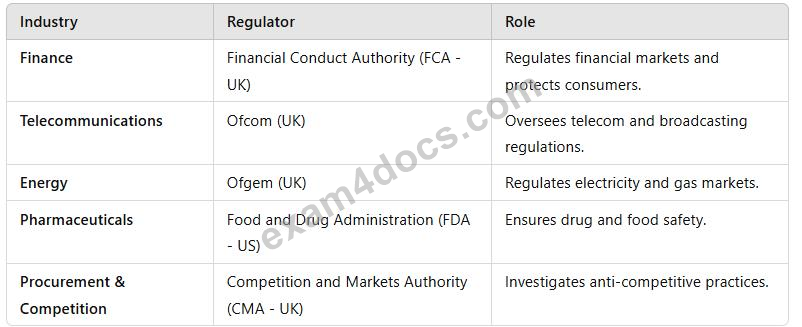
Case Example: The UK's Competition and Markets Authority (CMA) blocked Microsoft's acquisition of Activision Blizzard due to concerns over market dominance in cloud gaming.
2. Role of International Bodies
International bodies set global regulations, trade policies, and ethical standards that influence businesses operating across borders.
Case Example: The WTO's intervention in Brexit trade negotiations affected tariffs and supply chain costs for UK-based companies.
3. Influence of Industry Regulators and International Bodies on Business Strategy Businesses must align their strategies with regulatory and international frameworks to ensure compliance and avoid financial or reputational risks.
Example: The EU's General Data Protection Regulation (GDPR) forced global companies to enhance data protection policies or face heavy fines.
4. Advantages and Disadvantages of Regulatory and International Influence
✅ Advantages
Promotes Stability & Fair Competition - Reduces market manipulation and corruption.
Protects Consumers & Employees - Ensures safety, fair wages, and ethical standards.
Encourages Innovation & Sustainability - Businesses invest in R&D to meet regulatory requirements.
Facilitates Global Trade - International trade agreements create business opportunities.
❌ Disadvantages
Regulatory Burdens & Compliance Costs - Strict laws increase operational costs.
Trade Barriers & Bureaucracy - Lengthy regulatory approval processes slow down market entry.
Risk of Overregulation - Too many rules can stifle competition and innovation.
Example: The EU Emissions Trading System (EU ETS) requires manufacturers to pay for carbon emissions, increasing operational costs.
Conclusion
Industry regulators and international bodies shape the business environment by enforcing laws, ensuring ethical practices, and facilitating global trade. Companies must proactively monitor regulatory changes, integrate compliance into strategic planning, and adapt to international standards to maintain market competitiveness and sustainability.
SIMULATION
Analyse the GE McKinsey Matrix as a tool to influence directional policy
Correct Answer:
Analysis of the GE McKinsey Matrix as a Tool to Influence Directional Policy Introduction The GE McKinsey Matrix is a strategic tool used by businesses to prioritize investments, allocate resources, and influence directional policy. It expands on the BCG Matrix by evaluating business units or product portfolios based on two dimensions:
Industry Attractiveness (external factors such as market growth, competition, and profitability).
Business Unit Strength (internal factors such as brand strength, financial performance, and operational efficiency).
The matrix helps organizations decide where to invest, grow, or divest, making it a valuable tool for influencing long-term strategic direction.
1. Explanation of the GE McKinsey Matrix
The GE McKinsey Matrix categorizes business units into nine strategic zones, guiding investment decisions:
| Industry Attractiveness →
Example:
Apple's iPhone (High Industry, Strong Business Unit) → Invest & Grow
Microsoft's Bing Search Engine (Low Industry, Weak Business Unit) → Divest or Harvest ❌
2. How the GE McKinsey Matrix Influences Directional Policy
1. Investment Prioritization
✅ Identifies which business units deserve more investment.
✅ Helps companies allocate resources to high-potential markets.
Example: Amazon invests heavily in AWS (Cloud Computing) due to high industry growth and strong business positioning.
2. Market Entry and Expansion Decisions
✅ Assists in geographical and market expansion decisions.
✅ Helps assess whether to enter emerging industries.
Example: Tesla entered renewable energy (solar panels, batteries) due to high industry potential.
3. Strategic Exit or Divestment Decisions
✅ Identifies low-performing divisions that should be divested.
✅ Prevents financial losses by exiting declining markets.
Example: GE sold its financial services division (GE Capital) to refocus on industrial manufacturing.
4. Balancing Risk and Portfolio Diversification
✅ Encourages a balanced portfolio of high-growth and stable businesses.
✅ Ensures companies avoid over-reliance on a single product or market.
Example: Google (Alphabet) maintains a diverse portfolio of AI, search, and cloud businesses to balance risk.
3. Advantages and Limitations of the GE McKinsey Matrix
✅ Advantages
✔ More detailed than the BCG Matrix - Considers multiple industry and business factors.
✔ Helps with long-term strategic planning - Guides investment, expansion, and divestment.
✔ Balances risk and growth - Prevents over-reliance on a single revenue source.
❌ Limitations
✖ Subjective analysis - Industry attractiveness and business strength are difficult to quantify.
✖ Complex implementation - Requires detailed data collection and industry research.
✖ No direct action plan - Only provides guidance on resource allocation, not execution strategies.
4. Conclusion
The GE McKinsey Matrix is a powerful tool for influencing directional policy by helping companies prioritize investments, expand into attractive markets, and exit underperforming businesses. However, it should be used alongside financial analysis and market research to ensure strategic success.
SIMULATION
XYZ is a successful cake manufacturer and wishes to expand the business to create additional confectionary items. The expansion will require the purchase of a further manufacturing facility, investment in machinery and the hiring of more staff. The CEO and CFO are confident that the diversification will be a success and are discussing ways to raise funding for the expansion and are debating between dept funding and funding. What are the advantages and disadvantages of each approach?
Correct Answer:
Evaluation of Debt Funding vs. Equity Funding for XYZ's Expansion
Introduction
As XYZ, a successful cake manufacturer, plans to expand into additional confectionery items, it requires significant investment in a new manufacturing facility, machinery, and staff. To finance this expansion, the company must choose between:
Debt Funding - Borrowing from banks or financial institutions.
Equity Funding - Raising capital by selling shares to investors.
Each funding option has advantages and disadvantages that impact financial stability, ownership control, and long-term business strategy.
1. Debt Funding(Loans, Bonds, or Credit Facilities)
Definition
Debt funding involves borrowing money from banks, lenders, or issuing corporate bonds, which must be repaid with interest.
✅ Key Characteristics:
The company retains full ownership and decision-making control.
Loan repayments are fixed and predictable.
Interest payments are tax-deductible.
Example: XYZ takes a bank loan of £2 million to purchase new machinery and repay it over five years with interest.
Advantages of Debt Funding
✔ Ownership Retention - XYZ keeps full control over business decisions.
✔ Predictable Repayment Plan - Fixed monthly payments make financial planning easier.
✔ Tax Benefits - Interest payments reduce taxable income.
✔ Shorter-Term Obligation - Once the loan is repaid, there are no further obligations.
Disadvantages of Debt Funding
❌ Repayment Pressure - Regular repayments increase financial risk during slow sales periods.
❌ Interest Costs - High-interest rates can reduce profitability.
❌ Collateral Requirement - Lenders may require company assets as security.
❌ Credit Risk - If XYZ fails to repay, it risks losing assets or damaging credit ratings.
Best for: Companies that want to maintain ownership and have stable revenue streams to cover repayments.
2. Equity Funding(Selling Shares to Investors or Venture Capitalists)
Definition
Equity funding involves raising capital by selling shares in the company to investors, such as private investors, venture capitalists, or the stock market.
✅ Key Characteristics:
No repayment obligations, but shareholders expect a return on investment (ROI).
Investors gain partial ownership and may influence business decisions.
Funding amount depends on the company's valuation and investor interest.
Example: XYZ sells 20% of its shares to a private investor for £3 million, which funds new production lines.
Advantages of Equity Funding
✔ No Repayment Obligation - Reduces financial burden on cash flow.
✔ Access to Large Capital - Easier to raise significant funds for expansion.
✔ Attracts Strategic Investors - Investors may provide expertise and industry connections.
✔ Spreads Business Risk - Losses are shared with investors, reducing pressure on XYZ.
Disadvantages of Equity Funding
❌ Loss of Ownership & Control - Investors gain a say in company decisions.
❌ Profit Sharing - Dividends or profit-sharing reduce earnings for existing owners.
❌ Longer Decision-Making Process - Raising equity capital takes time due to negotiations and regulatory compliance.
❌ Dilution of Shares - Selling shares reduces the founder's ownership percentage.
Best for: Companies needing large funding amounts with less repayment pressure, but willing to share ownership and decision-making.
3. Comparison: Debt vs. Equity Funding
Key Takeaway: The choice between debt and equity funding depends on XYZ's risk tolerance, cash flow stability, and long-term growth strategy.
4. Conclusion & Recommendation
Both debt funding and equity funding offer advantages and risks for XYZ's expansion.
✅ Debt funding is ideal if XYZ wants to retain ownership and has stable revenue to cover loan repayments.
✅ Equity funding is better if XYZ seeks larger investments, strategic expertise, and reduced financial risk.
Recommended Approach: A hybrid strategy, combining debt for short-term capital needs and equity for long-term growth, can provide financial flexibility while minimizing risks.
Viewing page 1 out of 10 pages.
Viewing questions 1-4 out of 40 questions.
Over 70123+ Satisfied Customers

 Adrian
Bartholomew
Carey
Donahue
George
Jacob
Exam4Docs is the world's largest certification preparation company with 99.6% Pass Rate History from 70123+ Satisfied Customers in 148 Countries.

Our Clients












Our study guide torrent covers most questions of real test and can help you pass exam certainly. The high pass rate bring help you pass at the first attempt.
Contact Us
From Monday to Saturday
Support: Contact now
If you have any question please leave me your email address, we will reply and send email to you in 12 hours.
Copyright © 2026 EXAM4DOCS.COM. All rights reserved. All trademarks are the property of their respective owners and we don't provide actual questions from any vendor. Privacy Policy