
Choose DP-300 Korean most accurate study material
Pass your actual test with our Microsoft DP-300 Korean training material at first attempt
Last Updated: Nov 17, 2026
No. of Questions: 434 Questions & Answers with Testing Engine
Download Limit: Unlimited
Pass your DP-300 Korean actual test with our valid DP-300 Korean training material
We provide the most up to date and accurate DP-300 Korean questions and answers which are the best for clearing the actual test. Instantly download of the Microsoft DP-300 Korean exam practice torrent is available for all of you. 100% pass is our guarantee of DP-300 Korean valid questions.
100% Money Back Guarantee
Exam4Docs has an unprecedented 99.6% first time pass rate among our customers.  We're so confident of our products that we provide no hassle product exchange.
- Best exam practice material
- Three formats are optional
- 10 years of excellence
- 365 Days Free Updates
- Learn anywhere, anytime
- 100% Safe shopping experience
- Instant Download: Our system will send you the products you purchase in mailbox in a minute after payment. (If not received within 12 hours, please contact us. Note: don't forget to check your spam.)
Microsoft DP-300 Korean Practice Q&A's

- Printable DP-300 Korean PDF Format
- Prepared by DP-300 Korean Experts
- Instant Access to Download
- Study Anywhere, Anytime
- 365 Days Free Updates
- Free DP-300 Korean PDF Demo Available
- Download Q&A's Demo
Microsoft DP-300 Korean Online Engine

- Online Tool, Convenient, easy to study.
- Instant Online Access
- Supports All Web Browsers
- Practice Online Anytime
- Test History and Performance Review
- Supports Windows / Mac / Android / iOS, etc.
- Try Online Engine Demo
Microsoft DP-300 Korean Self Test Engine

- Installable Software Application
- Simulates Real Exam Environment
- Builds DP-300 Korean Exam Confidence
- Supports MS Operating System
- Two Modes For Practice
- Practice Offline Anytime
- Software Screenshots
In 2026, questions deserve quick answers. Exam4Docs's support team replies to instant messages and emails within two hours, whether you ask about the DP-300 Korean bank before buying or need help with the Microsoft Administering Relational Databases on Microsoft Azure (DP-300 Korean Version) materials after.
Microsoft DP-300 Korean Exam Overview:
| Certification Vendor: | Microsoft |
|---|---|
| Exam Name: | Administering Relational Databases on Microsoft Azure |
| Exam Number: | DP-300 |
| Available Languages: | Chinese (Simplified), English, Japanese, Korean |
| Exam Format: | Case study, Multiple-choice, Drag and drop |
| Passing Score: | 700 |
| Exam Price: | $165 USD |
| Related Certifications: | Microsoft Certified: Azure Database Administrator Associate |
| Certificate Validity Period: | 1 year |
| Real Exam Qty: | 40-60 |
| Exam Duration: | 120 minutes |
| Sample Questions: | DOWNLOAD DEMO |
| Exam Way: | Online proctored / In-person testing center |
| Pre Condition: | Recommended: Experience with Azure data services, SQL Server databases, and database administration concepts |
| Official Syllabus URL: | https://learn.microsoft.com/en-us/certifications/exams/dp-300 |
Microsoft DP-300 Korean Exam Syllabus Topics:
| Section | Weight | Objectives |
|---|---|---|
| Topic 1: Implement a PaaS database solution | 15-20% | - Implement and configure Azure SQL Database
|
| Topic 2: Implement secure resources | 20-25% | - Implement a risk mitigation strategy based on requirements
|
| Topic 3: Plan and implement data platform resources | 20-25% | - Recommend an appropriate database offering based on requirements
|
| Topic 4: Optimize database solutions | 10-15% | - Optimize query performance
|
| Topic 5: Monitor database operations | 10-15% | - Troubleshoot database issues
|
| Topic 6: Implement a SQL Server database | 15-20% | - Manage SQL Server databases
|
The DP-300 Korean Exam and Our Services, Question by Question
The latest exam information lists 40-60 questions for the DP-300 Korean exam, to be completed within 120 minutes minutes. Knowing the format cold is half the battle — timed practice handles the other half.
These are the core domains of the Microsoft Administering Relational Databases on Microsoft Azure (DP-300 Korean Version) blueprint:
- Plan and implement data platform resources (20-25%)
- Implement a PaaS database solution (15-20%)
- Implement secure resources (20-25%)
The remaining domains appear in the full official outline, all of which our bank addresses.
Microsoft sets the following prerequisites for the Microsoft Administering Relational Databases on Microsoft Azure (DP-300 Korean Version): Recommended: Experience with Azure data services, SQL Server databases, and database administration concepts.
Check the current requirements on the official certification page before scheduling.
Validity is maintained, not assumed. Our dedicated IT team checks the system and pushes new versions to the site continuously, so the DP-300 Korean bank on sale is always the latest — with expert-verified answers across the Microsoft Administering Relational Databases on Microsoft Azure (DP-300 Korean Version) objectives. You can also pick the format that fits your devices: an easy-to-read PDF, a Windows PC test engine, or a browser-based online engine for Windows, Mac, Android, and iOS. Questions? Support replies to instant messages and emails within two hours.
Upon successful payment, the complete materials are available immediately: a download link on screen and an automatic email to your mailbox within about a minute. If nothing arrives within two hours, check spam and contact support. Every purchase carries a 365-day service warranty — you can download the latest valid version free whenever it is released, no matter when you bought — and a 50% renewal discount follows when the period ends.
Yes, we keep our promises — in writing. If you fail the corresponding exam within 60 days of purchase, email us a scanned copy of your enrollment slip and your official Score Report PDF within two days of the exam date; we process verified refunds in full within seven days. The exclusions are plain: exams taken within three days of purchase, candidate names that do not match the payer, and free or expired products. If you prefer, we will exchange your product for two others of equal value at no charge.
As of the latest information, the DP-300 Korean exam's passing score is 700 and the registration fee is $165 USD. Microsoft can adjust either figure, so verify both on the official site before you book.
Microsoft Administering Relational Databases on Microsoft Azure (DP-300 Korean Version) Sample Questions:
Subscriptions라는 이름의 Azure 구독이 있습니다.
Template.json이라는 Azure Resource Manager(ARM) 템플릿이 있으며, 이 템플릿에는 다음과 같은 JSON 데이터가 포함되어 있습니다.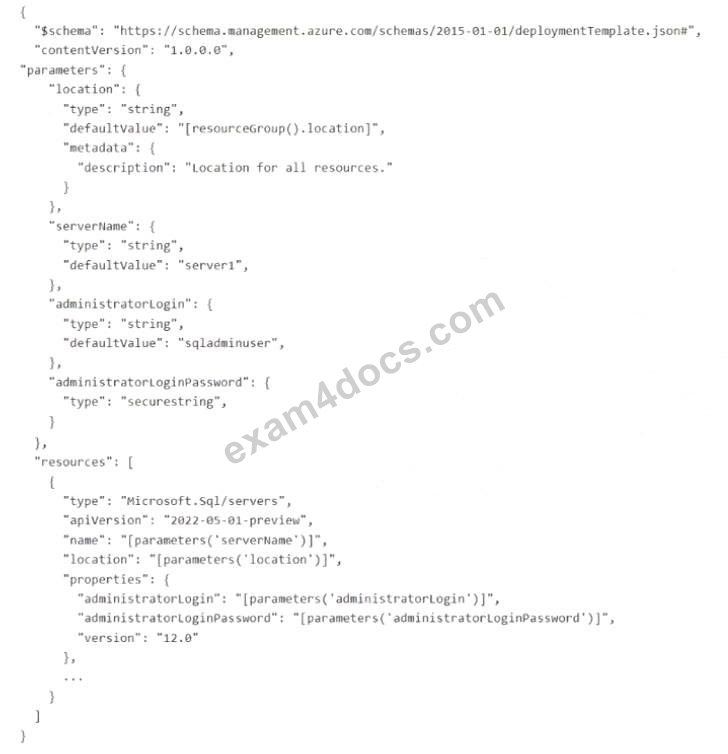
Template.json 파일을 구독1에 배포해야 합니다.
어떤 Azure 명령줄 인터페이스(CLI) 명령을 실행해야 합니까?
- A. az 그룹 배포 생성 --리소스 그룹 RG1 --템플릿 파일 template.json --매개변수
@parameters.json - B. az 그룹 배포 생성 --name Deployment1 --resource-group RG1 --template-uri https://www.
contoso.com/ed7f0949-6b29-4e15-8e47-2f79c9c6c6a5 - C. az 그룹 배포 생성 --resource-group RG1 --template-file template.json
- D. az 그룹 배포 생성 --이름 Deployment1 --리소스 그룹 RG1 --템플릿 파일 c:
\MyTemplates\azuredeploy.json --parameters c:\MyTemplates\azuredeploy.parameters.json
Correct Answer: C 🗳️
Explanation: Only visible for Exam4Docs members. You can sign-up / login (it's free).
DB1이라는 Azure SQL 데이터베이스가 있고, 그 안에 Table 1이라는 테이블이 있습니다.
Table1에 데이터를 로드하기 위해 쿼리를 실행합니다.
부하 운전 중 표1의 성능 지표는 다음 그림에 나와 있습니다.
아래 그림에 제시된 정보를 바탕으로 각 문장을 완성하는 답을 드롭다운 메뉴에서 선택하세요. 참고: 정답 하나당 1점입니다.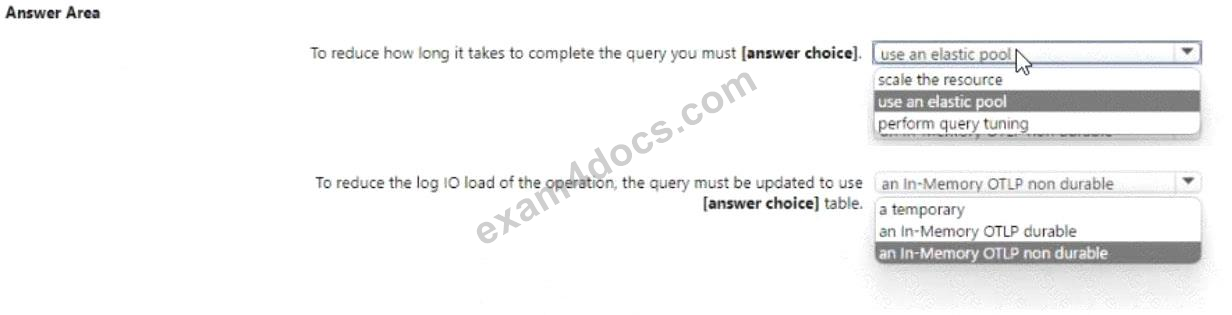
Correct Answer:

Explanation:
Basic Concept: This question tests Azure monitoring and performance management, including which metric, log destination, or alerting behavior fits the operational requirement.
Why the selected answer is Correct: The selected values fit this scenario because they apply the required Azure SQL configuration at the correct scope and sequence: You have an Azure SQL database named DB1 that contains a table named Table 1.
Why the alternate choices are Wrong: The alternate destinations or collection scopes miss part of the telemetry requirement: they either omit the server/pool/database layer or send data somewhere that does not support the requested analysis path.
Azure 구독에는 SQLVM1이라는 이름의 Azure 가상 머신에 설치된 SQL Server 인스턴스와 Windows Server를 실행하는 Server라는 이름의 가상 머신이 있습니다. SQLVM1과 Server는 Active Directory 도메인 서비스(AD DS) 도메인에 가입되어 있습니다. Server는 Sharel이라는 이름의 파일 공유를 호스팅합니다.
SQLVM1의 SQL Server 에이전트 작업 단계가 Share1의 파일에 액세스할 수 있도록 해야 합니다. 해결 방법은 최소 권한 원칙을 따라야 합니다.
어떤 세 가지 행동을 순서대로 수행해야 할까요? 정답을 선택하려면, 행동 목록에서 적절한 행동을 골라 답란에 옮겨 올바른 순서대로 배열하세요.
Correct Answer:

Explanation: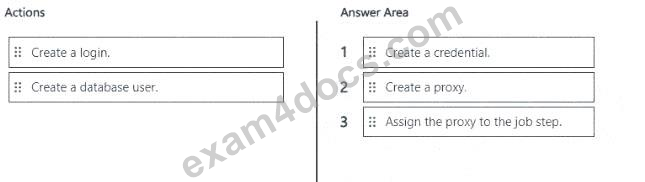
Basic Concept: This question tests identity and authentication for Azure SQL and SQL Server workloads, including when to use contained users, directory identities, certificate validation, or authentication profiles.
Why the selected answer is Correct: The selected values fit this scenario because they apply the required Azure SQL configuration at the correct scope and sequence: You need to ensure that a SQL Server Agent job step on SQLVM1 can access the files in Share1.
Why the alternate choices are Wrong: The alternate actions fail because Entra authentication must be established at the server/administrator level first, then mapped to contained database users, and finally used by the client connection.
과제 1
db1이라는 Azure SQL 데이터베이스에서 SalesLT.SalesOrderHeader 테이블의 PK_SalesOrderHeader_SalesOrderlD 클러스터형 인덱스에 대해 페이지 압축을 활성화해야 합니다.
Correct Answer:
See the explanation part for the complete Solution.
Explanation:
To enable page compression on the PK_SalesOrderHeader_SalesOrderlD clustered index of the SalesLT.
SalesOrderHeader table in db1, you can use the following Transact-SQL script:
-- Connect to the Azure SQL database named db1
USE db1;
GO
-- Enable page compression on the clustered index
ALTER INDEX PK_SalesOrderHeader_SalesOrderlD ON SalesLT.SalesOrderHeader REBUILD WITH (DATA_COMPRESSION = PAGE); GO This script will rebuild the clustered index with page compression, which can reduce the storage space and improve the query performance The script solution consists of three parts:
The first part is USE db1; GO. This part connects to the Azure SQL database named db1, where the SalesLT.
SalesOrderHeader table is located. The GO command separates the batches of Transact-SQL statements and sends them to the server.
The second part is ALTER INDEX PK_SalesOrderHeader_SalesOrderlD ON SalesLT.SalesOrderHeader REBUILD WITH (DATA_COMPRESSION = PAGE); GO. This part enables page compression on the clustered index named PK_SalesOrderHeader_SalesOrderlD, which is defined on the SalesLT.
SalesOrderHeader table. The ALTER INDEX statement modifies the properties of an existing index.
The REBUILD option rebuilds the index from scratch, which is required to change the compression setting.
The DATA_COMPRESSION = PAGE option specifies that page compression is applied to the index, which means that both row and prefix compression are used. Page compression can reduce the storage space and improve the query performance by compressing the data at the page level. The GO command ends the batch of statements.
The third part is optional, but it can be useful to verify the compression status of the index. It is SELECT name, index_id, data_compression_desc FROM sys.indexes WHERE object_id = OBJECT_ID( ' SalesLT.
SalesOrderHeader ' );. This part queries the sys.indexes catalog view, which contains information about the indexes in the database. The SELECT statement returns the name, index_id, and data_compression_desc columns for the indexes that belong to the SalesLT.SalesOrderHeader table. The OBJECT_ID function returns the object identification number for the table name. The data_compression_desc column shows the compression type of the index, which should be PAGE for the clustered index after the script is executed.
These are the steps of the script solution for enabling page compression on the clustered index of the SalesLT.
SalesOrderHeader table in db1.
과제 4
db1의 SalesLT.Customer 테이블의 LastName 열을 Always Encrypted를 사용하여 암호화해야 합니다.
Windows 인증서 저장소를 사용해야 합니다. SQL Server Management Studio와 Azure 포털이 필요할 수도 있습니다.
Correct Answer:
See the explanation part for the complete Solution.
Explanation:
Use SQL Server Management Studio Always Encrypted Wizard and encrypt:
Database: db1
Schema: SalesLT
Table: Customer
Column: LastName
Encryption feature: Always Encrypted
Column master key store: Windows Certificate Store
Do not use Transparent Data Encryption. TDE encrypts the database at rest, but this task specifically requires Always Encrypted, which protects selected columns and keeps the encryption keys outside the database engine. Microsoft states that Always Encrypted uses column encryption keys to encrypt column data and column master keys to protect those column encryption keys. Column master keys are stored outside the database system, such as in the Windows certificate store.
Method 1 - SSMS Always Encrypted Wizard
This is the correct method for the simulation.
Step 1: Open SSMS and connect to Azure SQL Database
Open SQL Server Management Studio.
Connect to the Azure SQL logical server that hosts db1.
Use a SQL admin account or Microsoft Entra admin account.
In Options > Connection Properties, select database:
db1
Connect.
If SSMS cannot connect, go to the Azure portal and add your client IP address under the SQL server firewall
/networking settings.
Step 2: Open the table column
In Object Explorer:
Expand Databases.
Expand db1.
Expand Tables.
Expand:
SalesLT.Customer
Expand Columns.
Locate:
LastName
Microsoft confirms that the Always Encrypted Wizard can be launched at the database, table, or individual column level. For one column, the cleanest path is to launch it directly from the column.
Step 3: Launch the Always Encrypted Wizard
Right-click the LastName column, then select:
Encrypt Column
or, depending on the SSMS version:
Always Encrypted Wizard
Alternative path:
Right-click db1 > Tasks > Always Encrypted Wizard
Then manually select:
SalesLT.Customer.LastName
Step 4: Select the LastName column for encryption
On the Column Selection page:
Find:
SalesLT.Customer.LastName
Select the checkbox for LastName.
Set the encryption type.
Use:
Randomized
unless the lab specifically requires searching or equality filtering on LastName.
Reason: Randomized encryption is stronger because identical plaintext values produce different ciphertext values. Deterministic encryption allows equality lookups, joins, grouping, and indexing, but leaks more pattern information because identical plaintext values produce identical encrypted values. Microsoft describes deterministic encryption as query-friendly but more pattern-revealing, while randomized encryption is more secure but does not support normal searching/grouping/joining without secure enclaves.
For this task, the requirement is only to encrypt the LastName column, so Randomized is the safer default.
Step 5: Choose or create a Column Encryption Key
For Encryption Key, select a new key such as:
CEK_Auto1
or create a new column encryption key if one does not already exist.
This is the key that encrypts the data in the LastName column. Microsoft states that a column encryption key encrypts the data in encrypted columns, and the column master key encrypts/protects the column encryption key.
Select Next.
Step 6: Configure the Column Master Key in Windows Certificate Store
On the key configuration page, create a new Column Master Key.
Use settings like:
Setting
Value
Column master key name
CMK_WindowsCert or default generated name
Key store
Windows Certificate Store
Certificate location
Current User
Certificate
Generate new certificate
Column encryption key
CEK_Auto1 or default generated CEK
In many SSMS versions, the wizard creates both:
CMK_Auto1
CEK_Auto1
That is acceptable as long as the CMK key store is Windows Certificate Store.
Microsoft states that SQL Server Management Studio supports column master keys stored in the Windows Certificate Store, and that a column master key can be a certificate stored in Windows Certificate Store.
Step 7: Run the wizard
On the final wizard pages:
Review the configuration.
Choose:
Proceed to finish now
or:
Run immediately
Select Finish.
SSMS will generate the column master key metadata, column encryption key metadata, and perform the data encryption operation. Microsoft explains that the wizard can encrypt selected columns and can generate a new column master key and column encryption key when needed.
During encryption, SSMS may temporarily create a new table, copy data, encrypt the selected column, and swap the table back, depending on whether secure enclaves are used. Microsoft notes that the wizard can move data out of the database and perform cryptographic operations inside the SSMS process when secure enclave in-place encryption is not used.
Verification Steps
Step 1: Confirm Always Encrypted metadata exists
Run this in db1:
SELECT
name,
key_store_provider_name,
key_path
FROM sys.column_master_keys;
You should see a column master key that uses the Windows certificate store provider.
Then run:
SELECT
name
FROM sys.column_encryption_keys;
You should see the column encryption key created by the wizard.
Step 2: Confirm LastName is encrypted
Run:
SELECT
t.name AS table_name,
c.name AS column_name,
c.encryption_type_desc,
cek.name AS column_encryption_key
FROM sys.columns AS c
JOIN sys.tables AS t
ON c.object_id = t.object_id
LEFT JOIN sys.column_encryption_keys AS cek
ON c.column_encryption_key_id = cek.column_encryption_key_id
WHERE t.name = ' Customer '
AND SCHEMA_NAME(t.schema_id) = ' SalesLT '
AND c.name = ' LastName ' ;
Expected result:
table_name: Customer
column_name: LastName
encryption_type_desc: RANDOMIZED
column_encryption_key: CEK_Auto1 or similar
If you selected deterministic encryption, the expected value will be:
DETERMINISTIC
The key requirement is that encryption_type_desc is no longer NULL.
Step 3: Test viewing the encrypted column
Open a new SSMS query connection without Always Encrypted enabled and run:
SELECT TOP 10 LastName
FROM SalesLT.Customer;
You should not see normal plaintext values.
Then reconnect with Always Encrypted enabled:
In SSMS, select Connect > Database Engine.
Select Options.
Go to Additional Connection Parameters.
Add:
Column Encryption Setting=Enabled
Connect again.
Run:
SELECT TOP 10 LastName
FROM SalesLT.Customer;
A client that has access to the Windows certificate/private key should be able to decrypt the values. Microsoft explains that the database stores encrypted data and key metadata, while client-side components with access to the column master key perform encryption and decryption.
Important Exam Notes
Do not choose Azure Key Vault
The task explicitly says:
You must use the Windows Certificate Store.
So the column master key should not be stored in Azure Key Vault.
Wrong:
Azure Key Vault
Correct:
Windows Certificate Store
Do not use TDE
TDE is not column-level Always Encrypted. It encrypts database files/logs at rest, but users and administrators querying the database still see plaintext if they have SQL permissions.
Correct technology:
Always Encrypted
Correct key store:
Windows Certificate Store
Correct target column:
SalesLT.Customer.LastName
Viewing page 1 out of 87 pages.
Viewing questions 1-5 out of 434 questions.
Over 70123+ Satisfied Customers
 Hyman
Lennon
Murray
Jack
All perfect DP-300-KR.
Lou
your Administering Relational Databases on Microsoft Azure dumps version is correct version.
Nick
Exam4Docs is the world's largest certification preparation company with 99.6% Pass Rate History from 70123+ Satisfied Customers in 148 Countries.

Our Clients












Our study guide torrent covers most questions of real test and can help you pass exam certainly. The high pass rate bring help you pass at the first attempt.
Contact Us
From Monday to Saturday
Support: Contact now
If you have any question please leave me your email address, we will reply and send email to you in 12 hours.
Copyright © 2026 EXAM4DOCS.COM. All rights reserved. All trademarks are the property of their respective owners and we don't provide actual questions from any vendor. Privacy Policy